


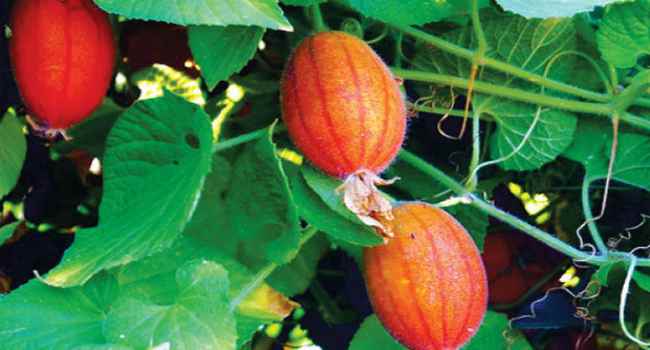


Not many people are familiar with the tladiana or red cucumber. And not everyone can adequately perceive the red-orange fruits that belong to cucumbers and will be very surprised to learn that this unusual cucumber grows well in our Far East. It was here that it was first discovered and is used not only for food, but also for the treatment of some common diseases.
Even Vladimir Ivanovich Michurin, our famous scientist-breeder, dreamed of creating perennial pumpkin crops on its basis, for example, a perennial watermelon or cucumber. What is tladiant, how is this red cucumber useful and how to use it, read below in the article.
Tladianta description what it looks like
Along with the existing and widespread 20 varieties of green cucumbers, you can also see fruits with an unusual red skin. Do not assume that such fruits are exotic.
In fact, the homeland of a tladiant from the pumpkin family (the plant also has a dubious name tladiant, and in Latin it is called Thladiantha dubia Thladiantha dubia) is the Far East. Although today it is massively grown in Southeast Asia, China, Latin America, Europe, Canada, USA. Wild varieties are preferred by Asian countries and warm regions of Europe.
The perennial plant itself is a dioecious climbing liana, the stem of which grows up to 5 meters.
Characteristic features are considered not only the red color of the peel, but also covered with small hairs (that is, pubescence) of the stem, the inner side of the leaves and the fruit (as they ripen, they fall off).
The leaves of the plant are heart-shaped and light green in color. They stick to clothing or even to exposed skin. True, this does not do any harm, they are not poisonous.
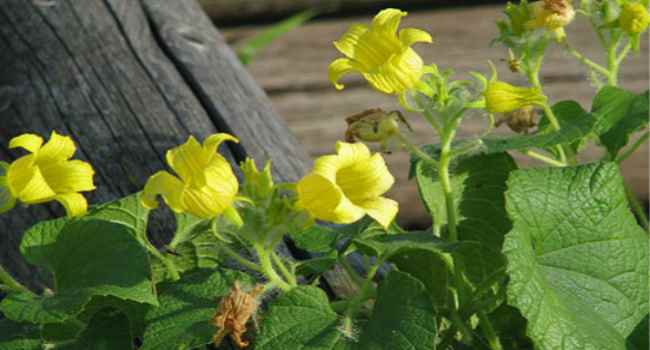
The red cucumber blooms, like the usual green cucumber, in summer and in the first autumn weeks. Moreover, the flowers are large, bright yellow and dioecious. Male flowers are distinguished by a bell-shaped appearance, similar to a tulip, curved petals and a factor of collection of flowers in inflorescences. The flowers of the female direction (only they bear fruit) are flat and extremely solitary.
At first glance, the tladiant resembles a green cucumber, but, when ripe, its rind acquires a pure red or red-orange color and becomes especially smooth.
Fruits grow up to a maximum of 6 cm in length and 2 cm in width. Their flesh is red, with many small dark seeds.
Landscape designers are still widely using this vine only for decorative purposes, decorating fences with it. True, they hide the fact that the plant is very tenacious (it cannot be removed from the site) and grows rapidly throughout the territory. In some cases, gardeners call this plant a “Trojan horse” and recommend protecting such a vine not with a net, but with a more reliable material such as thin slate.
In addition to the unusual red fruits, this vine has tuberous roots, which are more like potatoes and are still used to a greater extent for medicinal purposes. The tubers have a yellow peel, oval shape. It is thanks to the roots-tubers of the tladiant that the dubious can grow uncontrollably in different directions in one year within a radius of up to 2 meters. To avoid this, gardeners plant it in pipes.
The plant is very tenacious. One root remaining in the soil is capable of sprouting. Even dried tubers trapped in moist soil. Germinate well and give excellent offspring of new tubers.
What does a dubious tladianta look like
Club plants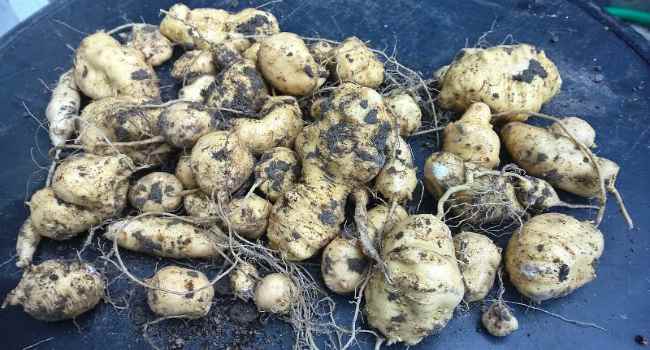
Red cucumber fruit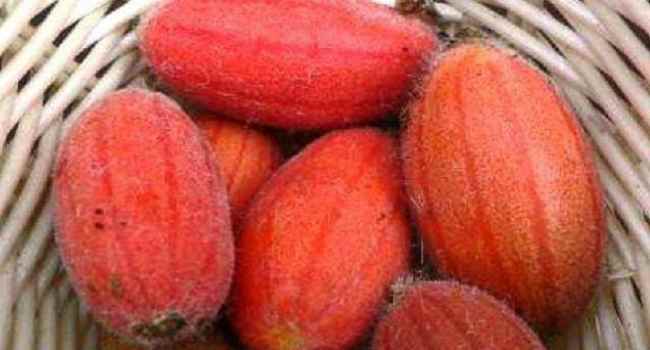
What is the use of the dubious tladiant
Despite its plant origin, in the composition of the plant you can see:
- water (up to 85%);
- vegetable proteins;
- fats (but there are very few of them);
- carbohydrates (mainly sugars, of which there are a lot);
- dietary fiber (fiber);
- essential enzymes;
- vitamin A (retinol);
- alpha-tocopherol (vitamin E);
- basic B vitamins (riboflavin, niacin, thiamine, folic acid);
- vitamin C (antioxidant ascorbic acid);
- mineral components such as iron, phosphorus, calcium, magnesium and cobalt.
Tladianta refers to a particularly low-calorie food, the calorie content of a red cucumber is only 14 kilocalories per 100 grams of pulp.
The energy percentage of proteins, fats and carbohydrates is 23/6/71%.
Tladianta beneficial properties
The most prized red variety of cucumbers in oriental folk medicine. After all, it was Asian healers who discovered many of the beneficial qualities of this herbal product, using it:
- as a natural choleretic agent (a decoction of rhizomes is used);
- as a diuretic (removes excess water, relieves puffiness);
- for better excretion of phlegm in bronchitis (has a good expectorant effect);
- in order to prevent the appearance of scurvy and vitamin deficiency;
- with intestinal disorders (has astringent properties; in particular, root crops);
- to reduce the level of high blood pressure in hypertension;
- to prevent and relieve headaches;
- as an immunostimulating agent during the flu and cold season;
- to improve the work of all organs of the gastrointestinal tract;
- in order to improve the condition with osteochondrosis;
- to relieve pain in sciatica (apply a gruel in the form of a compress to the affected areas of the disease).
According to doctors, it is advisable to include this vegetable in the diet of a person’s main diet all the time.
The use of red cucumber in cooking
It is customary to eat green unripe fruits that can be heat treated. As a result, unripe cucumbers become an ingredient in a variety of snacks, salads and side dishes.
Ripe red cucumbers with a special softness and combination of kiwi and pineapple flavors, containing a large amount of sugar, are used for the production of jam, jam and preserves.
If desired, it is possible to preserve, salt and pickle tladiand fruits.
Harm and contraindications
Naturally, many consumers are worried about the presence of contraindications and possible harm when using this, yet not unusual for many, product.
Indeed, everyone is used to green cucumbers and knows about the existing precautions. But red cucumbers are still exotic. Therefore, today they include such a number of contraindications:
- individual intolerance to vegetable components;
- the presence of diabetes mellitus (such people are recommended a significant restriction due to the large amount of sugars in the pulp).
Tladiant how to grow
The main attraction of growing this vine is still for landscaping. Liana is growing rapidly. It can grow several centimeters per day, creating large dense greenery. In just a month, it can cover a large surface. It is often used to create arches, green walls, gazebos, various green forms in the garden, and natural fences. You can mask compost heaps with it. In addition, it has a long flowering period: it blooms from July to September. And in the fall, no less beautiful red fruits appear.
Therefore, there has always been a demand for Tladian. It is propagated mainly by tubers, which can be divided into several parts. It can be propagated by seeds, which are planted first in pots and transferred to a permanent place in the spring. The tubers can be propagated in autumn and spring. When planting, you just need to take into account its rapid growth. Therefore, it is immediately better to plant it in pipes or fence off the site with slate or other material, digging it into a depth of 2 meters.
It grows well in shaded areas. Loves fertile, loose and moist soil. Care comes down to top dressing and regular watering.
The plant is practically not affected by pests and diseases. In the fall, you need to cut off all dry branches. It tolerates wintering well.
In general, the dubious tladiant can become a real decoration of the garden, besides, edible.
Watch the video how the dubious tladianta or red cucumber grows


