


- 1 Why posture gets worse (even if you try to sit straight)
- 2 Signs your posture needs correction
- 3 Posture correction exercises that actually work
- 4 How to combine exercises effectively
- 5 Infographic Unlock Better Posture: The Key Exercises
- 6 Typical mistakes with posture correction exercises
- 7 How to improve posture in everyday life
- 8 FAQ: posture correction exercises
- 9 Short version: what to do right now
- 10 Conclusion
- 11 Sources
Do you ever notice how you sit right now? Shoulders slightly forward, chin drifting toward the screen, lower back collapsing into the chair. You don’t feel it immediately. But after a few hours — tension, fatigue, maybe even a dull ache between the shoulder blades.
Most people don’t have “bad posture” because they’re careless. They simply spend too much time in positions their body adapts to. The good news: posture isn’t something you “force.” It’s something you rebuild — gradually, through the right posture correction exercises.
This guide will walk you through how posture actually works, which exercises matter, and how to integrate them into real life without turning it into a full-time job.
Why posture gets worse (even if you try to sit straight)
Here’s the part most guides skip: posture is not about willpower.
You can sit up straight for 5 minutes. Maybe even 20. Then your body returns to its привычное положение. Why? Because muscles and nervous system patterns are stronger than intention.
What actually changes your posture
- Muscle imbalance — some muscles become tight, others weak
- Habitual positions — long hours at a desk, phone use
- Fatigue — when muscles get tired, your body collapses into easier positions
- Breathing patterns — shallow chest breathing pulls posture forward
Key idea: posture correction exercises work not because they “force alignment,” but because they retrain your body to hold itself differently.
Signs your posture needs correction
You don’t need a specialist to notice the early signals. Most people experience at least a few of these:
- forward head position (chin drifting toward screen)
- rounded shoulders
- tight neck or upper back
- lower back discomfort after sitting
- feeling tired from “just sitting”
These are not isolated problems. They are part of the same pattern.
Posture correction exercises that actually work
Not all exercises are equally useful. Some strengthen, others mobilize, and some simply remind your body how to move.
The best results come from combining all three.
1. Chin tucks (for forward head posture)
This is one of the simplest and most underrated posture correction exercises.
How to do it:
- Sit or stand upright
- Gently pull your chin backward (not down)
- Imagine making a “double chin”
- Hold for 3–5 seconds
Why it works: it activates deep neck muscles that are often inactive when the head constantly leans forward.
Real-life example: this is especially helpful if you spend hours on a laptop or phone.
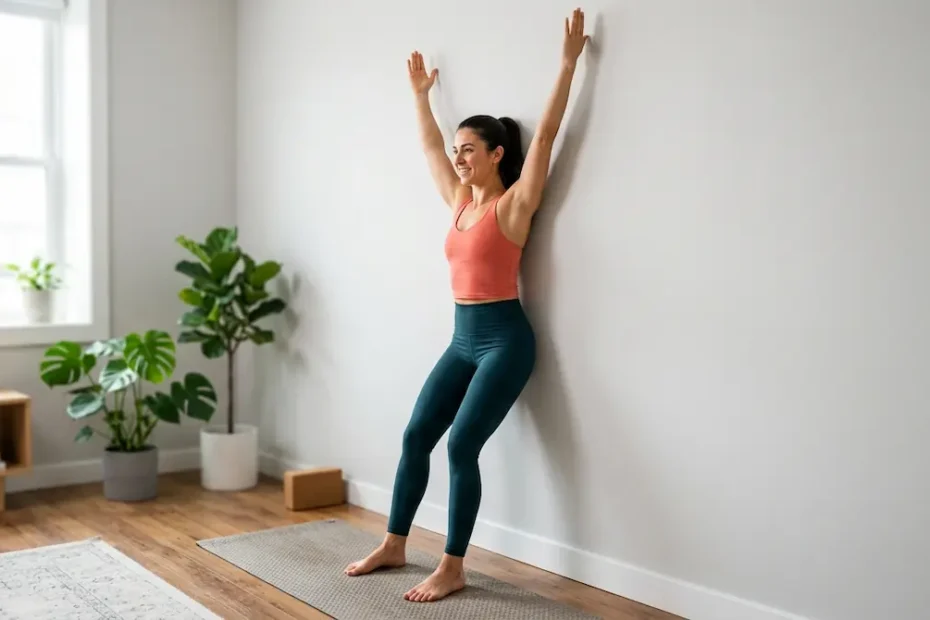
2. Wall angels (for shoulder alignment)
This exercise helps restore shoulder positioning and upper back engagement.
How to do it:
- Stand with your back against a wall
- Keep head, shoulders, and hips touching the wall
- Raise arms and move them slowly up and down like a “snow angel”
Why it works: it strengthens upper back muscles and improves shoulder mobility.
3. Thoracic extension (for upper back mobility)
Many posture issues come from a stiff upper back.
How to do it:
- Sit on a chair with a firm back
- Place hands behind your head
- Gently lean back over the chair
Why it works: it counteracts the constant forward bending position.
If you sit a lot, your hips are likely tight — and that affects your entire posture.
How to do it:
- Step one leg forward into a lunge position
- Keep torso upright
- Gently push hips forward
Why it works: tight hip flexors pull your pelvis forward, affecting your spine alignment.
5. Glute activation (for pelvic stability)
Weak glutes often lead to poor lower body posture.
Simple version: glute bridges
- Lie on your back, knees bent
- Lift hips upward
- Squeeze glutes at the top
Why it works: it supports proper pelvic positioning and reduces strain on the lower back.
How to combine exercises effectively
You don’t need a long workout. A simple structure works best:
| Type | Exercise | Goal |
|---|---|---|
| Activation | Chin tucks | Neck alignment |
| Mobility | Thoracic extension | Upper back movement |
| Strength | Wall angels | Shoulder stability |
| Stretch | Hip flexor stretch | Pelvic balance |
| Support | Glute bridges | Lower body stability |
Time needed: 10–15 minutes a day is enough to start seeing changes.
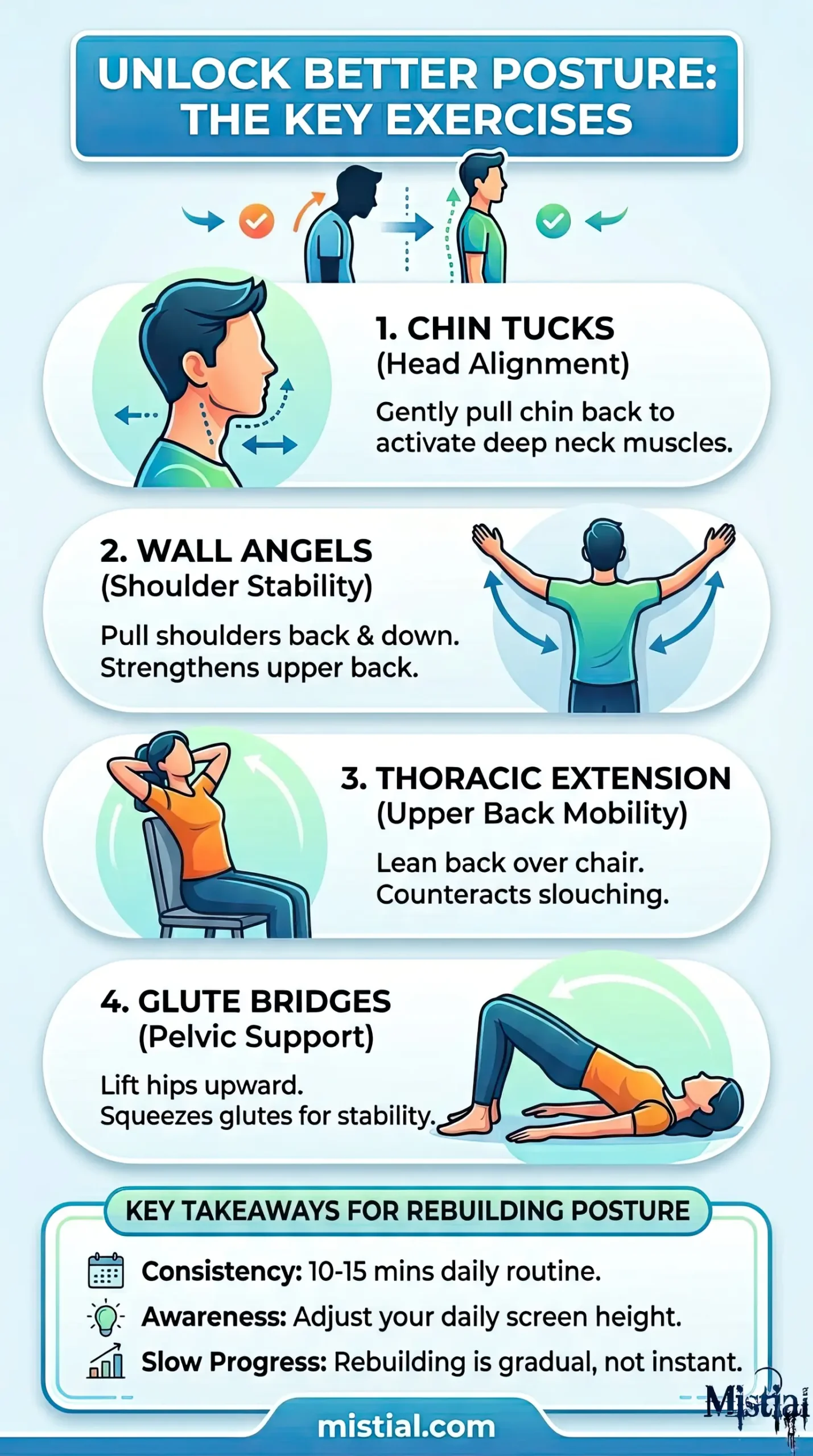
Infographic Unlock Better Posture: The Key Exercises
Typical mistakes with posture correction exercises
Many people try to fix posture — and quit because it “doesn’t work.” Often, the issue is not the exercises, but how they are used.
Common mistakes
- Trying to fix everything at once
Posture is a system. Focus on consistency, not intensity. - Overcorrecting posture
Forcing your body into a rigid “perfect” position creates tension. - Ignoring daily habits
Exercises won’t help if you sit 10 hours in the same position. - Doing exercises without awareness
Movement quality matters more than quantity. - Expecting quick results
Posture changes gradually — often over weeks, not days.
“Your posture is not something you hold. It’s something your body returns to when it’s balanced.”
How to improve posture in everyday life
Exercises are only part of the solution. Daily habits matter just as much.
Small changes that make a big difference
- raise your screen to eye level
- take short movement breaks every 30–60 minutes
- avoid holding your phone below chest level for long periods
- sit all the way back in your chair with support
- keep feet flat on the ground
Important: posture is dynamic. Sitting perfectly still is not the goal — moving regularly is.
FAQ: posture correction exercises
How long does it take to fix posture?
It depends on your starting point and consistency. Some people notice changes in a few weeks, but deeper adaptation can take longer.
Can posture be corrected at any age?
In most cases, yes. The body remains adaptable, although progress may be slower depending on individual factors.
Do I need equipment?
No. Most posture correction exercises can be done with body weight and basic support like a wall or chair.
Is it normal to feel discomfort during exercises?
Light tension or unfamiliar sensations are common. Pain is not. If something feels wrong, it’s better to adjust or pause.
Should I wear posture correctors?
They can provide temporary support, but they don’t replace muscle work and habit changes.
Can exercise alone fix posture?
Not entirely. Daily behavior — sitting, standing, moving — plays a major role.
Short version: what to do right now
- Start with 3–4 basic posture correction exercises (chin tucks, wall angels, hip stretch)
- Do them daily for 10–15 minutes
- Adjust your workspace (screen height matters more than you think)
- Take regular breaks from sitting
- Focus on awareness, not perfection
Conclusion
Posture is not something you “fix” once and forget. It’s a reflection of how you move, sit, and live every day.
The goal is not to become rigidly upright, but to create a body that naturally returns to a balanced position — without effort.
That’s what posture correction exercises are really about.
Sources
- Stuart McGill — “Back Mechanic”
- Shirley Sahrmann — “Diagnosis and Treatment of Movement Impairment Syndromes”
- American Physical Therapy Association (APTA)
- National Institute for Occupational Safety and Health (NIOSH)
- Kendall, McCreary, Provance — “Muscles: Testing and Function”
