


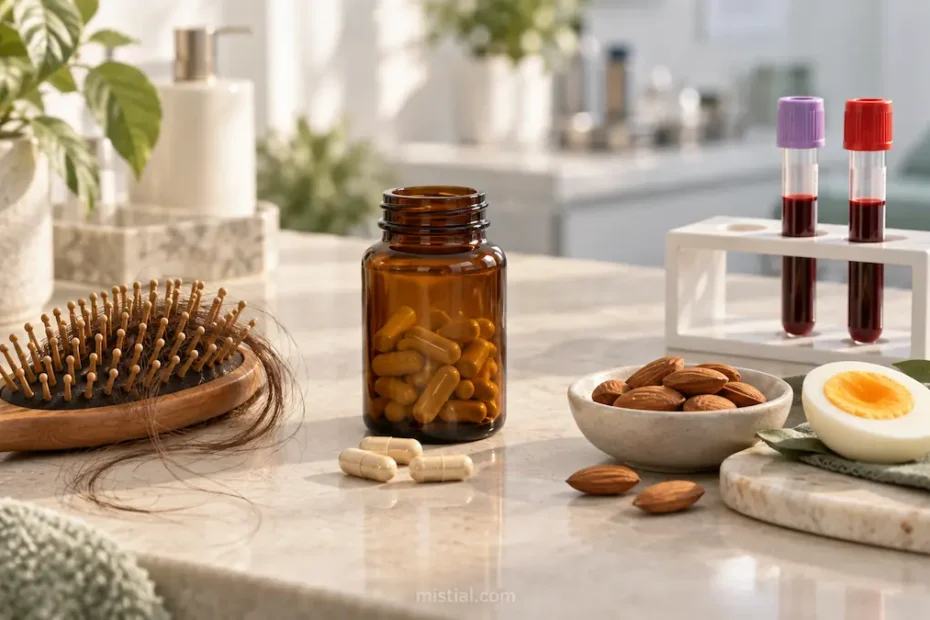
- 1 Before the blood draw, mention the beauty supplement
- 2 A useful message to the laboratory is specific
- 3 Essential for metabolism does not mean a hair-growth accelerator
- 4 Hair loss is a description, not a nutritional diagnosis
- 5 Brittle nails need their own explanation
- 6 Where biotin fits into ordinary meals
- 7 When a genuine shortage or processing disorder changes the picture
- 8 Read the whole formula, not only the beauty claim
- 9 Three situations, three different next steps
- 10 Questions that a biotin label rarely answers
A supplement bought for stronger nails or thicker hair can matter during a medical appointment for something entirely different. Biotin, also called vitamin B7, can interfere with certain laboratory tests. The result may look reassuring when it should not, or suggest a problem that is not actually present.
That does not make biotin an unnecessary nutrient. The body needs it for normal metabolism. It does mean that nutritional need, cosmetic promises and the safety of concentrated supplements are separate questions. A vitamin can be essential without extra amounts being useful for everyone.
If you already take biotin, the most practical first step is to include it when reporting medicines and supplements. If you are considering it for hair loss or brittle nails, start by identifying the problem rather than assuming that a familiar beauty ingredient provides the answer.
Before the blood draw, mention the beauty supplement
People often remember to report prescription medicines but leave out gummies, beauty capsules or a powder added to breakfast. These products may contain biotin even when the word is not prominent on the front. Check the full ingredient list and keep a photograph of the label.
Laboratory interference is different from the vitamin actually changing the condition being measured. Some tests use a biotin-based binding system as part of their measurement method. Biotin circulating in the sample can disrupt that system, producing a misleading result. Not every test uses this method, and affected tests do not all behave in the same way.
This is why “I take biotin” is useful information even when you feel well. You do not need symptoms of a side effect for an analytical problem to occur.
A thyroid result can tell the wrong story
With susceptible thyroid tests, biotin can make thyroid hormone measurements appear too high and thyroid-stimulating hormone, or TSH, appear too low. That pattern can resemble an overactive thyroid or suggest that prescribed thyroid hormone is excessive. The interference concerns the measurement; it does not prove that biotin has made the thyroid overactive.
If a result seems inconsistent with how you feel or with previous results, tell the clinician about biotin rather than changing your thyroid medicine yourself. The clinician and laboratory can assess whether the method used is susceptible and whether the result needs confirmation.
In an emergency, disclosure matters more than waiting
The FDA has warned that biotin can cause falsely low results in some troponin tests. Troponin is used when assessing possible heart muscle injury, including a heart attack. An incorrectly low value can complicate an urgent assessment.
If you have chest pain, severe breathlessness, fainting or other symptoms requiring emergency care, seek help immediately. Tell the team that you take biotin, but do not delay care while waiting for a supplement to leave your system.
This warning is not a reason to distrust all blood tests. It is a reason to give the team the information needed to interpret them properly. The laboratory method, the product and the timing of the last intake all matter.
A useful message to the laboratory is specific
Saying “I take a hair vitamin” is a start, but it may not identify the ingredient or the amount. A short record makes the conversation easier and reduces the need to remember packaging details during an appointment.
| Information to provide | Why it helps |
|---|---|
| Product name and a photo of the complete label | Shows whether biotin is present and identifies other ingredients. |
| Actual number of tablets, capsules or gummies taken | Clarifies whether the stated amount refers to one unit or a larger serving. |
| How often you take it and when you last took it | Helps the team assess recent exposure rather than relying on the directions on the bottle. |
| Other supplements, including occasional products | Reveals overlapping sources that may otherwise be missed. |
| Whether biotin was prescribed for a medical condition | Allows any testing plan to be coordinated with the treating clinician. |
There is no single pause before testing that is right for every person and every assay. Relevant factors include the amount taken, the test’s sensitivity to interference and how the body clears biotin. Kidney impairment can prolong clearance. Follow instructions from the requesting clinician or laboratory for your actual situation.
Do not stop prescribed biotin independently, particularly if it treats an inherited metabolic disorder. For planned testing, contact the team in advance. For an unexpected blood draw, report the product and last intake even if you were unable to prepare.
If blood has already been collected, it is still worth contacting the clinician. Do not declare the whole set of results invalid yourself. The team may find that the tests are unaffected, or may arrange confirmation using an appropriate method or a new sample.
Essential for metabolism does not mean a hair-growth accelerator
Biotin is a water-soluble B vitamin that helps certain enzymes function. These enzymes participate in processing fats, glucose and amino acids. Its nutritional role is therefore much broader than the hair-and-nails imagery on supplement packaging.
The distinction between enough and extra is central. When a genuine deficiency disrupts normal function, correcting it can help. That does not establish that adding more after requirements are met will improve hair growth, nail strength or energy.
Imagine a process that needs a particular component to work. Restoring a missing component can restart the process; supplying an excess does not necessarily increase its output. Biology is more complicated than this example, but it explains why evidence of necessity is not evidence of an additional benefit.
Biotin is not the same nutrient as vitamin B5, or pantothenic acid. Similar names and overlapping beauty marketing can make products look interchangeable, but they involve different nutrients and different evidence. A claim about one should not be transferred to the other.
Hair loss is a description, not a nutritional diagnosis
A widening part, increased shedding, broken hairs and a smooth bald patch may all be described as “hair loss”. They do not necessarily have the same cause. Inherited patterns, illness-related shedding, traction, inflammatory conditions and thyroid disease are among the possibilities a clinician may consider.
Nutritional inadequacy can also matter, including insufficient protein or certain micronutrients. But the presence of hair loss does not identify which nutrient is missing, or establish that a nutrient is the cause at all.
What would count as convincing evidence for biotin?
A useful study would test a defined biotin preparation in an appropriate group, compare it with a suitable control and measure meaningful changes in hair. It would also need to distinguish people with deficiency from those who already have adequate intake. Improvement in someone with a rare deficiency does not settle the question for an otherwise healthy person.
Research supporting routine biotin supplementation for hair growth in people without a demonstrated deficiency remains limited. This does not mean every positive personal account is dishonest. It means those accounts cannot reliably show that biotin caused the change or predict that another person will benefit.
Hair can change while someone is recovering from an illness, eating more adequately or starting another treatment. Photographs may also differ in lighting, styling and camera angle. When several things change at once, the supplement can receive credit for a result with another explanation.
Collect observations that help identify the cause
Before an appointment, note whether the change is patchy or widespread, whether the scalp is sore or itchy, and whether hairs are breaking or shedding from the root. Record recent illness, major dietary changes, new medicines and changes in hair styling. These observations are more useful than counting every hair repeatedly throughout the day.
Seek assessment for sudden, patchy, persistent or worsening hair loss, especially with scalp pain, inflammation or other symptoms. A dermatologist can examine the pattern and decide which tests are justified. Buying progressively stronger products can delay that assessment without making the cause clearer.
Bring any supplement you have already started. This is particularly relevant if the investigation includes thyroid tests: a product taken because of hair loss may complicate a test used to investigate that same complaint.
Brittle nails need their own explanation
Evidence for biotin in brittle nails includes small studies with important limitations. Improvement reported in a small group without a robust comparison cannot establish a dependable benefit for everyone with splitting nails. The initial nail problem and how improvement was assessed matter.
Consider what the nails experience day to day. Frequent wetting and drying, cleaning products, cosmetic procedures and repeated trauma can be relevant. Discolouration, thickening, pain or changes affecting only one nail may point towards a different problem from general brittleness.
A useful starting record is practical: which nails changed, when the change began, whether there is discomfort, and what products or activities contact them. This provides a better basis for advice than assuming that every nail change reflects a lack of biotin.
For routine care, avoid repeated mechanical damage and use suitable protection during wet or irritant work. Persistent or unusual changes deserve professional assessment. A supplement should not become a reason to overlook an infection or another nail disorder.
Where biotin fits into ordinary meals
Biotin is available from a range of foods, including cooked eggs, fish, meat, nuts, seeds and some vegetables. A varied eating pattern usually provides it without a special “beauty diet”. Food sources contribute other nutrients at the same time, which a single-ingredient supplement cannot reproduce.
Practical combinations might include cooked eggs with vegetables, fish as part of a main meal, or nuts and seeds incorporated into foods you already enjoy. These examples are ways to broaden a diet, not a prescription to eat one item repeatedly.
If you avoid a food because of an allergy, preference or dietary choice, focus on the range of alternatives rather than assuming that its absence creates a biotin deficiency. If your whole diet has become very limited, the overall restriction deserves attention.
The raw egg-white issue is about a repeated habit
Raw egg white contains avidin, a protein that binds biotin and can reduce its availability. Repeated consumption of substantial amounts of raw egg white can therefore contribute to deficiency. Cooking denatures avidin, reducing this binding effect.
This is not a reason to fear properly cooked eggs. It is a reason not to treat regular raw egg-white drinks as nutritionally equivalent to cooked eggs. There are also food-safety reasons to avoid unsafe raw-egg practices.
Food is not the main source of the laboratory concern
The interference issue discussed here centres on supplemental exposure, especially concentrated products. It is not a general instruction to remove biotin-containing foods before blood tests. Follow any preparation instructions for the particular test, and disclose supplements separately.
Likewise, avoiding ordinary food sources while continuing an unnecessary beauty supplement would miss the point. The sensible distinction is between meeting nutritional needs and adding concentrated amounts for an unproven purpose.
When a genuine shortage or processing disorder changes the picture
Biotin deficiency is uncommon in people eating a normal mixed diet. When it does occur, it can involve hair thinning, a scaly rash and neurological symptoms. These findings are not specific enough to diagnose the problem from appearance alone.
Prolonged nutritional restriction or a history that affects nutrient intake and handling can make nutritional assessment relevant. Some long-term medicines can also influence biotin status. Tell the clinician what you take, but do not discontinue necessary medication to address a suspected vitamin problem.
Biotinidase deficiency is different from buying a beauty supplement
Biotinidase deficiency is a rare inherited condition affecting the body’s ability to release and recycle biotin. A person can therefore have a problem despite an ordinary dietary intake. Diagnosis and management belong with a specialist team; prescribed biotin can be essential treatment.
For these patients, advice aimed at people casually taking a hair supplement must not be applied without medical guidance. Testing arrangements should account for the treatment rather than prompting an independent interruption. A confirmed inherited disorder and a self-assessed “vitamin shortage” are very different situations.
If a child has feeding difficulties, developmental concerns, seizures or a persistent rash with other symptoms, seek medical evaluation rather than trying an adult supplement. These symptoms have multiple possible causes and need an appropriate assessment.
A commercial nutrient result needs interpretation
Assessing biotin status is not simply a matter of finding the largest available blood-test panel. A result must be interpreted in relation to symptoms, diet, treatment and the type of measurement used. Recent supplementation also changes the context in which a result is obtained.
Ask what a proposed test will clarify and what action would follow. If the concern is hair loss, the useful investigation is one directed at its likely causes. A number labelled “biotin” does not explain every scalp, skin or nail change.
Read the whole formula, not only the beauty claim
Biotin may appear in stand-alone tablets, multivitamins, B-complex products and hair, skin and nail preparations. Taking several products for different purposes can create duplication. A gummy format does not change the need to check the ingredients.
Compare the units as well as the numbers. Milligrams and micrograms are different units, and a quantity listed per serving may refer to several gummies or capsules. A large percentage of a reference intake is a statement about content, not proof of greater benefit.
Other ingredients have their own risks. In particular, excessive supplemental vitamin B6 can harm peripheral nerves. The safety of a mixture cannot be judged solely by what is known about biotin.
No formal tolerable upper intake level has been established for biotin, but that should not be read as permission for unlimited supplementation. Laboratory interference is a clinically important risk even when a person has no obvious symptoms after taking the product.
If a product was started without a clear reason, review that reason before buying another bottle. If it was prescribed, discuss the intended benefit and monitoring with the treating professional. These conversations answer more useful questions than whether a supplement is simply “strong enough”.
Three situations, three different next steps
“My blood test is booked and I already take biotin”
Contact the requesting clinician or laboratory before the appointment. Send the label, explain how you use the product and ask for preparation instructions specific to the planned tests. Keep a record of the advice so you do not rely on remembering a generic recommendation from a website.
If the appointment is urgent, attend and disclose the supplement. Do not postpone needed care on your own. The clinical team can decide how to manage the testing.
“My hair is thinning, so I want to try something”
Document the pattern and arrange an assessment if the change is persistent, sudden or concerning. Review recent illness, dietary restriction, styling practices and medicines. Keep any photographs comparable rather than using different lighting or hairstyles to judge progress.
A clear diagnosis gives you a more useful way to choose care and assess improvement. Starting several products at once may add expense while making it harder to know what helps.
“I just want to make sure my diet is adequate”
Look at an ordinary week of meals. Identify missing food groups, routinely skipped meals or barriers such as poor appetite and limited access to food. Address those practical gaps rather than assuming the largest biotin percentage offers the best nutritional insurance.
If the diet is restricted for medical reasons or you cannot eat enough, ask for individual nutritional advice. The question is broader than whether one vitamin appears in a supplement.
Questions that a biotin label rarely answers
Are biotin and vitamin B7 the same thing?
Yes. Biotin is the nutrient commonly called vitamin B7. Check the ingredient panel because a product may use one name without prominently displaying the other.
Does biotin interfere with every blood test?
No. Interference depends on the analytical method and the amount of biotin in the sample. The laboratory can determine whether the specific tests are susceptible; taking biotin does not automatically invalidate an entire set of results.
Can I avoid interference by skipping only the morning tablet?
Do not assume that is enough. Preparation depends on the product, recent intake, clearance and the test method. Ask the clinician or laboratory for instructions rather than choosing your own interval.
If a supplement improved my nails, does that prove deficiency?
No. Nail care, reduced damage, natural change and other ingredients may contribute. Improvement is worth describing, but it does not by itself identify the cause or establish that more biotin would work better.
Should I hide biotin use so it does not complicate my appointment?
No. Reporting it helps the team make the testing more reliable. A label photo and an honest account of recent use are useful even if you do not know whether the product matters.
The most valuable habit around biotin is simple: treat it as relevant health information, even when it was bought for appearance. Keep the nutritional role, the cosmetic claim and the laboratory issue separate, and let the actual problem guide the next step.
