


- 1 The protection happens inside a membrane
- 2 One vitamin name, several different forms
- 3 Why a convincing mechanism can lead to a disappointing supplement trial
- 4 Build a food pattern before counting antioxidant claims
- 5 Eating enough and absorbing enough are separate questions
- 6 A deficiency is a clinical question, not a beauty checklist
- 7 The risks often appear in the rest of the medicine cabinet
- 8 Skin care uses a different route and a different standard of evidence
- 9 Five checks that make the next decision clearer
- 10 Questions that often remain after reading the label
- 11 Give the nutrient a clear role in your health decisions
A handful of almonds and a vitamin E capsule may contain the same essential nutrient, but they do not answer the same health question. Food helps supply what the body needs. A concentrated supplement introduces another question: will taking more improve a particular outcome, and what risks come with it?
Vitamin E has a well-established antioxidant function. It helps protect fats in cell membranes from oxidative damage. Yet this genuine biological role does not make it a proven treatment for tiredness, skin aging, or a general-purpose shield against chronic disease. Understanding that distinction makes food choices, supplement labels, and health claims much easier to interpret.
The protection happens inside a membrane
Cell membranes contain fats that help maintain their structure and regulate what passes into and out of the cell. Some of these fats are vulnerable to oxidation. When a reactive molecule attacks a susceptible lipid, the reaction can spread to neighboring lipids, producing a chain of damage known as lipid peroxidation.
Vitamin E is fat-soluble, which places it in the right environment to help interrupt that chain. Alpha-tocopherol, its main nutritionally relevant form in humans, can donate a hydrogen atom to a lipid peroxyl radical. This makes the radical less able to continue attacking nearby fats.
The process changes the vitamin E molecule itself. Other components of the antioxidant network, including vitamin C, can help regenerate its active form. This interaction illustrates why nutrition works as a coordinated system: a single antioxidant does not carry out every protective task.
The word antioxidant describes this chemical activity. It does not tell us whether a capsule will prevent a heart attack, improve memory, or extend life. Those questions require studies measuring actual health outcomes in people.
Free radicals are not simply waste to eliminate
Reactive molecules arise during normal metabolism as well as in response to exposures such as tobacco smoke. Some also participate in useful biological signaling. Oxidative stress develops when reactive processes overwhelm the body’s capacity to control them and repair the resulting damage.
It is therefore misleading to imagine health as a competition to remove every free radical. The useful goal is a functioning balance. An advertisement promising to eliminate oxidation is simplifying a process that cells need to regulate, not switch off completely.
This also explains why an antioxidant test performed in a laboratory cannot rank foods or supplements by how much longer they will help someone live. Absorption, metabolism, tissue distribution, and the person’s existing nutritional status all stand between a chemical test and a clinical result.
One vitamin name, several different forms
The vitamin E family includes eight naturally occurring compounds: four tocopherols and four tocotrienols. They share structural features, but the body does not handle them identically. The liver preferentially retains and distributes alpha-tocopherol, the form used to define human vitamin E requirements.
Labels may describe naturally sourced alpha-tocopherol as d-alpha-tocopherol and synthetic alpha-tocopherol as dl-alpha-tocopherol. Their biological activity differs, which matters when interpreting quantities. Neither the word natural nor a longer ingredient name establishes that a product is necessary, safer at any amount, or more effective for preventing disease.
Mixed tocopherols and tocotrienols are also studied. Their presence in a supplement does not, by itself, demonstrate better outcomes than an adequate diet. A claim about a different form still needs evidence for the particular benefit being advertised.
For a reader comparing products, the most useful question comes before the chemistry: what problem is this supposed to solve? If there is no clear answer beyond extra antioxidant protection, a more elaborate blend does not resolve the uncertainty.
Why a convincing mechanism can lead to a disappointing supplement trial
Suppose people who eat more nuts and vegetables have better health outcomes. That observation can help generate a research question, but it cannot show that vitamin E alone caused the difference. Those people may also eat more fiber, smoke less, exercise more, or have better access to healthcare.
A supplement trial asks something narrower: does adding a particular preparation improve outcomes compared with a control? The answer can differ from what researchers expected from food studies or experiments in cells. Replacing a missing nutrient and adding more to an already adequate supply are also different interventions.
These distinctions are especially relevant to three common claims.
Heart protection is not established by antioxidant activity
Routine vitamin E supplementation has not demonstrated a dependable benefit for preventing cardiovascular disease in generally healthy adults. The U.S. Preventive Services Task Force recommends against using vitamin E supplements for primary prevention of cardiovascular disease or cancer in community-dwelling, nonpregnant adults.
This recommendation concerns preventive supplementation. It does not mean that vitamin E is unnecessary in food or that a diagnosed deficiency should be left untreated. It means that a person cannot reasonably treat the word antioxidant on a bottle as evidence of protection against a future heart attack.
Cancer prevention claims need particular caution
The SELECT trial tested vitamin E and selenium supplements for prostate cancer prevention. Follow-up found more prostate cancer diagnoses in the group assigned vitamin E alone than in the placebo group. This result concerns the studied supplement regimen and population; it should not be translated into a warning against almonds, seeds, or other ordinary foods.
The practical lesson is that an essential nutrient can produce unwanted effects when used as a long-term preventive intervention. A biological theory may justify research, but it cannot substitute for the result of that research.
An eye-health formula is a specific medical use
AREDS2 supplements contain vitamin E alongside other nutrients. They can help reduce progression to advanced age-related macular degeneration in selected patients, particularly those with intermediate disease or late disease in one eye.
This does not establish that vitamin E by itself protects everyone’s eyesight. The benefit belongs to a tested combination used in a defined clinical setting. An eye examination and the stage of the disease determine whether the formula is appropriate; reading difficulty or screen fatigue alone does not.
Build a food pattern before counting antioxidant claims
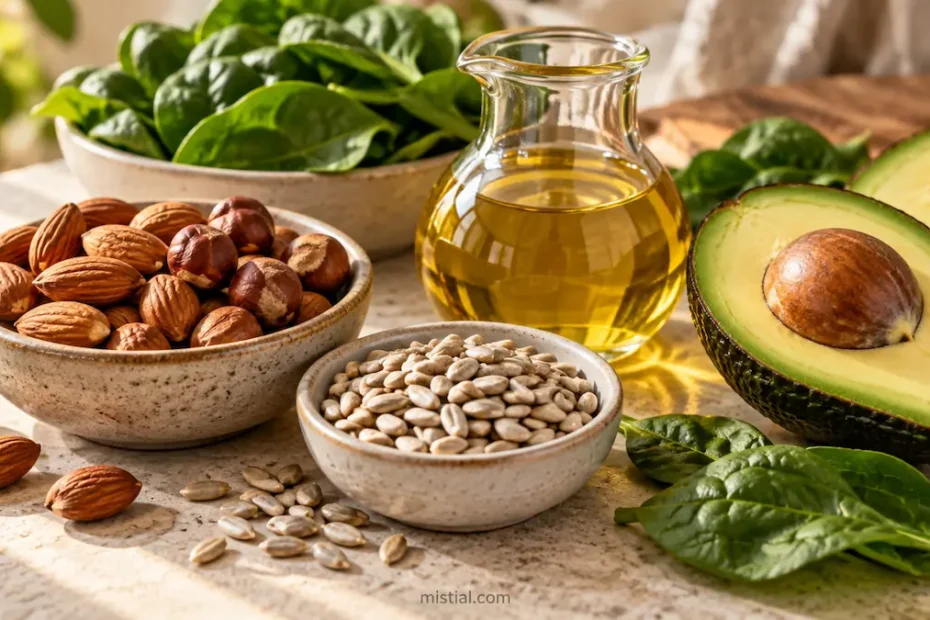
Useful vitamin E sources include nuts, seeds, plant oils, and wheat germ. Almonds, hazelnuts, and sunflower seeds are familiar options; spinach and broccoli also contribute. The amount varies by food, portion, and preparation, so simply describing a meal as healthy does not reveal its vitamin E content.
The everyday aim is to include dependable sources within a pattern of balanced nutrition. That is more practical than searching for one food with the highest possible antioxidant score.
Consider where a source would fit naturally into meals you already eat. Seeds can go into a grain bowl; chopped nuts can accompany breakfast; an appropriate plant oil can be part of a dressing. These are examples of meal planning, not a prescription to add every option at once.
- At breakfast: add almonds or sunflower seeds to oats or yogurt if they suit your preferences and allergy requirements.
- At lunch: include vegetables and a dressing containing a plant oil, rather than expecting plain lettuce to supply the full range of nutrients.
- For a snack: use nuts or a suitable nut or seed butter as one option in a varied rotation.
- At dinner: combine a vegetable such as broccoli or spinach with other food groups, instead of treating it as an antioxidant remedy.
Nuts, seeds, and oils are energy-dense. Their nutritional value does not create a need for unlimited portions. Replacing an existing ingredient often makes more sense than adding extra oil or repeated snacks solely to increase one vitamin.
A plant-based diet can readily include these foods, but the label alone guarantees nothing. A varied menu with nuts, seeds, vegetables, and suitable fats differs substantially from a restrictive menu built around a few refined foods.
For people with food allergies, the answer is not to force a standard list of recommended foods. Identify tolerated alternatives, read labels where necessary, and seek dietary help if several major food groups are excluded. A useful eating pattern must be safe and realistic enough to maintain.
Why daily requirements are not capsule instructions
Dietary reference values describe nutrient intake for a population or life stage. They are not automatically a supplement dose. They also differ between authorities, so figures copied from different countries may not use the same assumptions or terminology.
The U.S. adult recommended dietary allowance is 15 milligrams of alpha-tocopherol per day. This is a nutritional reference for total intake, not a recommendation to take a capsule containing that amount. Children and breastfeeding people have different requirements.
Equally, a published upper intake limit is not a target. Being below a maximum does not prove that a supplement will help, that it suits someone’s medicines, or that long-term use is free of risk. A label displaying a large percentage of a daily reference value should prompt a question about purpose, rather than confidence that more must be better.
Eating enough and absorbing enough are separate questions
Because vitamin E is fat-soluble, its absorption is linked to fat digestion. The intestine, bile, and pancreatic secretions all participate in the process. The nutrient then travels through the body with lipid-carrying particles.
For most people, this is a reason to include normal amounts of dietary fat, not a reason to construct a special high-fat meal. Nuts and seeds already contain fat. A mixed meal can provide an appropriate setting without extra spoonfuls of oil taken as a supplement.
When a medical condition impairs fat absorption, however, the problem changes. Eating more vitamin-rich foods may not fully correct a deficiency if the body cannot absorb them effectively. The underlying condition, the preparation used, and monitoring may matter more than finding a food with a larger number on its nutrition label.
This is one reason broad online advice can miss the point. Two people may report similar food intake while having very different nutritional needs because their digestive health is different.
A deficiency is a clinical question, not a beauty checklist
Clinically significant vitamin E deficiency is uncommon in otherwise healthy people. It is more likely with conditions affecting fat absorption or with certain rare inherited disorders. Possible consequences include muscle weakness, impaired coordination, altered sensation, and vision problems.
Dry skin, feeling tired, or noticing dull hair does not identify vitamin E deficiency. Those experiences have many possible explanations. Treating a nonspecific symptom as proof of one missing nutrient can delay attention to the actual cause.
A clinician may consider a blood test when symptoms, medical history, or an absorption disorder make deficiency plausible. The result needs to be interpreted in context. A test is useful when it helps answer a clinical question, rather than simply producing another number to optimize.
If you arrange an appointment, bring information that helps distinguish a dietary issue from an absorption or medication issue:
- How long the symptoms have been present and whether they are changing.
- Any diagnosed digestive condition or operation affecting the digestive tract.
- Major food restrictions and whether they began before the symptoms.
- All supplements currently used, ideally with photographs of their labels.
These details are more informative than a general statement that you need antioxidants. Persistent problems with balance, sensation, strength, or vision deserve medical assessment rather than an extended experiment with supplements.
The risks often appear in the rest of the medicine cabinet
Vitamin E supplements can increase bleeding risk, particularly at high intakes and in combination with anticoagulant or antiplatelet medicines. This is a relevant issue for people taking medicines such as warfarin, as well as anyone whose medical team is assessing bleeding risk before a procedure.
Antioxidant supplements can also raise questions during chemotherapy or radiation treatment. Their effects depend on the treatment and context. An oncology team should review them; an appealing explanation about protecting healthy cells is not enough to establish that adding them is appropriate.
Supplement stacking is another avoidable source of confusion. A multivitamin, an eye formula, and a product marketed for skin may all contain vitamin E. Looking only at the newest bottle can hide the combined intake.
Checking labels is therefore an information-gathering exercise, not an invitation to calculate a personal treatment plan. Write down the product name, serving size, vitamin E amount, and how often it is actually taken. If quantities use different units, ask a pharmacist to reconcile them rather than comparing the largest printed numbers.
Before adding a supplement: have its purpose and compatibility reviewed if you take blood-thinning medicines, receive cancer treatment, have a bleeding disorder, or are preparing for a procedure. Do not change prescribed medicines to make room for a supplement.
If vitamin E was prescribed for a diagnosed condition, discuss concerns with the prescriber. Evidence against routine preventive use does not automatically invalidate treatment given for a specific medical reason.
Skin care uses a different route and a different standard of evidence
Vitamin E occurs naturally in skin and is used in topical formulations. Its antioxidant properties provide a rationale for studying it in skin care, but the result depends on the finished product: stability, concentration, delivery, and the other ingredients all matter.
A cream containing vitamin E and an oral supplement should not be treated as interchangeable. Evidence about a topical combination cannot establish that swallowing vitamin E will produce the same effect, and evidence about nutritional adequacy cannot prove that an oil will improve a scar.
Claims that vitamin E reliably removes scars or reverses wrinkles go beyond what the evidence supports. Topical vitamin E can also cause irritation or contact allergy in some people. Opening an oral capsule and applying the contents to a healing wound is not equivalent to using a product designed and assessed for that purpose.
The broader influence of lifestyle and environment on skin helps put an individual ingredient in perspective. An antioxidant product does not replace sun protection or medical assessment of a persistent skin problem.
A useful way to assess a claim is to ask what was actually studied. Was it the finished formulation or a different ingredient mixture? Was the outcome improved skin appearance, a laboratory marker, or wound healing? Similar wording can conceal very different evidence.
Five checks that make the next decision clearer
You do not need to master antioxidant chemistry to make a sensible decision. You need to identify the question, separate food from treatment, and notice when personal medical factors change the answer.
- Name the goal precisely. Improving a limited diet, investigating symptoms, and treating a diagnosed deficiency require different approaches. General cellular protection is too vague to judge whether a product has succeeded.
- Review a few ordinary days of eating. Look for actual sources of vitamin E and for major restrictions. Do not use one unusually healthy meal or one rushed day as a verdict on the entire diet.
- Check what is already being taken. Include multivitamins, beauty products taken by mouth, eye formulas, and occasional supplements. Record actual use as well as the manufacturer’s suggested serving.
- Match evidence to your situation. A finding from people with a particular eye disease, an absorption disorder, or an established deficiency may not apply to someone seeking general prevention.
- Choose a next step that answers the question. A dietary gap may call for practical meal changes. Persistent symptoms call for assessment. A prescribed supplement calls for clarity about its purpose, monitoring, and planned review.
For example, someone who rarely eats nuts, seeds, or plant oils might first identify an acceptable food source and use it regularly. Someone with a diagnosed absorption disorder and new neurological symptoms needs a different response. Treating both situations with the same off-the-shelf capsule would ignore the reason their needs differ.
Questions that often remain after reading the label
Is vitamin E the same thing as an antioxidant?
Vitamin E is a nutrient with antioxidant activity. Antioxidant is a broader description that includes many substances and biological defenses. Sharing that label does not make different ingredients interchangeable.
Does vitamin E need to be taken with vitamin C?
The two can interact within antioxidant chemistry, but that does not create a general need for paired supplements. A biochemical partnership is not the same as evidence that a combination capsule improves health in someone whose intake is already adequate.
Can a blood test show how much antioxidant protection I have?
A vitamin E blood test measures a specific nutrient. It does not provide a complete score for antioxidant defenses or predict how much protection you have against future disease. Testing is most useful when a clinician has a reason to investigate vitamin E status.
If I feel better after starting a capsule, does that prove I needed it?
No. Symptoms fluctuate, and other changes may occur at the same time. Feeling better is worth reporting, but it does not establish a deficiency or identify the cause. A clear treatment goal and an appropriate review are more informative than assuming that the timing proves the explanation.
Give the nutrient a clear role in your health decisions
Vitamin E deserves a place in a varied diet because it performs an essential job. Decisions about concentrated supplements need a more specific justification: a nutritional problem, a medical indication, or another clearly defined need assessed in context.
If your concern began with an antioxidant claim, turn it into a concrete question. Is your diet missing useful foods? Are symptoms being left unexplained? Does an existing product overlap with another supplement? Answering that question is a better next step than simply choosing a stronger capsule.
