


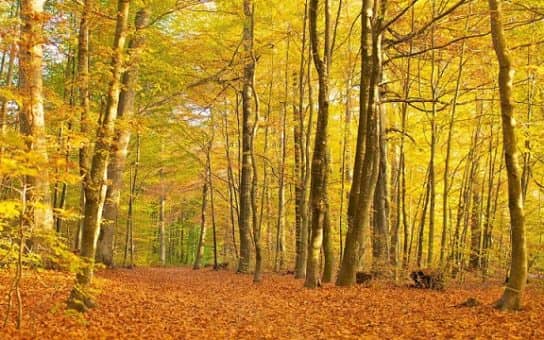
A feature of deciduous forest is its rapid spread over the area and a high growth rate. Trees in terms of growth density are much less common than in a coniferous forest. The leaves on such trees completely fall off in the fall, thereby protecting the tree from moisture loss in the winter cold. With the arrival of spring, buds appear on the trees with the rudiments of new leaves.
Trees common in such forests are unpretentious and easily take root in new soil, grow quickly and have a long life. Forests of this type can be up to 40 meters high. There are two types of deciduous forest: small-leaved and broad-leaved.
Small-leaved forests
In such forests, woody species with small deciduous plates predominate. Such forests love light and are unpretentious to the soil, they tolerate cold well. The main varieties of small-leaved forest trees include:
- Birch, it is more common in the Northern Hemisphere, some of its varieties can be 45 meters high with a trunk girth of 150 centimeters. Birch bark can be white or pinkish, brownish, gray or black. Birch leaves are smooth, their shape resembles an egg, which resembles a triangle or diamond. Their length can reach 7 centimeters and a width of 4 cm. In summer, flower earrings appear on the tops of elongated shoots, initially they are green, but turn brown over time. The seeds, due to their lightness, are well carried by the wind. In Russia, there are about 20 varieties of birches.
- Aspen can grow up to 35 meters high. It is characterized by the presence of a straight trunk, with a diameter of about a meter with a thin smooth bark of gray-olive color. Over time, lentils appear on the bark, which are similar in shape to a diamond. The tree tolerates frost and strong moisture well, tolerates shade well. Aspen leaves are rounded-rhombic in shape, width is greater than length, with a serrated frame. The front side of the leaves is bright green and shiny, the back is matte one tone lighter. In spring, beautiful flowers appear on the branches in the form of earrings. The flowers are bisexual, the female is light green, and the male is purple. In autumn, boxes with aspen seeds are formed on the flowers, when they fall, they open, they are picked up by the wind and carried around.
- Alder belongs to the birch family and has toothed-lobed or oval leaves. Alder flowers are bisexual and grow on one shoot, female in the form of spikelets, and the male with the shape of earrings. This tree is very fond of moisture and light, it grows near the shore of the reservoir. Alder bark is gray-green. In total, there are about 14 varieties of this tree.
Broadleaf forests
Such forest varieties have trees in which the upper tier has leaves of different sizes, both large and medium. Such trees tolerate shade well and are demanding on the soil and love light. Broad-leaved forests grow in a relatively mild climate, the main representatives are the following trees:
- Oak belongs to the beech family. This large tree with wide, fleshy leaves has a spherical crown. The root system is well developed and includes a taproot. The wood of this tree is very well prized. Oak loves light and fertile soil, refers to long-livers, tolerates drought well. In total, there are about 21 varieties of this plant.
- Maple has more than 60 varieties and is found in many parts of the world. This tree has a fiery red leaf color in the fall. Maple copes well with drought and is undemanding to the soil. The plant propagates by seed or by grafting.
- Linden is a large-leaved tree with a decorative crown shape. Linden is a representative of a soft-leaved species with large vessels through which juice passes. The wood of this tree is used in the manufacture of musical instruments. There are about 20 varieties of lindens.
- Ash grows up to 30 meters in height with a width of 10 to 25 meters. The crown of the ash tree is openwork, broadly oval, with slightly branched straight shoots. The tree can grow up to 80 cm per year. The leaves are bright green with inconspicuous flowers. The ash root system is very sensitive to soil compaction, loves fertile soil and sun.
- Elm, its homeland Asia, Europe, America and the Northern Hemisphere. The elm is a large-leaved tree with a height of no more than 35 meters and a crown width of no more than 10 meters. A tree with pointed leaves and a jagged edge of a dark green color. Elm flowers are small, united in bunches. The tree does not react well to shade, but it tolerates high humidity and drought well. Propagated by seeds, cuttings or grafting.
- Poplar is a member of the willow family. The maximum tree height can be up to 50 meters. Poplar flowers are small, they gather in earrings, which, when ripe, turn into boxes with poplar fluff. Trees are not long-lived, they are highly susceptible to all kinds of insect pests.
Forests can also be primary or secondary, which grow from the root of the tree after fire, logging, or insect destruction. They are more often small-leaved.
