


Pronghorn antelope (lat.Antilocapra americana) – the only living representative of the Vilorogov family, belongs to the order of carnivorous, genus Vilorogi. A ruminant that is considered the oldest hoofed animal in North America.
What does it look like
This animal has a rather slender and beautiful body, in size it is not far from the roe deer: the body length is 100-150 centimeters, the height at the shoulders reaches a meter and the weight of the pronghorn is on average 40-60 kilograms.
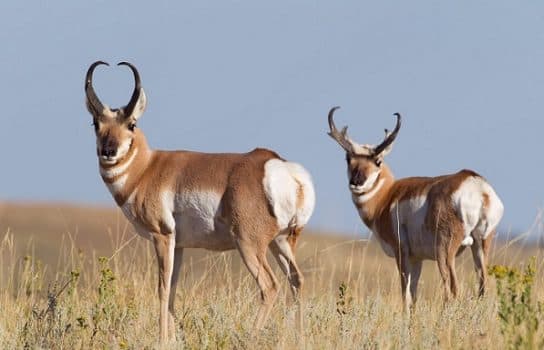
Horns, as the name suggests, branch out to the sides, forming a kind of “pitchfork”. In males, they are thick and short, no more than 30 centimeters in height, in females, the horns are much smaller and do not have a characteristic shape for the species, which is why it can be confused with any other antelope without any problems. In all bovids, with which pronghorns are very similar in their body structure, the horns are massive bone rods, which are later covered with the so-called “horny sheaths”. However, it is this species that is the only existing specimen that can drop its covers annually, and then grow them again. The change of horns occurs due to the end of the breeding season, and can take about six months in duration. Thus, pronghorn antelope is a kind of intermediate stage between bovids and deer.


The color is inconsistent, mostly brown, becoming lighter towards the legs. On the throat, there may be a white crescent-shaped spot, and in males and a small semi-collar of black color. The hair is thick, rather wavy, forming a lush and noticeable mane on the neck. Also, this species has very developed scent glands, which contribute to accelerated heat exchange and can knock predators off the track, spreading many different odors. With the help of them, by the way, they mark the territory during the rut.


Has large and keen eyes, set deep in the skull. Such a structure provides the beast with the ability to survey the surrounding space at 360 degrees.
A large heart that processes many liters of blood, voluminous lungs that provide the animal with great endurance, as well as a thick trachea, through which an abundant amount of oxygen passes, are the main features of the internal structure of pronghorns, thanks to which they can move very quickly over long distances.

On average, their maximum speed reaches more than 80 kilometers per hour, which is why the pronghorn antelope is considered the fastest representative of the family. This animal also ranks second in speed in the world, second only to the cheetah.
Where dwells
At the moment, it mainly inhabits all of North America, from northern Mexico and the Rocky Mountains to Canada and the Missouri River. For life, they try to settle near water sources, as well as in places with the greatest amount of vegetation, for example, on plains and hills.
What eats
This species is considered herbivorous, due to which it is enough for them only to eat food without being distracted by a long watering hole. Their food intake takes almost all the time, with short sleep breaks, which rarely lasts more than three hours.


The antelope’s stomach consists of four chambers, thanks to which they can digest cellulose without any problems, which means they can eat the leaves of low trees along with branches without worrying about the body.
The main food for these animals is wild fruits that they get with their hooves, grass vegetation, which is quite abundant on flat terrain, cacti that come across them on their way, as well as shrubs to replenish the supply of vitamins useful for the body. The mineral balance is restored by consuming a small amount of earth.
They graze mainly at dusk or early in the morning, as they are unable to withstand too hot temperatures. They spend almost their entire life in motion and in search of food.
Natural enemies
Pronghorns, like any other antelope, have quite a lot of enemies in the animal world: they are one of the most favorite delicacies of tigers, hyenas, leopards and lions. But it is this species that has the most opportunities to escape, because because of the speed, only cheetahs, which are not found in the habitats of pronghorns, can catch up with them.
The main creature that causes the greatest damage to the population is undoubtedly a person. It is people who love to eat antelope meat, because it is considered very tasty, and for many nations it is even delicious.
In the wild, they rarely live up to ten years due to a weak, albeit very hardy, organism. In national parks, the average age of life is about fifteen to twenty years.
Features and lifestyle
Many centuries ago, across the entire American continent, there were many huge herds of pronghorns, but now, mainly due to man and his activities, the number of animals has decreased several times. During cold weather, antelopes gather in herds, the number of which varies from fifty to several hundred individuals. When the food ends, the animals begin to migrate en masse, overcoming huge distances in a short period of time, which is facilitated by their speed and endurance.

By their nature, pronghorns are not aggressive and arrange battles only during the rutting period, when they need to prove their strength and show dominance in order to interest the female. Their food runs throughout the entire time, so they graze around the clock. The food, which is grass, contains a huge amount of moisture, thanks to which the animal may not go down to the watering hole for several weeks.
A white spot in the abdomen, which is very noticeable from afar, serves not only as an external decoration, but also as a warning about danger. When an animal notices a predator, the fur on this part of the body automatically bulges out, showing the others that it is time to run.
Unlike most other animals, the herd of this species is led by the female, and the male urges everyone from behind and acts as an observer, whose purpose is to find food and detect the enemy nearby. They generally try to weed out the old people, because they no longer have the former maneuverability, which means they will only interfere with the young herd.
Although these animals are fast, their jump height hardly reaches 0.5 meters. Due to this deficiency, during cold and hunger, when antelopes begin to migrate, many individuals cannot get to food without being able to jump over high obstacles, as a result of which they die, breaking their legs.
They have a wide range of sounds that they can pronounce, but mostly communicate with each other using bleating.
Reproduction
The breeding season begins in the summer and lasts approximately two to three weeks. Females and males begin to divide into separate groups, after which they look for the territory in which they will inhabit. They toughly and aggressively protect her, not letting anyone close.
Males often arrange painful fights for the loser, the purpose of which is to demonstrate their own strength and get a female. During battles, these animals ram each other with their horns, often ripping open each other’s stomachs, because of which the defeated one dies.

In essence, males are polygamous and have more than ten individuals in their harem, not limited to any one. The female, when she sees the strength and interest of the dominant male, raises her tail up, showing that she is ready for mating and wants to join his harem.
The duration of pregnancy lasts slightly less than in humans, approximately 7-8 months. For one litter, 1-2 cubs are born, twins are not such a rare exception, unlike most other artiodactyls. At birth, babies have a light brown color and weigh about three to four kilograms, rarely exceeding these indicators. After birth, they cannot stand on their feet, they are very helpless and hide in the grass, because they are very easily caught and eaten by predators. The mother tries to arrange feeding for her child 3-4 times a day.
After one and a half to two months, the babies can finally join the young and enter the main herd, and when they reach three months of age, the female stops feeding them milk, allowing the young antelopes to taste the grass.
Video about the pronghorn antelope


