


The gannet bird looks funny and sometimes stupid. The animal is rather clumsy and comically moving on land, which is why it got its name. Nevertheless, birds are very trusting and friendly, they are not at all afraid of humans. Boobies love to live in warm tropical seas. You can meet large birds in Mexico, on the islands near Peru and Ecuador. Today, there are very few animals and, unfortunately, their number is decreasing, therefore gannets are strictly protected by law.
general characteristics
The body length of the gannets ranges from 70 to 90 cm, the weight of adults is from 1.5 to 2 kg. Birds can flap their wings up to 2 m and gain speed up to 140 km / h. Special air cushions are located under the skin of the animal’s head, helping to soften the impact on the surface of the water.
The boobies have a short and blunt tail, an oval body, and a not too long neck. The wings of animals are narrow and long, which increases their endurance. The birds have webbed feet, a straight and sharp beak, and small teeth. The gannet’s nasal openings are covered with feathers, which makes breathing difficult, because the air enters through the beak.
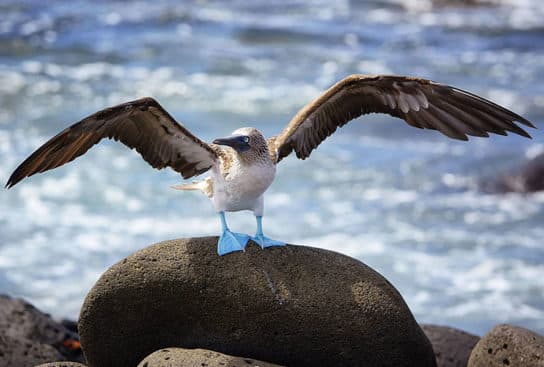
Gannets have binocular vision, plumage tightly fitting to the body, and bright blue legs.
Bird species
There are four types of gannets:
- brown – most likely to meet birds in the tropical zone of the Indian, Pacific and Atlantic oceans. Adults grow up to 75 cm in length with a weight of 1.5 kg. Seeing animals on land is almost impossible;
- red-legged – representatives of birds live mainly in the Pacific Ocean. Birds reach 70 cm in length, have light-colored plumage. There are black colors at the tips of the wings. Gannets are characterized by red, webbed feet and a blue beak;
- blue-faced – the largest representative of gannets, which reaches 85 cm in length and has a wingspan of up to 170 cm. The weight of the bird varies from 1.5 to 2.5 kg. Distinctive features of the sea inhabitant are white plumage, black mask on the face, bright yellow beak in males and greenish yellow in females. You can meet blue-faced boobies in Australia, South Africa and America;
- blue-footed – representatives of this group of birds are distinguished by bright blue swimming membranes on their legs. Gannets have long, pointed wings, brown and white plumage. Females grow larger than males and have a unique dark ring of pigment around their pupils. Gannets live mainly in Mexico, Peru and not far from Ecuador.
All types of gannets fly, dive and swim beautifully.
Behavior and nutrition
Seabirds live in flocks, the number of which can exceed several dozen. Boobies seek food throughout the day and are considered calm, peaceful animals. Flocking birds often “hover” in the air, carefully peering into the ocean, and then plummet into the water.
Boobies’ favorite foods are cephalopods and fish. Seabirds feed on herring, anchovies, sprats, sardines, and gerbils. Skillful hunters catch fish while emerging from the water. Sharp eyesight and a strong beak help them in this. Sometimes gannets replenish their diet with algae, which are also rich in vitamins and microelements.
Breeding features

Seabirds build nests on sandy islands, coasts, and areas with little rockiness. During the mating season, males look after females beautifully. During the seclusion period, the pair is located opposite each other and crosses the raised beaks. The female can lay 1 to 3 eggs. The incubation period lasts no more than 44 days. Both parents incubate their offspring, warming them not with feathers, but with their paws. Completely naked chicks are born, which already at the age of three months leave their native nest.
