


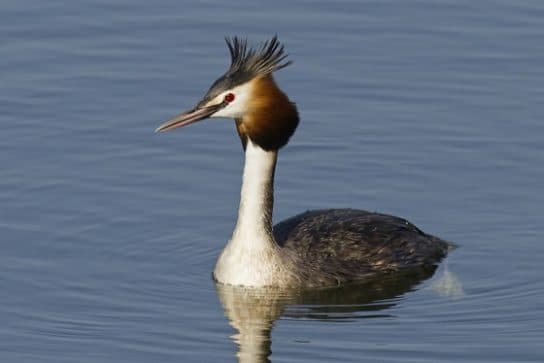
It is the largest of European grebes, with a long neck and a long, dagger-like beak. This shape of the beak is inherent in waterfowl hunting fish, and indeed, crested grebe, unlike other grebes, catch much more fish than invertebrates. They eat from 3 cm sticklebacks to eels over 20 cm.
Where do the Grebes live
Greater toadstools require a lot of plant-free water to hunt fish, so this species does not live in green areas of water that are inhabited by other toadstools. There is enough vegetation on the shore, birds use it as an anchor for a nest.

Mating rituals of large toadstools
These birds spend their time outdoors, so they are easy to observe, and their impressive courtship was the subject of one of the earliest in-depth studies of bird behavior.
The most common maneuver is the “head shake” maneuver, in which the members of the couple swim up to each other, shake their heads from side to side. This ceremony is interrupted by the plucking of feathers. Toadstools, it seems from the side, pluck feathers on the back of the chosen one, but in fact they just make movements with their heads. Then more complex manifestations of sympathy follow. Male and female dive for underwater plants, rip out stems, emerge and quickly swim towards each other. They meet chest to chest, rise out of the water, shake their heads from side to side, still holding the weed in their beak.
After choosing a pair and completing a colorful ritual of courtship, when the birds have already formed an alliance, they begin to lead a solitary life, lay eggs.

Greater toadstool nest
Features of growing chicks
Grebes have a surprisingly long breeding season. Eggs are laid by birds from February to October. The couple builds at least one nest. Birds construct auxiliary floating “platforms” for other purposes, including mating.
During incubation, the seated parent (both members of the pair incubate eggs) leaves the nest if it detects a predator in the distance. The bird covers the eggs with algae, so they quickly change color from white to dull brown. This reduces the likelihood that the eggs will be spotted by a predator.
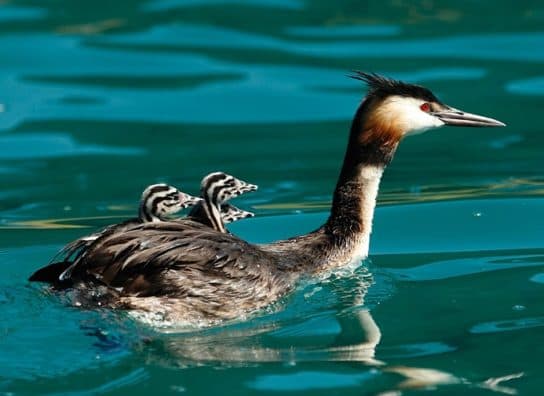
Great toadstool with chicks
Chicks are also at risk of being eaten if they stay in the nest for a long time without mum and dad, so they “stand on their feet” a few hours after birth. Parents carry small chicks on their backs, so it is easier for the whole family to swim away from the shore.
The chicks are striped, their color resembles the robe of prisoners. They perfectly know how to swim as soon as they hatch, but for the sake of safety and preservation of body heat, the juniors cling to the back of one of the parents, sit between the wings. They even hold onto their backs during an adult dive.
The young are fed by one parent when the brood sits on the back of the other. The peculiarity of later upbringing is not in the teamwork of the Grebe, but in the “distribution of the offspring,” with each parent receiving custody of his part of the brood, ignoring the other chicks. But sometimes older chicks from an earlier brood join the feeding of the juniors and help either parent.
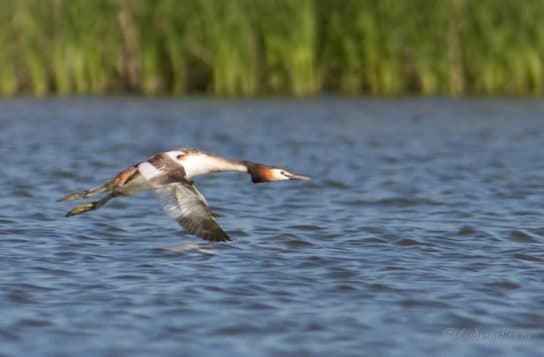
Big toadstool in flight
Greaters are adapted to the aquatic lifestyle. Therefore, it is difficult for a large toadstool to stand on a wing, unlike, say, meadow or forest birds. When it rises into the air, it scatters for a long time, struggling to break away from the water surface. That is why the Grecian Greater avoids small lakes and ponds.
Why do people like to watch big toadstools
Crested grebe on the water looks graceful, richly decorated plumage and stunning courtship rituals make the birds a favorite among aquatic animals.
