


The rook population is increasing from year to year and the birds appear to have adapted to the changes in agriculture that have affected many other species.
What rooks look like
The birds are usually 45 – 47 cm long, similar in size to a crow, although sometimes a little smaller, they look disheveled.
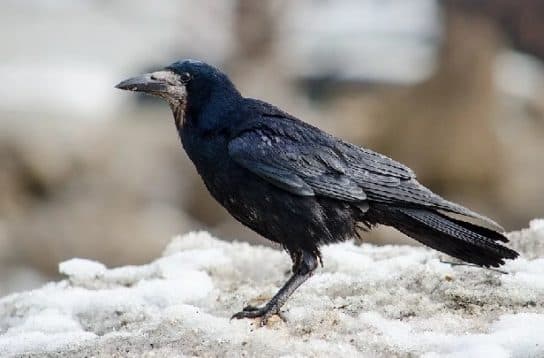
This species has black feathers that shine blue or bluish-purple in bright sunlight. The feathers on the head, neck and shoulders are especially dense and silky. The legs of the rook are black, and the beak is gray-black.
Rooks are distinguished from other similar members of the crow family by:
- bare gray-white skin before the eyes around the base of the beak in adult birds;
- a longer and sharper beak than a crow;
- plumage around the paws, which looks fluffy.
Despite the differences, the rook is similar to the crow, which causes some confusion. In rare cases, rooks with brown and sometimes cream plumage, pink paws and beaks are observed.
How long do birds live in nature and in captivity?
The life span of a rook in nature is 15 to 20 years. The oldest documented wild rook was 22 years old. Birds in captivity live much longer; the long-lived rook lived up to 69 years.
What habitats do rooks like?
Rooks are traditionally considered rural and farm birds, and live in places that crows don’t like, such as open farmland. The ability to adapt to new conditions has allowed rooks to find nesting sites in parks, urban areas and gardens, especially in winter. For them, the outskirts of cities are preferable to urban centers. Rooks are rarely seen singly, and they constantly fly in flocks.

Where and how rooks build nests
Rooks nest in a colony called rookery. Nests are built high up in a tree next to other nests, and nesting sites from previous years are reused by birds. Rooks’ nest is bulky. They weave it from branches, strengthen it with earth, cover the bottom with moss, leaves, grass, wool.
The female lays and incubates smooth, shiny, light blue, greenish blue or green eggs with dark spots. The eggs are about 40 mm long and both parents feed the hatched cubs.
Rooks breed in March and April, laying 3 to 9 eggs, which are then incubated for 16-20 days.

How a rook gives voice signals
The call of the rook is heard as a kaah sound, which is similar to the voice of a crow, but the tone is muffled. The rook makes sounds in flight and sitting. When the bird sits and “talks”, it flaps its tail and bows at each kaak.
In flight, rooks tend to voice signals separately, unlike crows, which call in groups of three or four. Solitary birds often “sing”, apparently for themselves, making strange clicks, wheezing and sounds similar to the human voice.
What rooks eat
Birds are omnivorous, rooks eat everything that falls into the beak, but prefer live food.
Like other corvids, rooks in urban or suburban areas choose places where people leave food leftovers. Birds circle garbage and food in parks and city centers. Rooks visit bird feeders, eat what people leave for the birds – grains, fruits and bread.
The diet of rural rooks, like most crows, is varied and includes insects, worms, carrion and seeds. Rooks also feed on earthworms and insect larvae and explore the land in search of food with their strong beaks.
When hungry, rooks attack vegetable gardens and orchards, eat up the harvest. Birds have learned to hide food, use supplies, if farmers put a scarecrow or the ground is frozen, it is difficult to find live food.
How does a rook differ from a crow – video
Other mentions of the rook on our site:
- City birds
- Birds of Central Russia
- Ural animals
