


Owl Owl is an amazing representative of the order of owls. The soft plumage makes the owl look very large, although it itself weighs no more than a kilogram and has a length of about 50 centimeters.
Outwardly, the tawny owl has the usual features for the owl family. However, it lacks the feather “ears” characteristic of most owls. The owl’s beak is high and flattened at the sides. The color of the feathers is red with a gray tint, decorated with dark spots. The peculiarity of the owl lies in the specific structure of the auricles, which the tawny owls hide under their feathers. The left side of the ears of the owl is smaller than the right. This asymmetry is characteristic of all owls, but only in owls it is pronounced. The iris of the eye is predominantly reddish-orange in color.
Types of owls
The tawny owl has a large number of species. Let’s consider the main ones:
Great gray owl. A distinctive feature of this species is a black spot under the beak that looks like a beard. Hence the name “bearded” came from. The predominant color of the bearded owl is grayish brown. There are pronounced dark rings on the eyes. It hunts in the light of day.
Common Owl. The most famous species that has settled in Europe. The plumage of the common owl is brown with dark stripes. Owner of rings around the eyes. The owl is awake at night, in the daytime it huddles in nests.
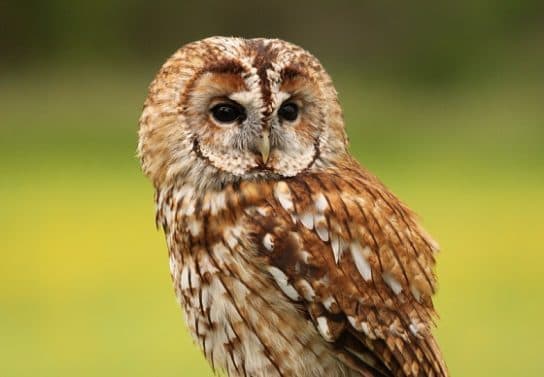
Long-tailed Owl. This species is outwardly similar to the common owl. They are distinguished only by the absence of pronounced dark rings around the eyes.
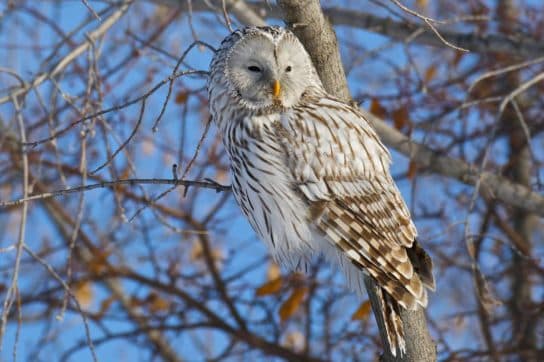
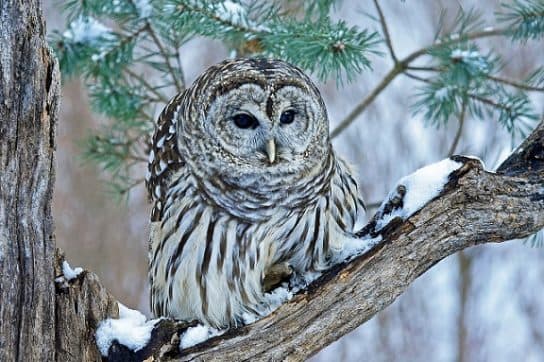
Barred Owl. Popular in North America. The external difference from other species is in color. The owl’s feathers are bright brown with white stripes. An exceptionally nocturnal bird.
Habitat
The population of this species of owls is widespread in Asia and Europe. Sometimes the tawny owl is found in northern Africa and in the American latitudes. In the Russian Federation, you can find bearded, long-tailed and gray owls. The common tawny owl is widespread in Europe. The habitats of these birds are located close to meadows and forest edges. As a rule, owls build their nests in tree hollows or between stones.

Breeding period
The mating season for owl owls varies depending on their species and climate. The male of the common owl owls the breeding season is marked with a prolonged loud squeal. Females answer with short sonorous exclamations. Tawny owls bear offspring early. Usually, the female incubates no more than four large eggs per month. The role of the male during the mating season is characterized by the production of food for the children and the mother. Chicks hatch with pure white plumage.

Owl with chicks
After a month, the grown owls are ready to leave their nests. Owls become sexually mature in the first year of life.
Nutrition
The diet varies depending on the species. Most of the owl owls are predominantly nocturnal predators. The gray owl prefers to eat small animals and hunt them at night. Sometimes owls can hunt small birds and reptiles. Can eat insects.
The Great Gray Owl differs from its relatives in that it obtains food during daylight hours. Prefers rodents. Don’t mind eating protein.

The adult long-tailed owl uses a variety of mice, such as voles. Sometimes a predator can be found hunting a squirrel or hazel grouse. Some species prefer fish and frogs.
The Owl is a dangerous predator!
Life expectancy and enemies in the wild
The average lifespan of a tawny owl is five years. As a rule, the lifespan of any owl depends on its size. Little owls have a shorter life cycle due to their fast metabolism.
While in the wild, the owl should always be on the lookout. The risk of meeting large predators is dangerous for any type of owl. The main reason for the death of most of the owls is associated with hunger and the attack of eagles or hawks.
Sexual dimorphism
There is practically no external difference between the sexes of the owl species. Only sometimes it is possible to distinguish a male from a female by plumage, size and body weight. For example, females of spotted ciccabs are noticeably heavier than males of this species.
