


- 1 Description of the appearance of nightingales
- 2 Types of nightingales
- 3 What is the singing of the nightingale
- 4 The area of the nightingales
- 5 What nightingales eat in nature
- 6 How nightingales prepare for the mating season
- 7 How nightingales give birth and care for them
- 8 Preservation of the species of nightingales
Usually they first hear and only then see the nightingale hiding in the foliage of the branches. The nightingale’s voice is heard day and night. Beautiful notes and melodic phrases make singing wonderful, creative and spontaneous.
Description of the appearance of nightingales
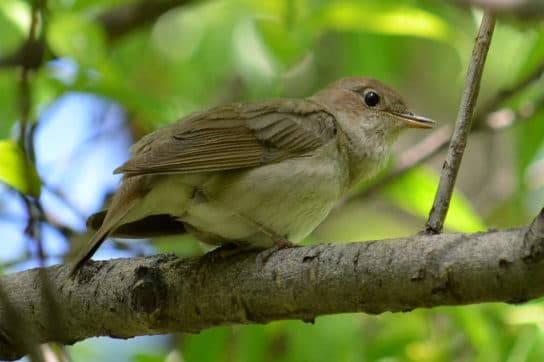
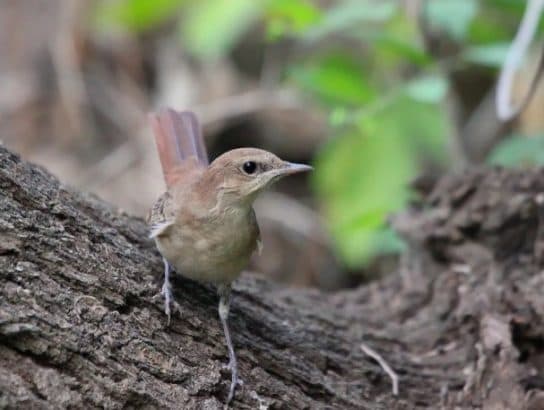
Both sexes are similar. The adult nightingale has a brownish upper body, rusty brown croup and tail. Flying feathers are reddish brown in the light. The lower part of the body is pale or light white, the chest and sides are light sandy red.
On the head, the front part, crown and back of the head are rusty brown. The eyebrows are indistinct, pale grayish. The chin and throat are whitish.
The bill is blackish with a pale pinkish base. The eyes are dark brown, surrounded by narrow whitish rings. Flesh to brownish toes and feet.
Young growth of nightingales is brownish with reddish spots on the body and head. The beak, tail and wing feathers are rusty brown, paler than in adults.
Types of nightingales
West, found in northwest Africa, Western Europe, Turkey and Levan. Does not breed in Africa.

Western nightingale
Yuzhny, lives in the region of the Caucasus and Eastern Turkey, North and South-West of Iran. Does not breed in Northeast and East Africa. This species is duller in color, less rufous on the upper body and paler on the lower body. The chest is mostly gray-brown.
Memory, endemic in eastern Iran, Kazakhstan, southwestern Mongolia, northwestern China and Afghanistan. Does not breed in East Africa. This look has a gray upper body, whitish cheeks, and fuzzy eyebrows. The lower part of the body is whitish, the chest is sandy.
What is the singing of the nightingale
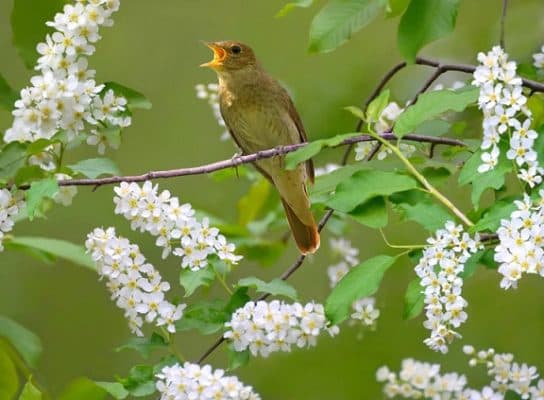
The nightingale sings day and night. The artistic and melodic song of the nightingale makes the greatest impression when males compete in the silence of the night. They attract females, which return from African wintering grounds after a few days after the males. After mating, the males sing only during the day, mainly marking their territory with a song.
The song consists of loud, rich trills and whistles. There is the characteristic Lu-Lu-Liu-Liu-Li-Li crescendo, which is a typical part of the nightingale song, which also includes crisp flute-like cuts, chirps and chirps.
How does the nightingale sing?
The bird also utters a series of long phrases “pichu-pichu-pichu-picurr-chi” and their variations.
The male sings during courtship, and this song near the nest consists of a plaintive “ha ha ha ha”. Both partners sing, keep in touch in the breeding area. Nightingale calls include:
- hoarse “crrr”;
- tough tech-tech;
- whistling “viyit” or “viyit-krrr”;
- sharp “kaarr”.
Singing nightingale video
The area of the nightingales
Nightingale prefers open forest areas with thickets of shrubs and dense plantations of vegetation along bodies of water, edges of deciduous and pine forests, as well as the borders of arid regions such as chaparral and maquis. Solovyov is seen in areas with hedges and shrubs, in suburban gardens and parks with fallen leaves.
The bird species is usually found below 500 meters, but depending on the range, nightingales nest above 1400-1800 / 2300 meters.
What nightingales eat in nature
The nightingale hunts invertebrates all year round, both in breeding grounds and during wintering. The bird eats:
- Zhukov;
- ants;
- caterpillars;
- flies;
- spiders;
- earthworms.
In late summer and autumn, he picks berries and seeds.
The bird feeds on the ground in fallen leaves, as a rule, it finds prey inside a dense cover. Can also pick up insects on low branches and leaves. Sometimes hunt from a branch, falls on prey on the ground, performs air pirouettes, chasing an insect.
The nightingale is difficult to see in its natural habitat due to the brown plumage that matches the color of the branches and foliage. Fortunately, the long, wide, red tail allows identification of the bird among its natural hiding places.
When feeding on the ground, the nightingale is always active. The body is held in a slightly upright position, moves on long legs, the bird jumps with a raised tail. The nightingale easily moves along the forest floor, makes dexterous jumping movements, wags its wings and tail.
How nightingales prepare for the mating season
During the breeding season, birds usually return to the same nest year after year. The male performs mating rituals, sings softly songs for the female, flaps and inflates his tail, and sometimes lowers his wings. Sometimes the male chases the female during the rut, at the same time utters the pitiful sounds “ha-ha-ha-ha”.
Then the groom lands next to the chosen one, sings and dances, lowers his head, inflates his tail and flutters his wings.
During the fertile period, the female receives food from the challenger for the heart. The partner also “protects the bride,” follows her wherever she goes, sits on a branch directly above her and observes her surroundings. This behavior reduces the likelihood of competing with other males for the female.
How nightingales give birth and care for them
Breeding season varies by area, but most often occurs from late April to mid-July throughout Europe. This species usually produces two broods during the mating season.
The nest of a nightingale is located 50 cm from the ground level at the base of a hummock or low grass, it is well camouflaged by its parents among the fallen leaves. The nest is shaped like an open bowl (but sometimes with a dome), a bulky structure made of fallen leaves and grass. The inside is covered with small grasses, feathers and animal hair.
The female lays 4-5 olive green eggs. Incubation lasts 13-14 days, the female is fed by the male during this period. Approximately 10-12 days after hatching, young birds disperse into shelters in the immediate vicinity of the nest. The young are ready to fly 3-5 days later. Both parents feed and care for chicks for 2-4 weeks. The male takes care of the offspring, and the female prepares for the second clutch.
Preservation of the species of nightingales
There are many nightingales in nature, and the number of representatives of the species is stable and is not currently under threat. However, some decline due to changes in habitat is observed, especially in Western Europe.
