


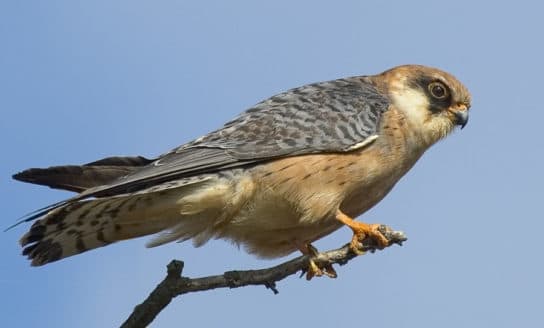
The red-footed fawn is a medium-small, long-winged bird species. The adult male is blue-gray, with the exception of the red underside of the tail and paws. The female has a gray back and wings, an orange head and lower body, a white head with black stripes at the eyes and “mustache”. Young birds are brown at the top, with dark veins below, the pattern on the head is similar to that of females. Cobs are 28-34 cm long, wingspan 65-75 cm.
Natural habitat
The species is found in all types of open areas, bordered by plantations or with rare trees, where there are numerous populations of prey, especially insects. These include:
- steppes and wooded steppes;
- gallery forests along river banks crossing meadows;
- swamps or swamps, peat bogs;
- drained and irrigated fields;
- large forest glades;
- burnt areas;
- parks, gardens, groves (even within cities);
- foothills of the mountains.
Male cats do not build nests, the colonial tendencies of the species shift the choice of habitat towards areas where large birds (for example, corvids) previously bred, suitable nests are seasonally vacated, preferably in the crowns of tall, densely growing trees of any species, broad-leaved or conifers.
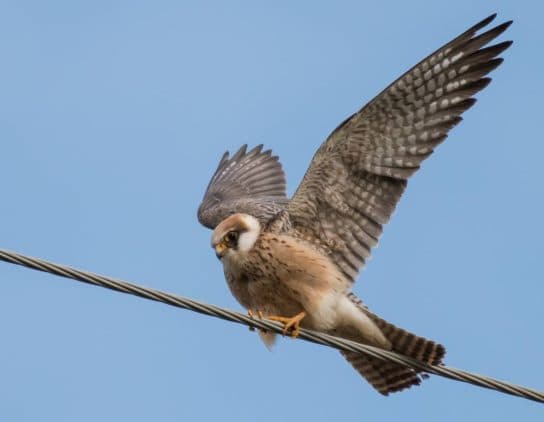
Overhead wires, poles, and other structures use kobchiks to rest between insect hunting sessions.
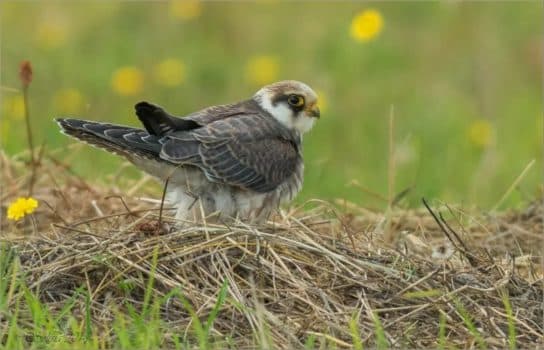
What does the male cat eat?
They feed mainly on insects, but they also hunt small vertebrates, including amphibians, reptiles and mammals. Birds hover, looking for insect clusters. Most of the aerial hunting takes place in the middle of the day, in the morning and in the late afternoon the birds sit on trees or power lines, where they rest and gain strength. In the winter range in southern Africa, they hunt in packs, and small kestrels join the red-breasted cats. Birds feed:
- termites;
- swarms of locusts;
- other food sources.
Reproduction and offspring of fawn
Kobchik breeds in western Eastern Europe, central and north-central Asia, with the main range from Belarus south to Hungary, northern Serbia and Montenegro, Romania, Moldova and eastern Bulgaria, east through Ukraine and northwest to southern Russia and north Kazakhstan, to the north-west of China and the upper reaches of the Lena River (Russia).
Upon arrival at the breeding site in late April, the male will perform a brief show of mating plumage, followed by an easy pairing. Eggs are laid shortly thereafter (within 3 weeks of arrival) and the birds then incubate eggs in large colonies of abandoned (or captured) nests.
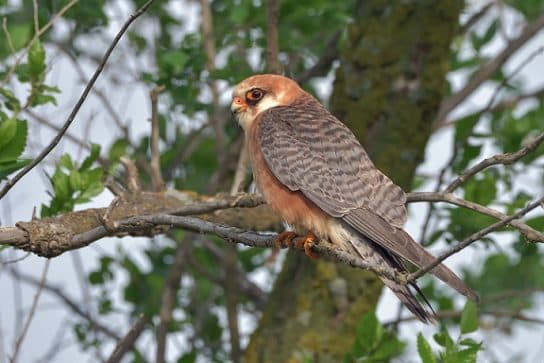
3-5 eggs are incubated by both members of the pair for 21-27 days, starting with the laying of the second egg. Juveniles are born at intervals of 1 or 2 days, fledging after 26-27 days.
Nesting colonies of fawn begin to leave approximately in the third week of August and by the end of the same month the breeding sites are empty.
Where do felines fly in winter
Migration begins in mid-September. The species overwinters in the south, from South Africa in the north to the southern part of Kenya.
The main threats to birds
The total number of felines is about 300-800 thousand specimens, but the latest data indicate that in some regions the number of birds is significantly decreasing. In Europe, there are 26-39 thousand couples (which is 25-49% of the total).
In the key groups of Russia and Ukraine, the number of male cats has decreased by more than 30% over 10 years (3 generations). In Eastern Siberia, this species disappears from the Baikal region.
In Hungary, there are 800-900 pairs, in Bulgaria there are few active colonies. Populations in Central Asia are stable and distributed in suitable habitats (especially in the forest-steppe zone), and there is no evidence that the population is decreasing there.
