


Description
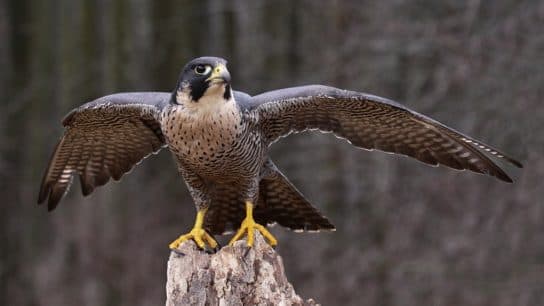
Peregrine Falcon is the fastest representative of living beings on our planet. The size of the peregrine falcon is small. In length, an adult grows up to 50 centimeters, and the weight rarely exceeds 1.2 kilograms. The body shape is streamlined. The muscles on the chest are very well developed. The tail is short. Small at first glance, the beak is actually very sharp and strong, ending in a small hook.
But the most important and formidable weapon of the peregrine falcon is strong and long legs with sharp claws, which at high speed easily rip open the body of the prey. The color is the same for both sexes. The upper body is dark gray, including the head and cheeks. The lower part of the body is painted in a reddish-buffy color interspersed with dark feathers. The wings are pointed at the ends. Depending on the size of the peregrine falcon, the wingspan can reach 120 centimeters. The peregrine falcon has large eyes. The iris is dark brown and the eyelids are bright yellow.
Habitat
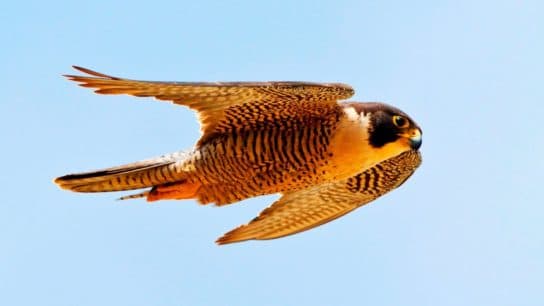
The habitat of this predator is extensive. Peregrine Falcon inhabits the entire continent of Eurasia, North America. Also, most of Africa and Madagascar, the Pacific Islands up to Australia are included in the peregrine falcon habitat. It can also be found in the southern part of South America. Basically, the peregrine falcon prefers open terrain, and avoids the desert and densely planted forests. But despite this, peregrine falcons get along very well in modern cities. Moreover, the urban peregrine falcon can settle both in old temples and cathedrals, and in modern skyscrapers.
Depending on the habitat, peregrine falcons can lead a sedentary lifestyle (in the southern and tropical regions), nomadic (in temperate latitudes they migrate to more southern regions), or be a completely migratory bird (in the northern territories).
The peregrine falcon is a solitary bird and only during the breeding period are they united in pairs. The couple very strongly protects their territory, and will drive away from their territory not only relatives, but other, larger representatives of the feathered world (for example, a raven or an eagle).

What eats
The most common prey for the peregrine falcon are medium-sized birds – pigeons (when the peregrine falcon settles in urban areas), sparrows, gulls, starlings, waders. For a peregrine falcon, it is not difficult to hunt for birds that are many times heavier and larger than themselves, for example, a duck or heron.
In addition to excellent hunting in the sky, the peregrine falcon is no less dexterous in hunting animals that live on the ground. The peregrine falcon’s diet includes gophers, hares, snakes, lizards, voles and lemmings.
It should be noted that in horizontal flight the peregrine falcon practically does not attack, since its speed does not exceed 110 km / h. Peregrine falcon hunting style – pique. Having tracked down its prey, the peregrine falcon rushes down with a stone (making a steep dive) and pierces the prey at a speed of up to 300 kilometers per hour. If such a blow was not fatal for the victim, then the peregrine falcon finishes it off with its powerful beak.
The speed that the peregrine falcon develops during hunting is considered the highest among all the inhabitants of our planet.
Natural enemies
An adult peregrine falcon has no natural enemies, since it is at the top of the predatory food chain.
But eggs and already hatched chicks can become prey both for ground predators (such as the marten) and other feathered predators (such as the owl).
And of course, for the peregrine falcon, the enemy is a person. Developing agriculture, people are increasingly using pesticides in the fight against insect pests, which are harmful not only for parasites, but also for birds.
Interesting Facts
- According to scientists, a fifth of all birds will become a meal for a peregrine falcon.
- During the Second World War, soldiers exterminated peregrine falcons because they intercepted carrier pigeons.
- Peregrine falcons nests are located at a distance of up to 10 kilometers from each other.
- Swans with offspring, geese, geese very often settle near the nesting site of the peregrine falcon. This is due to the fact that the peregrine falcon never hunt near its nest. And since he himself does not hunt and removes all large birds of prey from his territory, swans and other birds feel completely safe.
