


- 1 What This Article Covers
- 2 Understanding the Two Modalities
- 3 Structured Clinical Comparison
- 4 Key Takeaways for Patients and Referring Clinicians
- 5 The Biological Cost: Why Enamel Preservation Matters
- 6 Long-Term Outcomes: What the Evidence Shows
- 7 Expert Clinical Insight: The York House Dental Practice Protocol
- 8 When to Choose Which: A Decision Framework
- 9 Maintenance Protocols: Maximising Restoration Longevity
- 10 Conclusion: Restoring Smiles With Biological Intelligence
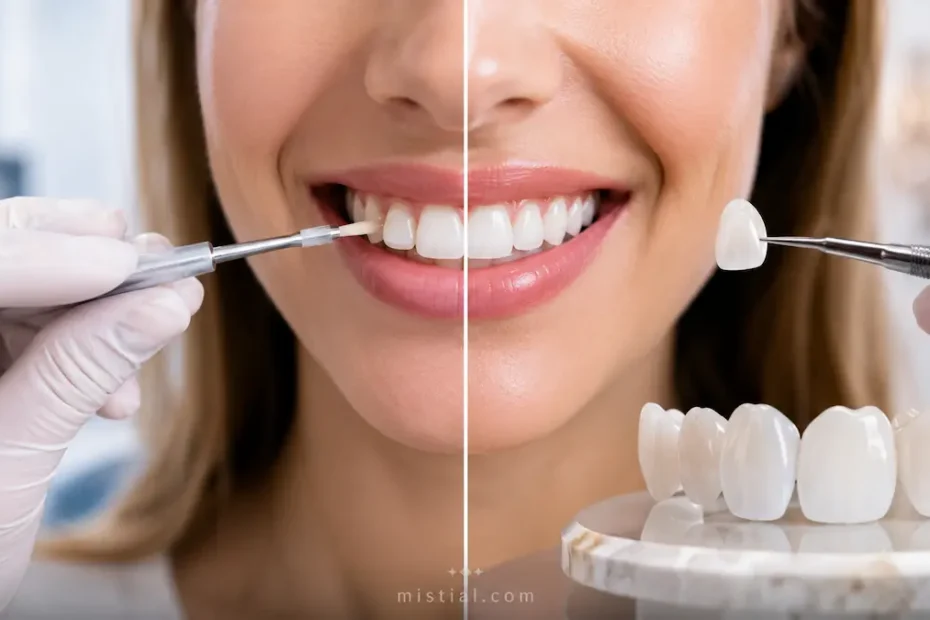
When a patient sits in the dental chair and asks, “Which is better—composite bonding or porcelain veneers?” the honest answer is: it depends on your biology, your behaviour, and your long-term goals. Both procedures sit at the intersection of restorative dentistry and cosmetic dentistry, yet they differ profoundly in terms of enamel preservation, gingival margin adaptation, long-term durability, and biological cost. This guide is written for patients, health editors, and referring clinicians who need an objective, evidence-based framework for decision-making.
What This Article Covers
- The clinical mechanics of composite bonding and porcelain veneers
- A structured comparison of durability, aesthetics, and biological impact
- Enamel preservation protocols and gingival margin considerations
- Long-term cost-effectiveness and maintenance requirements
- Expert clinical insights from the restorative team at York House Dental Practice
Understanding the Two Modalities
Composite Bonding: The Minimally Invasive Approach
Composite bonding involves the direct application of tooth-coloured resin composite material to the facial surface of anterior or posterior teeth. It is typically performed in a single appointment and requires little to no removal of healthy enamel—often described as an “additive” or “no-prep” technique.
Clinical Indications:
- Minor chips, cracks, or fractures
- Closing small diastemas (gaps between teeth)
- Masking mild intrinsic discolouration
- Reshaping peg laterals or uneven incisal edges
- Interim restorations during orthodontic relapse management
Biological Advantages:
- Maximum enamel preservation—often zero preparation
- Reversible in many cases
- Immediate results with no laboratory delay
- Lower initial financial outlay
Porcelain Veneers: The Definitive Restorative Solution
Porcelain veneers are thin ceramic laminates—typically 0.3–0.7 mm in thickness—that are bonded to the prepared facial surface of teeth following minimal enamel reduction. They are fabricated indirectly in a dental laboratory or via CAD/CAM milling and require at least two clinical visits.
Clinical Indications:
- Severe intrinsic staining (e.g., tetracycline staining, fluorosis)
- Significant structural compromise or wear
- Major shape or alignment discrepancies
- Patients seeking maximum longevity and stain resistance
- Cases where orthodontic relapse has caused positional instability
Biological Considerations:
- Requires controlled enamel reduction (typically 0.3–0.8 mm)
- Irreversible—once enamel is removed, it cannot be regenerated
- Superior optical properties mimicking natural dentine-enamel complex
- Excellent gingival margin biocompatibility with polished ceramic margins
Structured Clinical Comparison
| Criterion | Composite Bonding | Porcelain Veneers |
|---|---|---|
| Enamel Removal | None to minimal (0–0.3 mm) | Controlled reduction (0.3–0.8 mm) |
| Procedure Time | Single visit (30–90 minutes per tooth) | Two visits + laboratory time (2–3 weeks) |
| Longevity | 3–7 years (with maintenance) | 10–15+ years (with proper care) |
| Stain Resistance | Moderate—porous surface susceptible to extrinsic staining | Excellent—glazed ceramic is non-porous |
| Repairability | Highly repairable—additions possible chairside | Requires replacement if fractured; cannot be patched |
| Aesthetic Refinement | Good—limited by material thickness and polishability | Exceptional—translucency, fluorescence, and layering mimic natural enamel |
| Gingival Margin Adaptation | Good—requires excellent moisture control | Superior—precision-milled margins with excellent tissue response |
| Cost Per Tooth (UK Private) | £150–£400 | £500–£1,200+ |
| Reversibility | Partially reversible in no-prep cases | Irreversible—permanent enamel alteration |
| Biological Risk | Low—preserves tooth structure | Low to moderate—dependent on preparation design and bonding protocol |
Key Takeaways for Patients and Referring Clinicians
- Enamel preservation should always be the primary guiding principle. When tooth structure is healthy, additive techniques (composite bonding) should be considered before subtractive ones (veneer preparation).
- Composite bonding is not a “cheap alternative”—it is a legitimate, evidence-based modality with distinct indications, particularly for younger patients whose dentition is still maturing or for those with limited financial resources.
- Porcelain veneers represent the gold standard in aesthetic durability but carry the irreversible cost of enamel removal. They are best reserved for cases where structural or aesthetic demands exceed the capabilities of composite.
- Maintenance is non-negotiable for both. Regular hygiene appointments, night guard provision for bruxism, and dietary awareness significantly extend the lifespan of either restoration.
- Orthodontic stability must be confirmed before any restorative veneer work. Placing veneers on teeth with active orthodontic relapse risks is clinically contraindicated and compromises long-term outcomes.
- Gingival margin health is paramount. Both materials can achieve excellent soft tissue integration, but this depends entirely on precise margin placement, polishing, and the patient’s oral hygiene compliance.
The Biological Cost: Why Enamel Preservation Matters
Enamel is the hardest substance in the human body, but it is acellular and cannot regenerate. Every micron removed during preparation is a permanent loss of structural integrity. In restorative dentistry, the principle of minimum intervention—championed by the Minimal Intervention Dentistry (MID) movement—dictates that clinicians should preserve as much natural tooth structure as biomechanically possible.
Composite bonding aligns naturally with this philosophy. By building upon existing enamel rather than removing it, the tooth retains its full structural resilience. This is particularly relevant for paediatric and adolescent patients, where pulpal size and dentine thickness demand conservative approaches.
However, when enamel is already compromised—through erosion, abrasion, or previous restorations—veneer preparation may actually remove weakened structure and replace it with a stronger ceramic laminate. The decision, therefore, is not simply “which looks better?” but “which protects the biological foundation most effectively?”
Long-Term Outcomes: What the Evidence Shows
A 2021 systematic review in the Journal of Dentistry reported survival rates of 91.5% for porcelain veneers at 10 years, compared to 74.3% for direct composite restorations over the same period. However, the composite group showed significantly higher repairability—minor chipping could be addressed chairside without full replacement.
Importantly, veneer failure modes tend to be catastrophic (debonding or fracture requiring replacement), whereas composite failure modes are typically incremental (surface staining, marginal wear, minor chip). For patients who prioritise longevity and are prepared for the biological commitment, porcelain offers superior performance. For patients who value reversibility, lower initial investment, and easier maintenance, composite bonding remains a clinically sound choice.
Expert Clinical Insight: The York House Dental Practice Protocol
According to the clinical director at York House Dental Practice, the decision between composite bonding and porcelain veneers should never be made on cost alone. “We conduct a full smile assessment that includes occlusal analysis, periodontal charting, and digital smile design before recommending any restorative pathway. In our experience, patients who understand the biological trade-offs make better long-term decisions and report higher satisfaction at five-year follow-up.”
The restorative team at York House Dental Practice follows a strict protocol: no veneer preparation without confirmed orthodontic stability, comprehensive periodontal health, and informed consent that explicitly addresses irreversibility. This approach aligns with GDC standards for patient-centred care and ensures that every restoration is placed with the patient’s long-term oral health as the primary objective.
When to Choose Which: A Decision Framework
| Patient Profile | Recommended Modality | Rationale |
|---|---|---|
| Young patient (under 25), healthy enamel, minor aesthetic concerns | Composite bonding | Preserves enamel; reversible; cost-effective; accommodates future orthodontic or restorative changes |
| Patient with bruxism or parafunctional habits | Composite bonding (with night guard) or postpone veneers | Veneers are high-risk in uncontrolled bruxism; composite is more forgiving and repairable |
| Severe intrinsic staining, structural loss, or previous large restorations | Porcelain veneers | Superior masking ability; structural reinforcement; long-term aesthetic stability |
| Patient seeking “trial smile” before committing to veneers | Composite bonding (diagnostic/mock-up) | Allows aesthetic preview; can be refined or converted to veneers later |
| Active orthodontic relapse or unstable occlusion | Stabilise orthodontically first; defer restorative work | Restoring unstable teeth guarantees premature failure; occlusal stability is prerequisite |
| Patient with thin gingival biotype or recession risk | Composite bonding or ultra-thin/no-prep veneers | Minimises gingival margin invasion; preserves papilla architecture |
Maintenance Protocols: Maximising Restoration Longevity
Regardless of material choice, long-term success depends on patient compliance and professional maintenance:
- Professional hygiene every 3–6 months—polishing composite surfaces reduces extrinsic stain accumulation; monitoring veneer margins prevents secondary caries.
- Night guard for all bruxism patients—occlusal loading is the leading cause of veneer fracture and composite debonding.
- Dietary modification—reducing acidic and highly pigmented foods protects both composite resin and natural enamel.
- Avoid using teeth as tools—opening packaging, biting nails, or chewing ice introduces shear forces that neither material is designed to withstand.
- Immediate reporting of changes—marginal staining, sensitivity, or subtle chip changes are early warnings that permit conservative intervention.
Conclusion: Restoring Smiles With Biological Intelligence
The choice between composite bonding and porcelain veneers is not a matter of superiority—it is a matter of suitability. The best restoration is the one that preserves the most enamel, respects the gingival margins, aligns with the patient’s functional and aesthetic goals, and is supported by evidence-based maintenance.
For patients in the UK seeking personalised guidance, a comprehensive clinical assessment remains the only valid starting point. The principles of modern restorative dentistry demand that clinicians look beyond the immediate aesthetic outcome and plan for the decades ahead. Whether through additive composite techniques or definitive ceramic restorations, the goal is the same: a healthy, functional, and confident smile that lasts.
About York House Dental Practice: York House Dental Practice is a private dental clinic based in the UK, offering evidence-based general dentistry, cosmetic dentistry, restorative dentistry, and orthodontic services. The practice is committed to GDC-compliant, patient-centred care with a focus on long-term oral health outcomes. For more information or to book a consultation, visit www.yorkhousedentalpractice.co.uk.
