


This is a typical representative of the bustard family living in the steppe. This name was given because birds can run quickly if danger arises. The bustard is a rather massive bird: it weighs about 16 kg and has a long body that can reach 100 centimeters. The wingspan of the bird is also surprising, since it is about 200 centimeters.
What does a bustard look like
The appearance of birds is quite common. Their wide body, together with a large chest, are supported by three-toed legs, covered with scales and adapted to long-term walking. A small head holds a short neck. The forehead area smoothly turns into a massive beak. The birds have bright red or black plumage with light blotches. Almost all parts of their torso are painted the same color. Sometimes brown specks are found on feathers. There are white feather beds near the beak – this is a unique feature of birds.

Sexual dimorphism is expressed by the size and color of the plumage. So, the male is much larger and more elegant than the female. In males, the body has a coverage of one meter. They weigh from 7 to 16 kilograms and have a long body. In turn, the maximum female weight is 8 kg.
Kinds
There are two types of bustards – European and East Siberian. Today, the population of both is under threat due to the fact that predators eat bird eggs, and humans destroy them due to the development of territories. Their main difference is their habitat, although plumage also plays an important role.
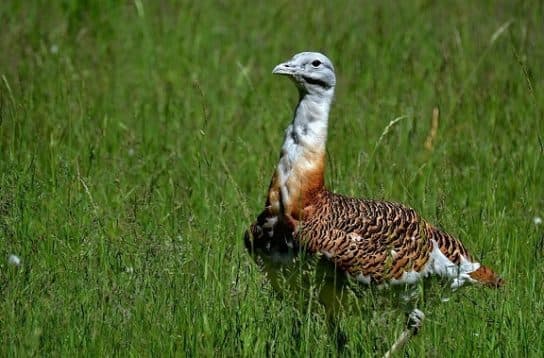
The European bustard is dark in color, combining brown and black. Its habitat is the Rostov region and the Lower Volga region. Sometimes individuals of this species can be found in Iran.
The East Siberian bustard has black stripes on the back and whitish tufts on the head of males, which grow in summer. Representatives of the species can be found in various republics of the Russian Federation: Buryatia, Tyva.
Habitats
They live in northern Europe, northwest Africa and the south of many countries such as China and Russia. Sometimes bustard populations are found in Mongolia or Kazakhstan. They usually live on plains where there is feather grass. The bird does not like too humid lowlands and mountains. Forage meadows are what she needs.

Nutrition
The birds eat very differently. They can eat insects, grains and beetle eggs. The last option is relevant in the spring. Before dawn, birds hunt mice and other rodents or lizards. Sometimes they eat relatives who have been wounded.
In winter, the diet consists of legumes, cabbage plants. These can be various shoots, buds or fruits. In some cases, the bustard eats the roots of wild onions and wheatgrass. Due to the peculiarities of their gastrointestinal tract, the bird cannot eat coarse fibers.

After hunger is satisfied, you need to drink plenty of water. Bustards pay a lot of attention to its quality. They need a cool and fresh liquid without any impurities.
Lifestyle
They lead a terrestrial life, although they can fly. They walk slowly and measuredly. To take off, the animal must scatter and take off with one jump. Gaining height, the birds occasionally, but powerfully flap their wings and eventually gain speed. Food is collected from the surface of the earth and do not like to dig it out from there. Food is caught with a massive beak, one blow of which kills the victim. In order for food to be better absorbed, they eat stones that grind food.
Great bustards are more active during the day, and in the evening they prefer to collect food.
By their nature, they live alone. It is unusual for them to gather in flocks, although during the migration period, this is possible. However, in the colonies there are birds of the same sex. Usually bustards come back the same way, but they do it only during the day.
They are sedentary birds. Sometimes in the north you can see birds flying to other regions for wintering. These are birds that easily adapt to environmental conditions. But their body is not adapted to rain or cold climates, since there is no greasy secretion. For this reason, bustards cannot fly in cold weather. But this is not the only problem. The difficulty lies in the fact that it is difficult to extract food from under the snow, and there is very little game at this time of the year.
Voice
The sounds that these birds make can be called bleating. Males are more talkative and have a hoarse voice. What they say can be called a combination of consonants. Females can send warning signals to offspring in case of danger.
We offer to listen to the voice of the bustard
Reproduction and population
In females, maturity begins at the age of 3, when males are about 5. During the mating period, males have their own territory, where they do not let others in and where they try to conquer the female. Usually, males show the back of the body, cuddling to the ground. At this time, they breathe often, and their head is drawn into the neck, as it were. This technique is repeated every 5 minutes. Great bustards are not monogamous, so they mate with several partners at once.
The nest is equipped in May. This is a hole located in a place that is heavily overgrown with grass. Only the female is engaged in the creation and arrangement of the “home”. With the help of its beak, the bird removes the weeds from the site, and then gives the dwelling a round shape, on the bottom of which the fluff lays.

Chicks
Usually the female clutches 2 eggs, which reach 7 centimeters in length. The shell is greenish with spots of dark colors. It takes about 3 weeks to incubate the chicks, which the female is engaged in. At this time, the male leaves to the place of molting.

The bustard incubates chicks, practically not moving, so as not to lead the predators on the trail. As soon as danger approaches, she begins to pretend to be wounded and tries to run away from the nest as far as possible. The female still leaves the offspring, but only in order to get food.
Youngsters have been exploring the area literally from birth. After 7 days, the mother takes the chicks to the steppe so that it learns to hunt. As soon as the birds are 40 days old, they start flying on their own.
How long do bustards live?
They usually live for about two decades. However, due to the heavy load on the body of males, they die much earlier than females. In turn, chicks die because of agricultural machinery or predators who steal eggs and want to feast on the young.
