


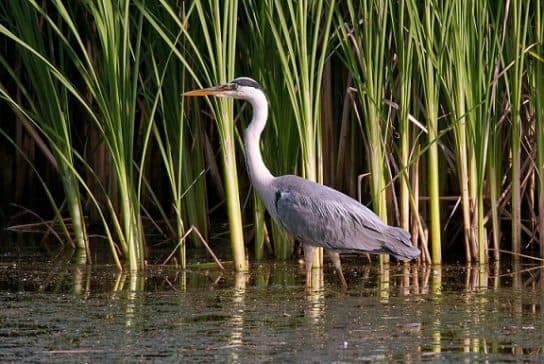


Gray herons are found in most of Europe, and their range extends across Russia east to Japan, south through China to India. Also, gray herons are found in parts of Africa and Madagascar, North America, Greenland and Australia.
Where gray herons make their homes
These herons migrate partially. Birds that breed in areas with cold winters migrate to warmer regions, some travel long distances to reach and return nesting areas.
Herons mainly live near freshwater habitats such as rivers, lakes, ponds, reservoirs and marshes, salt or brackish depressions and estuaries.
Description of the gray heron
Gray egrets are large birds, ranging in height from 84 to 102 cm, including an elongated neck, a wingspan of 155 to 195 cm and a weight of 1.1 to 2.1 kg. The upper plumage is predominantly gray on the back, wings and neck. The plumage on the lower part of the body is off-white.
The head is white with a wide black “eyebrow” and long black feathers that grow from the eyes to the beginning of the neck, forming a crest. Strong, dagger-like beak and yellowish legs in non-breeding adults, turning orange-reddish in mating season.
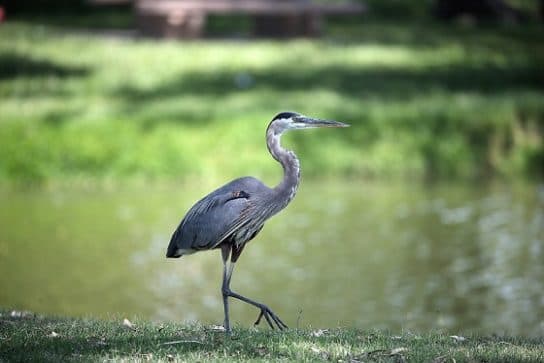

They fly by stretching out their long necks (S-shaped). A distinctive feature is the wide arched wings and long legs hanging in the air. Herons fly slowly.
What do gray herons feed on?
Birds feed on fish, frogs and insects, reptiles, small mammals and birds.
Gray herons hunt in shallow water, stand completely motionless in or near water, waiting for prey, or slowly chase it and then quickly strike with their beak. The victim is swallowed whole.
A gray heron caught a huge frog

Nesting gray herons
Gray herons breed singly or in colonies. Nests are built in trees near water bodies on the coast or in reeds. Herons are faithful to their breeding grounds, returning to them from year to year, including subsequent generations.
At the beginning of the breeding season, males choose nesting sites. Couples stay together throughout the mating season. Breeding activity is observed from February to early June.
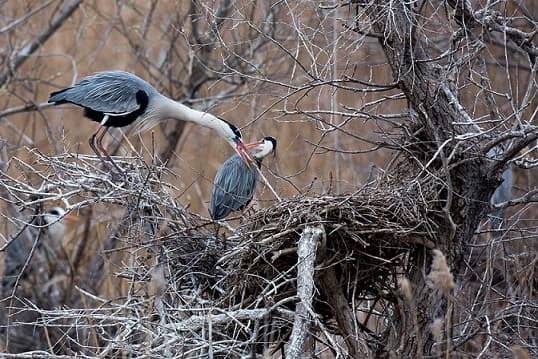

Bulky nests on the platform are built by herons from twigs, sticks, grass and other material that the males collect. Nests sometimes reach 1 meter across. Gray herons nest in crowns of tall trees, in dense undergrowth and sometimes on bare ground. These nests are reused in subsequent seasons or new nests are built on old nests. The size of the nest attracts females, they prefer large nests, and the males fiercely defend the nests.
Females lay one or as many as 10 eggs in the nest. The amount depends on how favorable the conditions are for raising young animals. Most nests contain 4 to 5 light blue-green eggs. Parents take turns incubating eggs for 25 to 26 days before chicks emerge.


Gray heron chicks
Cubs are covered with down, and both parents take care of them, protect and feed the regurgitated fish. Loud clicking sounds of hungry chicks are heard during the daytime. At first, the parents feed, regurgitating food into the beak, and later on to the nest, and the chicks compete for the right to eat the prey. They push rivals out of the nest and even eat up dead brothers and sisters.
Chicks leave the nest after 50 days, but remain close to their parents until they are self-sufficient after a few weeks.
How long do gray herons live?
The oldest heron lived for 23 years. The average life span in nature is about 5 years. Only about a third survive to the second year of life; many gray herons become victims of predation.
Gray heron – video


