


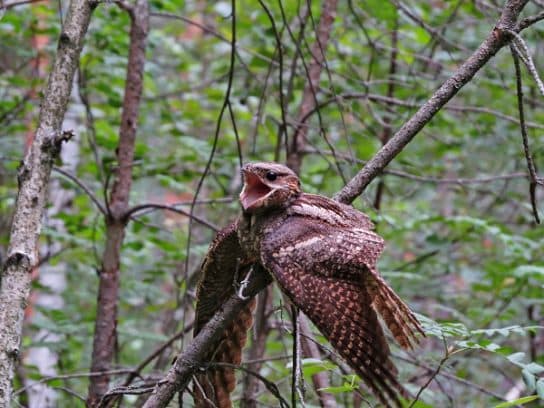
The mysterious and often invisible nightjar is the only member of this mysterious family of birds. The nightjar flies to the nesting sites from the end of April, but more often in May, the first sign of return is a terrible tweet song, which the male sings on branches on its territory.
How the nightjar sings
Each song passage lasts several minutes, with a number of shorter but faster trills lasting about half a second. The bird emits these short trills when it takes breath. This explains how she sings for so long without stopping. These couplets contain about 1900 notes per minute, and birdwatchers can distinguish individual birds by analyzing the frequency of trills and the length of the phrases.
We invite you to listen to the voice of the nightjar
What nightjars eat in nature
Insects, especially moths and beetles, make up a large part of the nightjar’s diet, so this species mainly feeds at dawn and dusk, when insects are most active. Nightjars are similar in appearance to falcons, and just like these birds of prey, they are capable of quick turns in the air and dive.
Nightjars have two main feeding methods:
- “Trawling”, when the bird flies back and forth, catches insects that come across on the way;
- “Attack”, the bird sits on a branch and waits for a butterfly or beetle to fly by.
Nightjars have unusually large, wide slits on their beaks, around which tough “bristles” – virtually feathers without feathers – grow around which help the birds successfully catch their prey.
How nightjars see, features of vision
All birds have keen eyesight, large eyes are located on the sides of the head, which provides a good all-round view. There are no cones on the retina, as birds do not need color vision and instead have layers of motion-sensitive rods. The membrane layer behind the retina, called the tapetum, reflects the light that the rods have passed through the retina, giving the nightjar’s eyes extra sensitivity. It is this layer that makes the bird’s eyes shine under artificial lighting.
The mating games of the nightjars
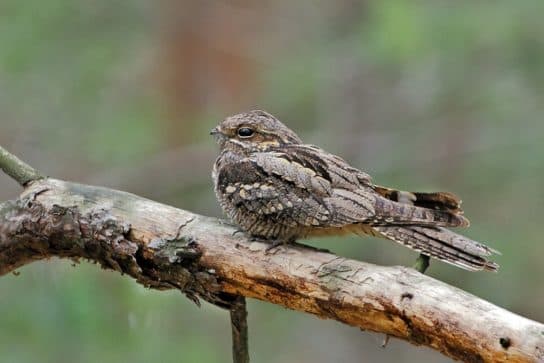
When courting, the male flies in an “attacking” style, alternating slow flapping of wings with occasional flaps of wings, gliding with raised wings and tail down. During this ceremony, white spots are clearly visible near the tips of the wings and under the tail of the male. If the moon is full in early June, then the nightjars mate closer to that date. This ensures that by the next full moon, conditions are best for catching insects to feed the young.
Whether the nightjars are threatened with extinction
The number of nightjars is estimated at 930,000–2,100,000, but numbers and numbers are declining, especially in the Northwest and North of Europe. The decline in wasteland and the number of insects are probably the reasons for the disappearance of nightjars from some regions, but the population is now increasing again.

How to find a nightjar in its habitat
Low-lying wastelands and newly deforested areas are preferred habitats for this species. Nightjars usually become active around dusk, singing for an hour after sunset and again before dawn. They can be heard at a distance of at least 200 meters, and sometimes up to a kilometer. Warm and dry nights are the best time to listen to the nightjar chant.
Birds often arrive and inspect the guest. Soft flaps that mimic wing flaps attract nightjars, but the most successful method is to wave a white handkerchief at arm’s length. This movement imitates the flapping of the male’s white wings and will attract the bird. Do not use recordings with singing nightjars, as this negatively affects their reproduction.
