


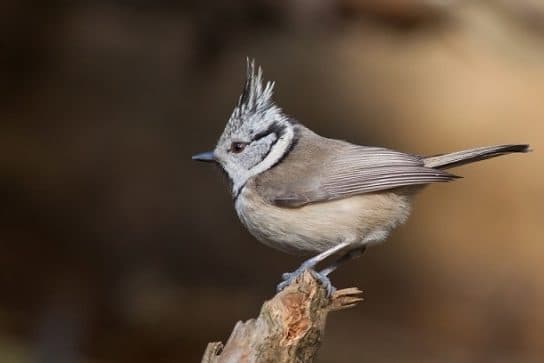
This small bird is predominantly gray-brown in color with a raised crest.
Appearance
Thanks to her characteristic crest, she was awarded another name – the grenadier. Most of the body is of a monochromatic brown-gray color. However, there is a small dark stripe that extends from the anterior edge of the eye and, not reaching the base of the beak, continues behind the eye in the region of the ear feathers. Thus, it forms a contrasting black crescent against the background of white facial feathers. The nape of the crested tit is black, and there is a small dark speck on the throat. The area of the abdomen and head is off-white. When the grenadier is aggressive, you can see how she stretches her neck forward and presses the crest to her head. In size, the crested tit reaches no more than 14 centimeters in length, and its weight barely reaches 14 grams.
Sexual dimorphism consists in a short crest and narrow lateral patterns of the female.

Habitat
The largest population of the crested tit has spread over the territory of the southern Trans-Urals and the entire European region of Russia. Many types of grenadiers are found in the Ukrainian Carpathians. In Europe, the crested tit can be found in Central Europe and Scandinavia, in the south this bird is extremely rare.
As a habitat, the grenadier prefers coniferous forests, but can also settle in mixed ones. They prefer to choose an area without dead spaces.

Nutrition
The basis of the diet of crested tits consists of various insects. In particular, caterpillars that inhabit the trunks of coniferous trees are their favorite food. In addition to caterpillars, grenadiers can eat invertebrates such as butterflies, spiders, leaf beetles, wasps, bees, weevils, mosquitoes and flies. From autumn to winter, seeds and berries are eaten, such as fir, mountain ash, spruce, juniper and dogwood. In the spring season, do not mind eating birch or maple sap.

Reproduction
Grenadiers prefer to equip nests in the thick of the coniferous forest. Hollows, stumps or small holes between trees are chosen as a place for arranging nests. If the bird does not find a suitable place for itself, it can populate the abandoned nests of other animals. The bird covers the bottom of the nest with moss; it can use rolled squirrel wool. The period of incubation of eggs lasts no more than 16 days. As a rule, the female lays 6 eggs on average. The incubation period begins in May. The eggs are small in size, solid white in color, without distinctive spots. The hatched chicks remain in the nest for another three weeks. At this time, the female feeds them with caterpillars. The male helps in finding food for the offspring. Feeding can last up to 22 days.
After the cubs of the crested tit fly out of the nest, the parents can periodically feed them for another month.
Lifestyle
Many crested tits move among conifers in small flocks. Also, these birds are extremely fast and active. Rarely are grenadiers who can sit in the same place for a long time. In order to survive the winter, crested tits can fly closer to the gardens, where they feed on grain. In summer they form pairs and fly away to coniferous forests.
