


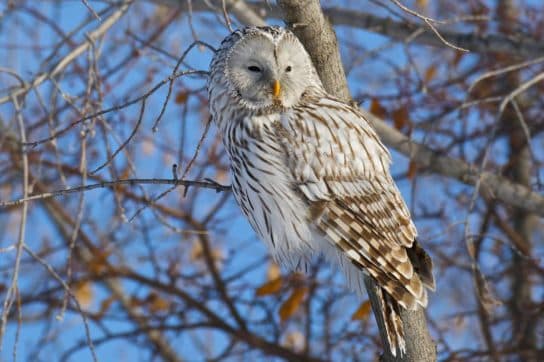
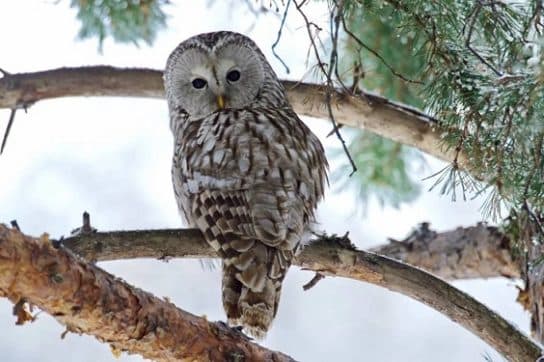
The long-tailed owl has a second name “Ural owl”, since the first time this representative was found on the territory of the Urals. The Long-tailed Owl is a rather large bird of the genus of owls. The body size ranges from 50 to 65 centimeters in length, and the wing size can reach 40 centimeters with a span of 120 centimeters. The upper part of the body is predominantly brown in color with spots of white and dark shades. On the lower part of the body, the color is grayish with brown veins. Feet are thick, gray-brown in color and feathered up to the nails. The facial disc is gray, framed by a black and white border. It has large black eyes. The long-tailed owl got its name due to its noticeably long wedge-shaped tail.
Habitat
The population of the species of the Ural or Long-tailed Owl extends over the territory of the Paleoarctic taiga. Many representatives settled in the area from Western Europe to the shores of China and Japan. In Russia, the species of the Ural owl is found everywhere.
As a habitat, this representative prefers large forest areas, in particular, coniferous, mixed and deciduous forests. Some Ural owls were found in wooded mountains at an altitude of up to 1600 meters.
The voice of the great-tailed owl
Nutrition and lifestyle
The Long-tailed Owl is active at night, usually at dusk and dawn. Spends daytime next to trees or in the thick of foliage. Due to its physiological characteristics, the owl is an excellent predator capable of completely silent flights. This feature is due to the fact that the feathers of the long-tailed owl have a distinctive structure. The edges of the wings are not smooth, but have flight feathers that muffle the gust of wind. The main prey of the long-tailed owl is the vole, which makes up 65 or 90% of the bird’s diet. In addition to voles, the owl can hunt shrews, rats, mice, frogs, and insects. Some great-tailed owls can feed on small birds.
Reproduction
Long-tailed owls use tree hollows, rock holes or the space between large stones as nests. Some representatives use empty nests of other birds. The female lays 2 to 4 eggs in the chosen nest. This period falls on the spring season. The incubation period lasts about a month. During incubation, the male’s role is reduced to finding food for himself and his female. During this period, the Owl is extremely aggressive and cautious. Chicks mature 35 days after birth. After another 10 days, they are able to fly well and can leave the nest. However, up to 2 months of age, the long-tailed owl chicks are under the control and protection of their parents. They become sexually mature only at the age of 12 months.
Population and status of the species
The number of long-tailed owls becomes much less in regions where there is a decrease in the population of murine rodents, which make up 90% of the owl’s diet. The species is included in the IUCN and Russian Red List.
Keeping the Owl at home
