


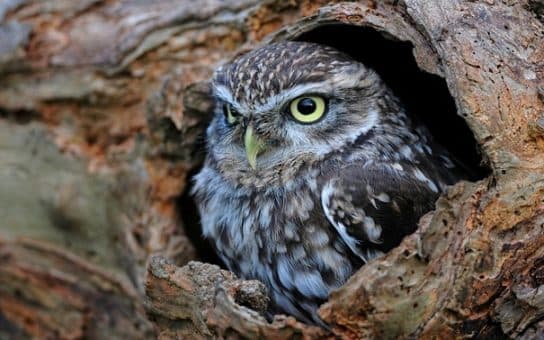
The little owl got this name for a reason. This representative of the owl family is often seen as a pet. Due to its small size, this representative fits perfectly into the home environment.
Appearance
The body length of the house owl is no more than 25 centimeters long, and these birds weigh an average of 150 grams. Outwardly, this representative is distinguished by a gray-brown color of feathers and the absence of feather ears. The feathers are decorated with white specks along the back. The owl’s head is very small, but the neck is extremely flexible, which can be rotated up to 180 degrees. This feature is associated with the immobility of the eyes. The iris of the eyes is bright yellow with a large pupil.
The beak is small brown or yellowish. The body is streamlined, helping the owl to move easily in space. The owl’s wings are only 15 centimeters long. The tail is rather small. Due to its lush plumage, the bird looks larger and fuller. The owl’s legs are short and covered with feathers up to the claws. Claws, like most representatives, are sharp and strong.

Habitat
The house owl population is widespread everywhere, except for the South and North Poles. It is found in all European countries, including inhabited many territories of the Russian Federation. The bird feels comfortable in Asia, America and Africa. The little owl is not found in mountainous areas and lowlands. Often chooses a vast empty area where it can successfully hunt for prey. The little owl loves residential settlements in which it builds its nests. If the bird is tamed as a pet, then for its comfortable existence an entire room is allocated or aviaries are built.

Nutrition
Like all representatives of the owl family, the little owl belongs to predators. The hunting period begins in the evening and ends at sunrise. If necessary, it can fly out for daytime hunting. In search of prey, house owls freeze on branches and await the approach of a potential victim. Their victims include such small mammals and insects as:
- Frogs;
- Snakes;
- Lizards;
- Voles, shrews, small mice and rats;
- Moths, insect larvae, locusts.
If the house owl finds a victim, he begins to hover over it for a long time, calculating the right moment to attack. Finding a prey, the owl falls on it and grabs it with sharp claws, not giving the animal the slightest chance.

Lifestyle features
House owls are very brave birds. However, being close to a person, the bird very quickly gets used to it and becomes non-aggressive. Thanks to this character, the little owl has become a good friend of man. Birds love to play and mistake humans for their flock.
In the wild, the owl activates and prepares food supplies for the arrival of winter. Depending on their character, house owls can live in pairs or alone. Sometimes a small group of owls is chosen to hunt, so they can capture larger prey.
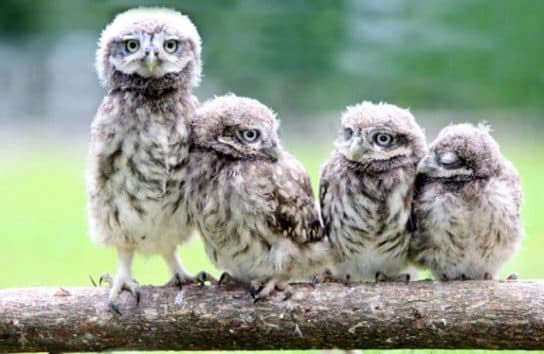
Owl chicks
Reproduction
The breeding season for house owls begins in spring. Young males, in search of the chosen one, arrange a whole performance. The male makes loud sounds, gets food and arranges demonstration dances for the female. In the event that the female agrees, their pair remains for many years. The female lays 4-5 eggs and incubates them for 22-28 days. At this time, the male goes in search of food for himself and the female. Chicks are born very tiny with a weight of no more than 10 grams. The first week, the female spends all the time with her chicks. When the chicks get stronger, their parents go hunting together in search of prey for the whole family. Already on the 40th day, the little chicks are ready to leave the nest.
Some parents push their young on their first foray. Ripe chicks are able to form small flocks, which keep until the moment of pair formation. The lifespan of the house owl in captivity can reach 12 years.
Enemies of the Little Owl
Such a small representative of owls is often endangered by larger predators. Since these birds are quite fearless, they very easily become prey for such animals as eagles, kites, foxes, weasels or ermines. Despite its size, the little owl is quite strong. He can repulse enemies with his tenacious claws and sharp beak.
