


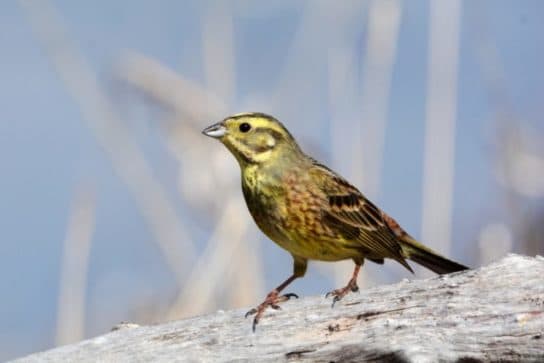
Buntings live all year round in the Middle lane. From the northern regions in winter they migrate to warmer regions. Buntings love bushes and hedges.
They look like finches, but they are still distinguished due to a slightly different beak structure and a flatter head. Long bodies and tails lend a memorable look.
Unfortunately, over the past 25 years, the population has decreased significantly, and therefore some buntings are listed in the Red Book. To a large extent, depopulation is associated with changes in agricultural practices. Sowing cereals in autumn reduces the fodder supply in winter.
Buntings live in open areas, feed on the seeds of sown grasses and invertebrates. They extract seeds from the hay they feed their livestock.
Types of oatmeal
Common oatmeal
Dubrovnik
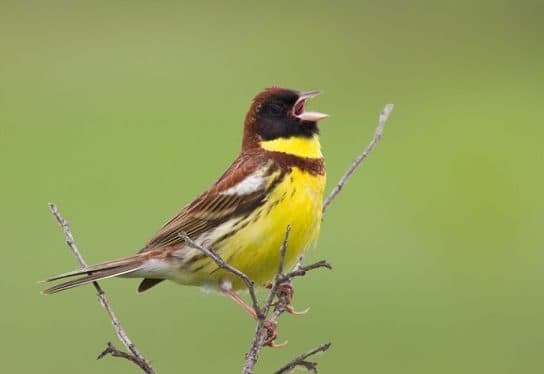
Bilious oatmeal

Red-billed bunting

Prosanka

Yellow-browed bunting

Mountain bunting

Gray oatmeal

Garden oatmeal

Yellow-throated bunting
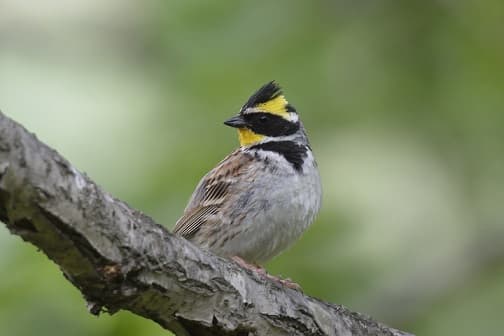
Garden bunting
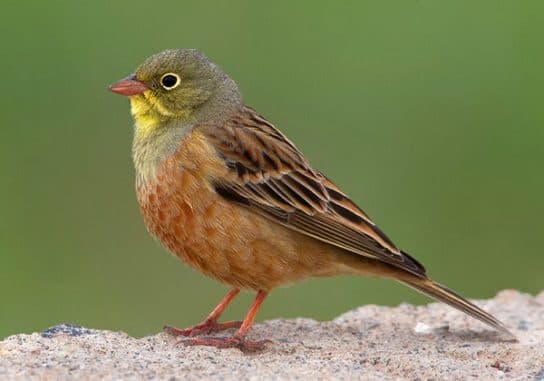
Yankovsky’s oatmeal

White-capped bunting

Black-headed bunting

Oatmeal crumb

Oatmeal-Remez

Reed Bunting

Japanese oatmeal
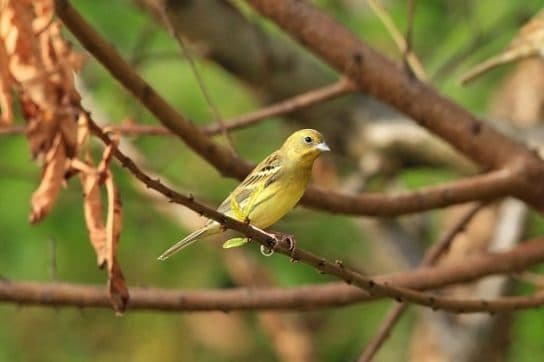
Taiga bunting

Features of the appearance of oatmeal
Buntings are similar in size to sparrows, but their tails are longer. The male has a bright yellow head and lower body, a dark striped mantle. The female has a predominantly brown color, more stripes on the head and upper body, some yellow feathers on the belly. Both sexes have white tail feathers, and the chestnut-colored hindquarters are noticeable in flight. The eyes and paws are dark, the tail is long, bifurcated.

Where do buntings live
Bunting breeds in Eurasia, from Britain east to Siberia and south to the Mediterranean. Many birds from northern populations winter in North Africa, the Middle East, and southern Asia.
Oatmeal lives in open areas, on agricultural land with ditches and hedges, pastures with shrubs and trees, stubble, and cultivated fields infested with weeds. Buntings are also often seen in urban gardens and parks outside the breeding season, especially in areas where grass seeds have recently been sown. The birds are common in coastal habitats, grasslands, but rarely nest in alpine areas. It is found mainly at sea level up to 600 m, sometimes up to 1600 m.
How buntings breed
Birds, as a rule, make double clutches of eggs during the mating season and defend the territory for a long breeding period. Nest is on the ground or close to the ground in tall grass or dense bushy vegetation. The shape of the nest resembles a cup of dry grass covered with fine fibers inside. The female lays 3-5 pinkish-white with dark brown scrawl and spotted eggs. The offspring is mainly incubated by the female, the chicks are fed by both parents with invertebrates for 12-13 days and approximately 3 more weeks after plumage.
How oatmeal behaves
Birds spend most of their time on the ground, in pasture, plowing, crops and stubble, on lawns and in gardens. Buntings are monogamous during the breeding season, but they gather in flocks ranging in size from a few individuals to thousands of birds outside the mating season. They often fly in mixed flocks with other species, including finches, goldfinches, and sparrows.
Males sing from a prominent branch or perch during breeding, such as at the top of a tree or on power lines. If the nest is destroyed by predators, then the parents “go crazy”, fly and scream.
What do oatmeal eat

The bird uses a long, pointed tongue to collect and eat many ants at one time. But birds don’t only feed on insects. The bunting sits on the nest and allows the ants to crawl on their wings. Scientists believe that the acid secreted by ants fights parasites.
They feed on oatmeal seeds:
- barley;
- ryegrass;
- dandelion;
- amaranth.
Buntings hunt for:
- grasshoppers;
- moths;
- caterpillars;
- flies;
- Zhukov;
- aphids;
- bedbugs;
- cicad;
- spiders.
How long do birds live
Buntings live on average for 3 years, but there are scientific records of birds that lived up to 13 years.
