


Crake, or, as it is also called, dergach is a prominent representative of the shepherd family. Its small size allows not only to hide in the grass, but also to move around in it without any problems. And it was her secrecy that made this bird a desirable trophy among many hunters.
Description
Typically, corncrake nests in wet meadows, always with tall grass, in swamps with dense bushes, arable land and even open landscapes across Eurasia – with the main population breeding in Russia. However, the bird is migratory and winters in the savannas of Africa, its southeastern part.
The corncrake is nocturnal, practically not protruding from the thickets chosen by it, it flies very reluctantly (and only out of strict necessity), but during flights it is able to cover significant distances of thousands of kilometers.
Despite the fact that the corncrake is almost impossible to meet alive, since the bird does not go out into open spaces, its voice perfectly outlines the place of its nesting – in calm weather, the cry “derg-derg” (from which, probably, the name of the species has gone) is carried at a distance of up to 2 kilometers.
Listening to the voice of the corncrake
Usually, the call of the corncrake can be heard in late spring – in May and early June – this is how males attract the female and mark their habitat, from evening to early morning. The rest of the time, the bird behaves silently, especially during the wintering period, so as not to attract too much attention from its enemies.
Corncrake is not in vain afraid: after all, poultry meat has pleasant taste, and hunting for it is an interesting entertainment due to the secrecy and behavior of these chickens.
Many naturalists note that the structure of an adult corncrake is very reminiscent of a chicken that is familiar to everyone in adolescence. The size of a bird can be compared to a quail.
Appearance
The corncrake has a miniature body with a streamlined shape, and its modest grayish color with longitudinal tan marks in the upper part and a light abdomen perfectly suits the task of conspiracy.
Females differ from males in color of the chest and head, which are buffy, while in males these places are painted in the same way as the whole body.
The peculiarities of the physique and color of the dergach give the bird the ability to move quickly and dexterously in the thickets of plants, maintaining speed and dexterity. On the ground, the bird feels much more confident than in flight, which it resorts to in the most extreme case. Seeing the danger, the corncrake is able to fly over a relatively minimal distance, in order to then hide in the herbs in a favorite way, which, according to some scientists, gave the name to the species: twitching, running, stretching out its head. For this, nature has awarded this species with thin, long legs, very strong, the task of which is to run quickly in tall grass.
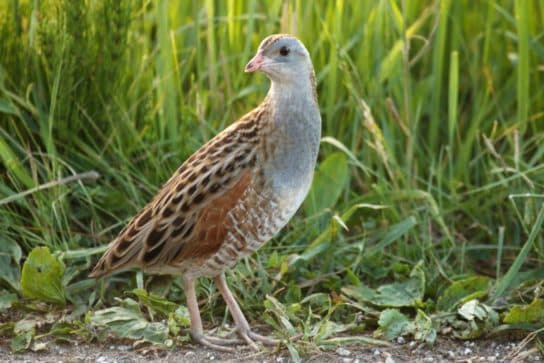
Crake is not the largest bird – its size coincides with the size of a quail: the body is up to 30 cm long, and the weight is up to 200 grams. Due to its conspiratorial abilities, the bird has a fairly significant lifespan – up to seven years.
An elongated neck, a rounded head, a strong conical beak, and a relatively short one (shorter than that of a shepherdess, but larger than that of a quail) – everything in the dergach helps him to lead his usual secretive lifestyle.
Males are slightly larger than females and differ slightly in color: they can be immediately distinguished by the grayish color of the head and chest – but only during the breeding season. At other times, the color lightens significantly and acquires ocher tones to match the body.
It is interesting that during the mating season, males are able to achieve a female and sing songs for more than a month, both night and day. Only a weather cataclysm in the form of a drop in temperature or significant gusts of wind can prevent this madness.
Habitat
The corncrake prefers to inhabit and nest in Eurasia (forest and steppe zones), and even penetrates into Transbaikalia. It is also found in the northern territories – from the Russian taiga to Norway. To the south, the place of its distribution captures Italy, Greece, Iran, Kazakhstan, Altai and even South Africa.
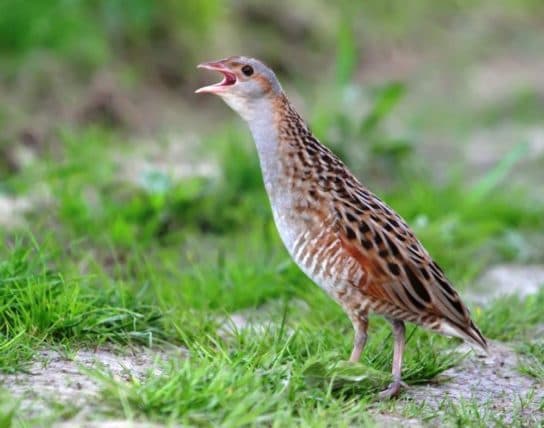
This species of birds prefers to nest in semi-open landscapes, taking a liking, first of all, to meadows with tall grasses, thickets and bushes. He also does not neglect agricultural fields – grain, potato, clover, as well as forest clearings, swamps, steppe and alpine meadows.
He loves places with tall grass, but, unlike reeds, avoid long-term puddles and open spaces. In Africa, it prefers savannas with high vegetation; in China, it can settle among flax.
Diet
The diet of the corncrake is diverse – it is mixed, but still with a preponderance towards animal products. Invertebrates form the basis of the diet: worms, spiders, snails, beetles, insects and even some pests such as clickers and mosquitoes. Rarely, the dergach catches small mice and frogs.
The corncrake reproduces several times a year, for which it arranges a nest in a convenient hollow (preferably in the shade and with comfort). In the clutch of a bird, you can find up to 15 greenish eggs with red dots. Interestingly, males do not take any part in raising offspring.
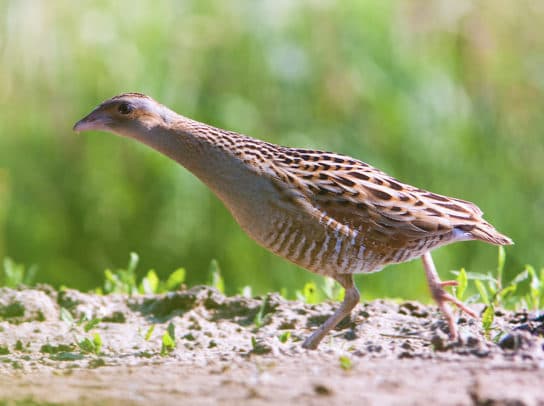
Reproduction
For a long time, the Red Book considered the corncrake a vulnerable species, but gradually the situation began to improve, and new information on the number of this species appeared in Europe. This was facilitated by a significant change in the hay collection technology, which previously caused the death of a significant number of clutches.
During the breeding season, corncrake are significantly territorial, but they prefer to settle in small groups of several families, despite the large number of unoccupied territories.
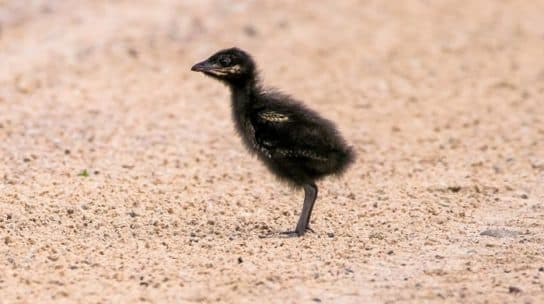
Scabies chick
At the same time, the males shout out, outlining the opportunity to protect their territory and family. Although the concept of a family in dergachi is conditional – these birds are polygamous, both males and females. Those. are in constant search of a new partner. That is why the males look after on their territory, and the females calmly move around any territory, since they are not a threat. Well, after the breeding period, the boundaries are erased – and already males have the opportunity to calmly move in search of food and shelter.
