


These are amazing birds belonging to the hawk family, which suggests that they are predators. They live in Eurasia, England and even in some territories of the African continent. Usually, small reservoirs or lakes, where there are thickets of reed mace or reeds, become their refuge. There are about 5 species of these unusual hawk-like species in Russia.
Description
Marsh harriers have a beautiful dark beak, which is about 2 centimeters long. The color of the male is predominantly brown, although the feathers on the neck and head are yellowish. The abdominal region is usually rust colored interspersed with yellowness. Their weight is small – usually it is 500 grams. Females are less visible and have a grayish head, chest with yellow-brown stripes. They weigh more than males, namely about 800 grams. Basically, the body reaches 40-60 centimeters in length, and the wingspan can reach almost half a meter. Birds have binocular vision, but it has a significant drawback: to see side objects, you need to turn your head.

Kinds
There are many species of this bird, although 2 of them have disappeared from the face of the Earth forever. So, now there are the following:
- Swampy moon. This type is more common among the rest.
- Circus assimilis. Representatives of the species live in the territories of Australia and Indonesia. They are called spotted because of the small blotches of white on the feathers.
- Circus Approximas. They are called Australian Marsh Harriers. A special feature is the gray end of the wing feathers.
- Long-winged harrier. Populates South America. It has long feathers on its wings that help it find food more efficiently.
- Circus Cyaneus. This is a harrier that lives in Eurasia. They can be found both in the Alps and Kamchatka.
- Circus Cinereus. Gray Harrier from South America.
- Circus Macrosceles. Marsh Harrier from Madagascar. He also lives in the Comoros.
- Circus Macrourus. Steppe Harrier. It can be seen on the territory of Kazakhstan and Mongolia.
- Circus Maurus. Black Harrier living in Africa. Creates nests in South Africa and Namibia.
- Circus Maillardi. Lives on Reunion Island. It is considered endemic.
- Circus Melanoleucos. It lives mainly in Asia, you can find it in Transbaikalia or in the Amur territories.
- Circus Rygarus. Meadow Harrier that lives in Eurasia. Nests and catches prey all over Europe. He prefers to spend the winter in India.
- Circus Spilonotus. This is a harrier that lives in the East. Creates nests in the field, both in the Ural Mountains and Baikal.
- Circus Ranivorus. It winters in the south and center of Africa.
- Circus Spilothorax. Lives in New Guinea.
Lifestyle
The harrier is a migratory bird. However, in Spain or Turkey, you can find populations that live sedentary. Thanks to good living conditions, they refuse to migrate.
The journey to the wintering grounds starts in the autumn, usually they do not gather in flocks for this. The only union they made is a couple. And then it does not exist for more than one season.
Birds tend to choose similar terrain for nesting and wintering periods. So, these are flooded meadows or fields created for the needs of agriculture. They got their name precisely for their love for thickets of reeds.
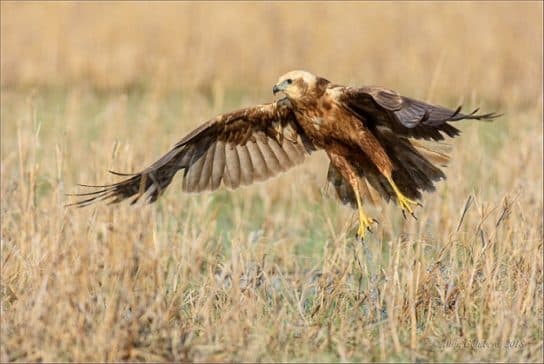
Nutrition
It is quite varied. Moons can feed on ducklings or other people’s chicks, fish or birds. They also eat rodents and reptiles. Where there are many mice and hamsters, animals will eat only them. When the period of rearing of offspring begins, these animals attack waterfowl, such as the sandpiper. During the period of nest creation, harriers can attack migratory birds. Sometimes attempts end in success, but this usually happens when the victim is sick. A bird to hunt, almost silently flying over the game, which the predator has been looking out for for a long time. In each region, the diet is different, for example, in Germany, individuals prefer voles, and in Holland, rabbits are popular.
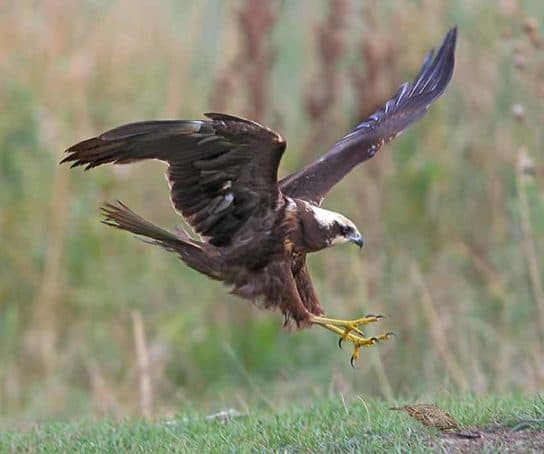
Marsh Harrier hunting
Voice
They emit something like a chirp with a nasal echo. During the mating period, the male publishes “kwya-kvi”, and the restless female produces something similar to the “yukuka”. Chicks that ask for food make a whistle.
The voice of the swamp harrier
Reproduction and population
In spring, birds fly to nesting sites. First, their goal is to recuperate after a long journey, and then the period of finding a pair begins, if it has not yet been created. It is important to note that their marriageable age is 2-3 years.
In these unions, of course, there is a special mating behavior. The birds soar in the air together, making incredible maneuvers. After this, the time immediately comes to start working on the nest. The most favorite place for the harrier is the reed thickets. Each year they are based in approximately those territories where they have already nested.
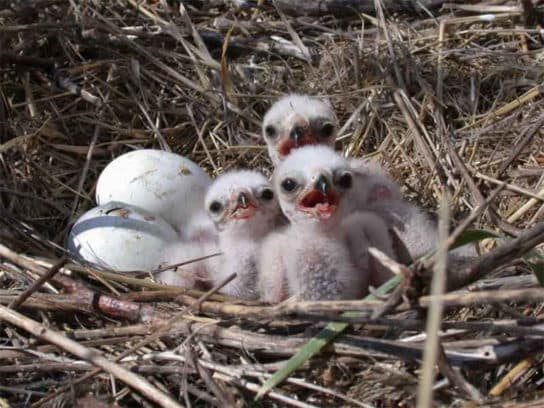
Marsh Harrier Chicks
It is mainly the female who creates the nest. The male also helps by bringing material for construction and feeding the female. The breeding place of the offspring consists of branches and is covered with dry grass and is located close to the water, but about two hundred meters from someone else’s nest. It performs the function of protecting chicks. To do this, it is made very invisible even in places where there are no trees or tall grass.
Towards the end of April, the female lays eggs. Their number varies, but usually it is 4 eggs. After 20 days of waiting, the first chick breaks through the shell. The others keep up with him. They weigh about 40-50 grams and are therefore helpless. It is important that the killing of the weak is not practiced by this species.
First, the offspring and the female are fed by the male and only then the female herself begins to look for food. Sometimes they are able to fly 5 kilometers away from the nest.
At the end of June, chicks begin to fly out, but before that, their food falls on the shoulders of their parents. Young individuals try to attack adult birds and in case of failure they ask their family for food. At the end of summer, broods gradually disintegrate, and already at the beginning of autumn, females stop giving birth and feeding children.
The planned autumn migration usually begins in September. Lone chicks sometimes linger and fly away later. The birds still have about 13 years in stock – this is how long the harriers live.
Their population is now going through difficult times due to the extermination of the individuals themselves and the degradation of habitats.
