


Appearance
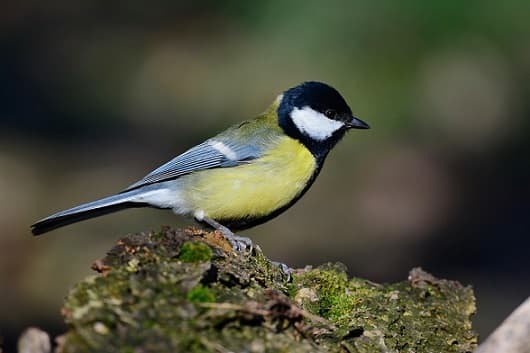
The peculiarity of this bird lies in the bright yellow color of the abdomen with a characteristic black stripe in the middle, reminiscent of a tie. The plumage of the head is black, which contrasts with the white cheeks and olive-greenish back. The color of the tail and wings has a bluish tint.
The bird has a small, slightly flattened on the sides, beak. Sharp claws are located on the paws. The body size of this representative is slightly larger than that of sparrows. Due to its size, the bird received the nickname “big”. The body length reaches 20 centimeters and weighs up to 20 grams.
Great tits belong to the order Passeriformes and the Tit family. Sexual dimorphism is very weak. The female can be distinguished by a duller plumage and a grayish tint to the chest and head. However, the color of tits can vary depending on their range.
Habitat
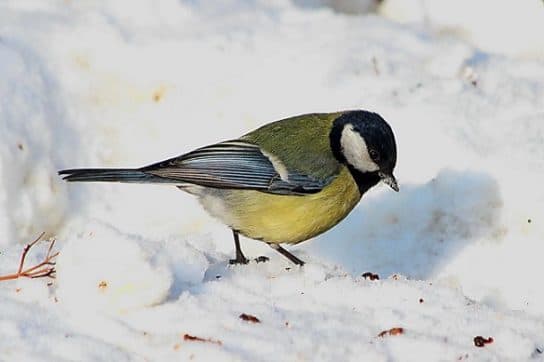
The great tit population has spread throughout Eurasia and Northwest Africa. This representative can be found in forests, gardens, parks and spacious open areas. They love to inhabit the edges of deciduous forests. Birds do not mind settling on the territory next to people. They move to cities with the onset of winter, due to the difficulties in obtaining food in the wild.
Nutrition
Great tits prefer to feed on caterpillars during the warm season. This is one of the rare representatives that can easily cope with the hairs of caterpillars, which are saturated with a dangerous poisonous substance (list of poisonous caterpillars). In order to safely feed on caterpillars, the great tits clamp it with their paws and make a small side hole with their beak, and then suck out all the insides of the victim through it.
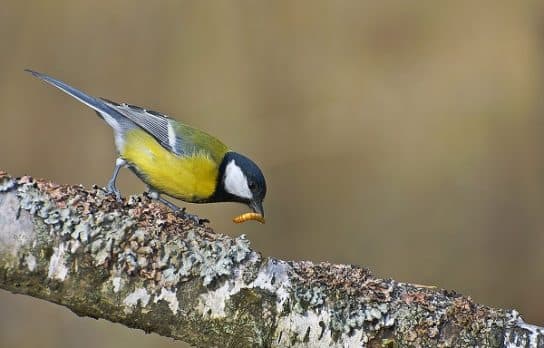
It is noteworthy that some great tits have gotten used to pecking at milk bottles during a hunger period. In cities, birds do not hesitate to eat food that is placed in the feeders. For example, they easily cope with lard and frozen meat.
By themselves, these representatives are absolutely omnivorous. Their diet can also include various beetles, spiders, eggs of butterflies and flies. From plants, the great tits of hunting consume berries and fruits of the plants.
Lifestyle
Great tits are not migratory birds by nature, but are forced to move to cities to survive the winter. By themselves, they are extremely restless and constantly move from branch to branch. Jumps between trees. In late spring titmits look for food on deciduous trees, and in autumn they move to coniferous forests. The voice of a great tit, similar to the ringing of a bell, is noteworthy. In total, there are up to 40 variations of the great tit sound. They can also combine sounds into one song by slightly changing the timbre of the voice.
Listening to the voice of the big tit
In winter, they gather in small flocks to keep warm.
Reproduction
The mating season for the great tits begins in early spring. During this period, the female is actively looking for a nest for her future offspring. As a rule, hollows of trees up to 5 meters high from the ground level are chosen. The bottom of the hollow is lined with pieces of animal hair and moss. Chicks hatch twice a year. The first brood appears from the end of April, and the second occurs in June. As a rule, the female lays no more than 12 eggs. The eggs themselves are white with red dots and a shiny tint. During the incubation period, the male is actively looking for food for two.
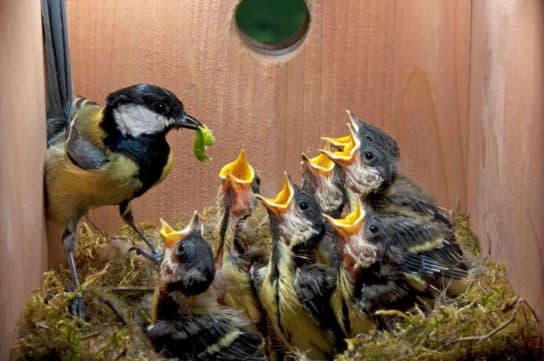
Great tit chicks
Typically, the incubation period lasts no more than two weeks. With the appearance of chicks, the female is inseparable from them for three days. Then she, together with the male, goes out in search of food for herself and her offspring.
Chicks grow stronger for 20 days, after which they get out of the nest. The already strong big tits are learning to fly.
A week later, young chicks are ready to live independently, but can still live near the territory of their parents, who periodically feed them. At the end of summer, small family flocks form, which combine with other species of tits.
Some flocks form up to 50 individuals. Together they fly in search of food. During winter, most of the great tit population head south, with some looking for nearby populated areas.
