


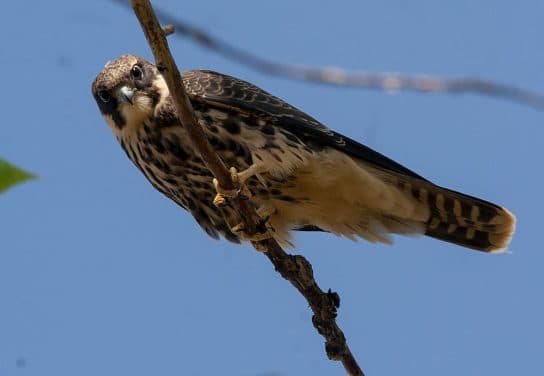
The hobby is a miniature bird that belongs to the genus of falcons. Differs in agility, speed and dexterity. Got spread on the Eurasian continent. The hobby is a migratory bird; it spends the winter in Africa and Asia.
Appearance
In appearance, the hobby resembles a small copy of a falcon. Some confuse it with a peregrine falcon. The main difference lies not only in size, but also in the specifics of the color.
The hobby has a body length ranging from 28 to 36 centimeters and a wingspan of 69 to 84 centimeters. Weight ranges from 130 to 340 grams. Sexual dimorphism is that females are slightly larger than males. The rest of the sex differences are practically not pronounced. The color of the feathers on the back is dark gray. In the area of the lower part of the body, the color takes on a reddish tint with dark stripes. The feathers on the head are dark, but the cheeks and throat are completely white.
A notable feature is a black horizontal stripe from beak to throat that resembles a mustache.
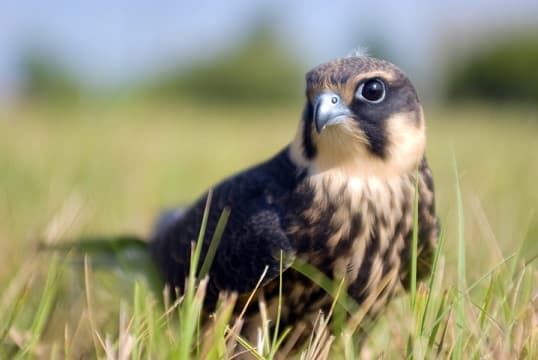
The flight wings and tail are painted with white feathers below, and many transverse stripes are visible from above. The eyes are dark brown in color, the beak and paws have a bluish tint. Juveniles are distinguished by the brown color of the back and buffy edges on the head.
Habitat
The hobby has spread throughout Western Europe, including Asia, Spain, Asia Minor and Greece. It cannot be found in southern Asia, in the tropical forests of Africa, China and India. As a habitat, he prefers spacious light woodlands with open spaces. They can settle in old pine forests. They are also found on the edges of forests, near the banks of large rivers, pastures and agricultural lands.
Nutrition
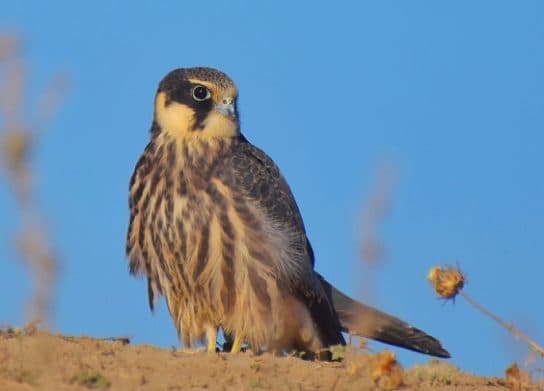
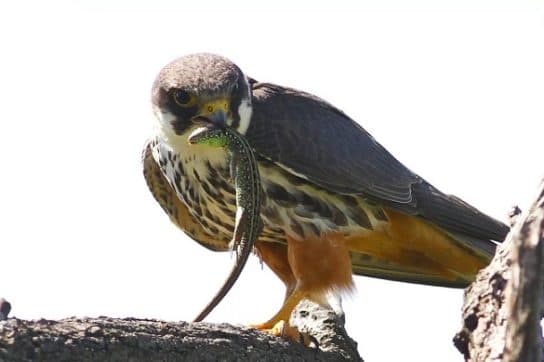
The hobby’s main diet consists of small birds and insects. Most often, its prey are beetles, butterflies and dragonflies. Prefers starlings and sparrows as birds. Bats can become its prey at night. It prefers to live near the habitat of swallows and swifts. It is extremely rare that they can feed on mice and small terrestrial inhabitants. Hunt in flight.
Breeding period
The nesting period starts in April. At this time, the branches of the trees take on green leaves. Birds prefer to use one nest for several years. The mating season is marked by extraordinary activity. Males put on incredible shows in the sky to get the attention of the females.
The laying period begins at the end of June. As a rule, the female lays 2 to 6 eggs, which are colored gray-brown or dark orange with bright spots. The incubation period is about 27 days. The female is incubating, and the male is looking for food for two. Chicks are born, which are covered with a small white fluff. At first, the female is engaged in feeding them, then the male is connected. At the age of one month, small hobbyists are already ready to fly. However, for several more weeks they are fed by their parents. Fully fledged chicks are ready for independent life.

Hobby chicks in the nest
Lifestyle
The hobby falcon lives in all possible places in which a warm, temperate climate prevails. Differs in its fast intermittent summer. Due to its low weight and body structure, it can float without much effort. The bird itself is rather fussy and agile. It is inherent in her to enter into conflicts with other birds. These can be both completely different species of birds, and their close relatives. If the hobbyist senses the approach of a strange bird, he starts a fight. Small birds become his quick prey.
With people, the hobby remains neutral, but does not come close. Still, people indirectly affect the life of this bird, displacing them from their natural habitat.
If the hobby is close to agricultural areas, then it can perfectly cope with the invasion of small pests, in particular, with sparrows and starlings. It actively uses its incredibly fast speed when hunting for living creatures.
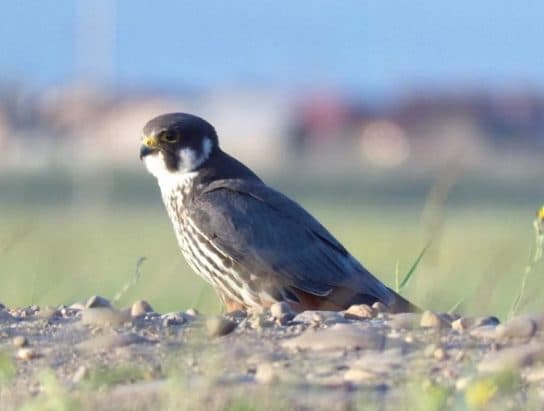
Males are distinguished by their attentiveness towards the chosen ones. They can feed the selected female directly from the beak during flight. They live most often in tall trees. It is common for these birds to occupy empty nests, and even drive out the owners. The formed pair very carefully guards the nest from intruders.
Subspecies of woodpeckers
At the moment, there are about 3 subspecies of hobbyists, which differ in their habitat and appearance. These include:
African hobby
Inhabited the territory of southern Sahara. It has no fundamental differences with the usual hobby.
Australian hobby
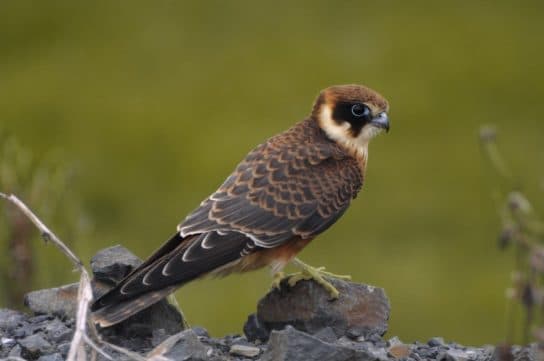
This is a rather small bird, the color of which ranges from dark gray to ocher with characteristic streaks. It lives, as the name suggests, in Australia, eastern Indonesia and New Guinea.
Silver hobby
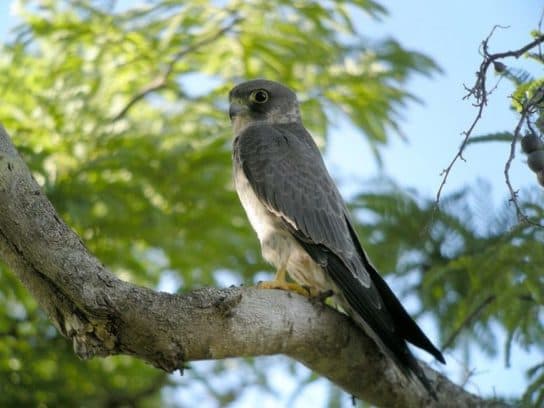
This subspecies is slightly larger than usual. Its body size ranges from 32 to 37 centimeters with a wingspan of up to 90 centimeters. Inhabited the territory of northeast Africa, the Middle East, as well as the Arabian Peninsula. Spends winter in Madagascar and Mozambique.
A sedentary lifestyle is inherent in the inhabitants of Southeast Asia.
