


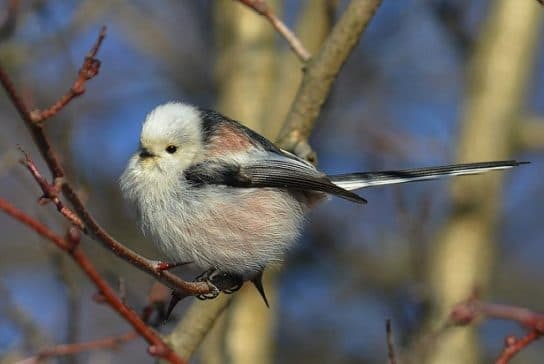
The long-tailed tit has a very long tail, elegant appearance and the ability to build complex nests. This bird is widespread, including in Russia. Most often it can be found in the forest, but sometimes it flies into city parks.
What a long-tailed tit looks like
Tits belong to the order of passerines, which automatically means small sizes. The body length of this titmouse is only 12-15 centimeters, of which the tail feathers occupy most of it. The “tail section” can reach almost 11 centimeters. The maximum weight of an adult bird is only nine grams.
Long-tailed tit feathers are very soft and fluffy. At a certain glance, this bird may seem like an almost even ball, from which a long tail sticks out. Also, its shape resembles a Russian folk spoon for pouring, for example, soup. From such a similarity, the long-tailed tit has a second, unofficial, name – the ophthalmologist. In fact, such tits have even more names. Taking into account all local dialects and peculiarities, the names of birds can be typed in about two dozen.
The long-tailed tit has a beautiful outfit. Three colors reign in her plumage: white, black and slightly pink, which harmoniously add to each other. Feathers have three distinct color areas. So, the head, neck and almost the entire lower part of the body are white, the sides and back are pinkish. The tail and wings are painted in a mixture of black, white and gray tones.
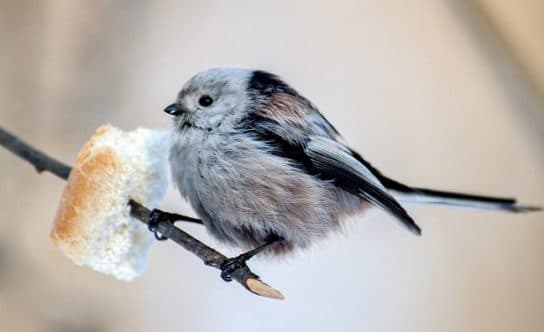
Long-tailed tit eats bread
Habitat and lifestyle
The long-tailed tit lives in deciduous and mixed forests, gardens, parks, thickets along river banks, and bushes. She inhabits many European territories, Asia Minor, China, Korea, Japan. In Russia, it is most widely represented in the Siberian region.
The favorite nesting places of long-tailed tits are hard-to-reach thickets of willow or dense birch forest. The nest is often built in dense bushes not far from the reservoir. The Long-tailed Tit is an excellent nest-builder.
The nest of this bird is an egg-shaped structure with an upper entrance (entrance). The main material for the construction is moss, but the main feature is its strengthening with cobwebs or loose insect cocoons. Thanks to this “braid” the walls of the nest are very thick and warm. At the end of construction, the long-tailed tit covers the nest with small pieces of bark and lichen, and inside creates a soft bed of feathers.
Moths are usually seen in groups of 8-20 birds, and these fast moving flocks give off characteristic contact sounds. The inviting cry of the birds is a sharp “tsurp” repeated several times. When heard, it is easy to remember, and the often audible chirping is the first sign that there is a small group of militiamen somewhere nearby.
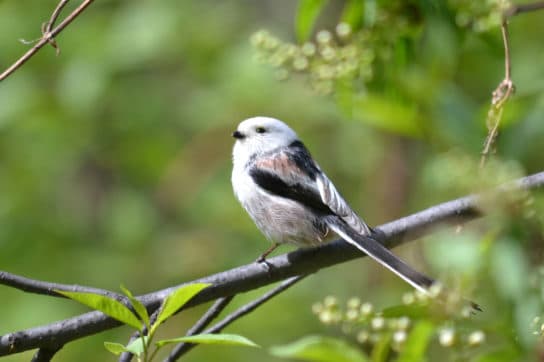
Long-tailed tits feeding
The long-tailed tit prefers to eat live food, although it can also eat plant food. All kinds of insects, which the bird seeks, masterly taking any poses, become classic delicacies. Like many other tits, it can be easily hung upside down, examining the underside of the leaves. The long-tailed tit is perfectly oriented even in dense foliage, looking out for insects or their larvae.
The main part of the bird’s diet is aphids, leaf flies, butterfly caterpillars. It also includes some beetles, such as weevils. During the transitional seasons and in winter, the titmouse eats seeds and fruits of plants. The greatest amount of food is needed for the bird when feeding the chicks. It is estimated that long-tailed tits feed their chicks up to 350 times a day. During this period, they destroy the maximum number of insects, among which there are agricultural pests.
Mating season mating
Birds begin to breed earlier than other tit species. Construction of the complex domed nest begins at the end of February. They place their nests high in a fork in a tree or in thorny bushes such as hawthorn. The nest is made of moss, woven with cobwebs and animal hair, masked outside with lichens and lined with feathers on the bottom.
It takes up to three weeks to build a nest at the start of the breeding season. Nests erected at the end of the breeding season are ready to lay in a week. Nurse birds, which help raise the young, join the breeding female. These may be mother birds after an unsuccessful laying of eggs, possibly related to the pair.
