


Life is not only about eating food, chasing fashion brands and making money for all this. Life is, first of all, the formation and development of the personality, the disclosure of the essential characteristics and potential of a person. In psychology, this process is often called self-actualization, that is, the acquisition of one’s own “I”, the realization of all their resources: talents, abilities, opportunities.
The essence of self-actualization. C. Rogers theory
The concept of “self-actualization” is the main one in humanistic psychology – one of the leading directions of modern psychological science. It was first used by one of the founders of this trend, the American psychologist K. Rogers.
From his point of view, the need for self-actualization is inherent in every person from birth, and it is the driving force behind the entire development of the personality. Society can help or hinder the realization of innate potential, but not define it.
All people have natural abilities and capabilities, and the main goal of any person is their maximum manifestation. This is self-actualization, which in psychology is considered as the full disclosure of the potential of the individual and the inclusion in active activity of all his abilities and talents. Only in this case can a person feel like a full-fledged and harmonious person, he should strive for this.
The process of self-actualization has no age limits and lasts a whole life, since there is no limit to perfection. From the point of view of K. Rogers, this is not only constant mental growth, but also the development of personal potential, when with each new step, more and more opportunities for self-actualization are revealed to a person. Therefore, in psychology, it is customary to talk about a self-actualizing personality, emphasizing that this is not a completed stage, but constant self-development.
A person is gradually formed as a gifted harmonious personality, useful not only for himself, but also for society. And he does not wait for society to impose any strict requirements on him or to propose areas for the realization of his abilities. In the process of self-actualization, the individual has internal motives and incentives. He masters new types of activity, gains new knowledge and skills, is actively involved in professional and social life, because this is his nature. Self-actualizing personality lives very rich and interesting, as she has many hobbies, plans, projects, ideas, friends.
If self-actualization is a basic need of any person, then why does the mass of people not strive for it? Another of the founders of humanistic psychology A. Maslow answers this question.
Hierarchy of needs, or the path to self-actualization
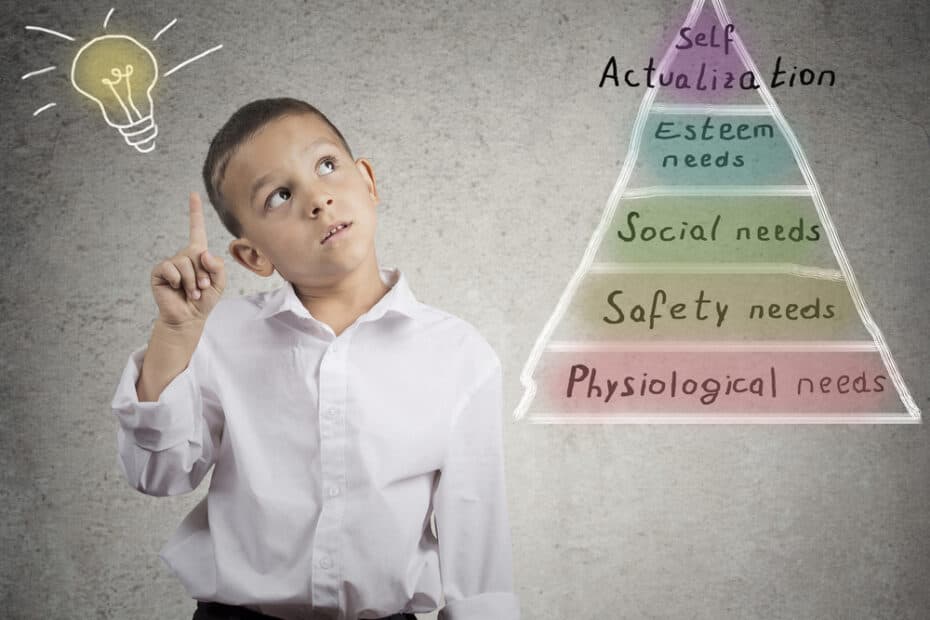
The need for self-actualization, although the highest, is not the only human need. From the point of view of A. Maslow, the question of its satisfaction arises only when and if the needs of the lower levels are satisfied. This psychologist formulated the principle of a hierarchy or pyramid of needs, which perform the function of motivating personality development. There are five levels in this pyramid:
- Physiological level. It contains all natural, biological needs: food, water, heat, biological partner, health, etc.).
- The level of security is not only the need for the absence of a threat to life and health, but also the need for peace of mind, confidence in the future, in a well-paid job or in a comfortable home, in peace and prosperity.
- Social level. It contains the needs for a comfortable social environment, friends, loved ones, family.
- The level of self-esteem is the need for self-esteem, for self-acceptance and pride in the results of one’s activities.
- Self-actualization level. At this level, according to A. Maslow, are the needs for creativity and socially approved activities, for personal harmony and beauty, for the fullest possible realization of one’s own “I”.
If you build a hierarchy of needs in the form of a pyramid, then self-actualization will be at the very top, and it is based on ever lower levels. This is very important, since a person thinks about the needs of a higher level only if the lower ones are satisfied. One should not expect not only harmonious development, but also self-respect from a hungry person who does not have normal housing. And he begins to think about the family not earlier than he has dealt with the first two levels.
But this does not negate the significance of the highest level to which one must strive. Moreover, A. Maslow called only a person who had reached the level of self-actualization a psychologically healthy person.
Self-actualization as a process
And yet it is not clear why there are so many seemingly quite prosperous, “arranged” people around, who do not even think about self-actualization, but simply go with the flow? Are they feeling good anyway? Or, perhaps, not very well, and a feeling of dissatisfaction gnaws at them, but they do not know and do not understand what and how to change in life. How to embark on the path of self-actualization, stop waiting for “tomorrow” (or Monday), and start living in this “tomorrow”?
Humanistic psychology has answers to these questions. A. Maslow describes a number of possible ways or conditions for self-actualization:
- Experiencing and living everything that happens to you, without moving away from what is happening and without hiding your head in the sand. It must be remembered that self-actualization presupposes the fullness of life in all its manifestations.
- Understand life as a constant choice of path options, actions, relationships with people. Do not shy away from the need to choose and appreciate that its opportunity is available only to a free person.
- Self-actualization is not just freedom of choice, but also responsibility for it, for everything that happens to you and your environment. Understand that responsibility is not a burden, but a benefit and social advantage of an adult free person.
- Responsibility to oneself and society is combined with independence – judgments, thoughts, opinions, actions. An independent person is free, and self-actualization is impossible without freedom.
- Trust in yourself, your experience, opinion, position.
- Self-actualization is a creative process. And the enjoyment of creativity, the experience of the ecstasy of inspiration is its important condition.
- Awareness of all their problems, including mental and physical, and the ability to find the strength to overcome them, without hiding behind the barrier of psychological protection.
Even if self-actualization is not easy at all, this process proceeds in different ways – for someone it seems natural and easy, as if a person moves forward and upward without experiencing any problems. And for some, self-actualization is associated with serious intrapersonal problems and social conflicts.
Types of self-actualization
Self-actualization is not only difficult, but also a very individual process. You can say: how many people, there are so many options, because this is the disclosure of personal potential. However, there are also common moments in the process of self-actualization, and they allow us to single out several of its types.
Superficial and deep
Superficial is more common and involves the actualization of a variety of personality traits without their critical analysis and assessment. This is free self-expression, in which not always the best and socially acceptable “talents” of an individual can be realized. After all, every person is a complex alloy of good and bad, positive and negative properties. Here superficial self-actualization does not concern the comprehension of their social significance. In simple words: what has developed has developed.
Deep, on the contrary, is the result of introspection and assessment of one’s potential not only in terms of level, but also in terms of social significance. Deep self-actualization is always growth, progressive, progressive development with the identification and disclosure of all the best in a person, those qualities that ensure the efficiency and productivity of his development and interaction with society.
Harmonious and problematic
It is good if the process of socialization is not only actively carried out by the individual himself, but is also supported by society. And it is absolutely wonderful if a person, in his early youth, decided on the sphere of realization of his talents and abilities. He clearly knows what he wants and goes straight to the set goal, rejoicing in his every success, and perceiving failures as a useful experience.
But unfortunately, not everyone has such a harmonious self-actualization. Often a person rushes about in search of himself, the way of realizing his personal potential. And it fails because it cannot find the right path and is disappointed in its capabilities and in its benefits for society. All this can become a source of serious mental problems, and such a restless personality is at odds with society. The creativity of this person is often not accepted by society, and the hope of success is not justified.
Perhaps the individual chose the wrong path, the wrong field of activity, or his psyche is not able to cope with the load given to him. You cannot go to success by jumping three steps – this is the easiest way to stumble and fall.
Active and careful
These two types have been described by different leaders in humanistic psychology. The active one was described and supported by A. Maslow, and K. Roger believed that the most acceptable was cautious.
What is the difference between them? In active or energetic self-actualization, a person moves forward, rapidly overcoming difficulties. He wants to achieve his potential and success as quickly as possible. Russians say about such people that they have everything in their hands, or that they have soles on the move. Indeed, this person is able not only to burn, but also to kindle others with his energy and enthusiasm.
But K. Roger believed that gradual, thoughtful work on oneself, the accumulation of internal potential, resources for a leap forward is much more useful for a person. Such a person may move more slowly, but he makes fewer mistakes, and as a result, on the way to success, he often outstrips those who are too hot and energetic.
Probably, if the goal is to create a classification of the types of self-actualization, then many more of them could be distinguished. But in psychology, no one has yet set this goal.
What kind of self-actualizing person is she?
Summing up, let’s figure out who can be called a self-actualizing person? Well, perhaps we will try on this image. You are definitely such a person if you:
- are open to the world and have a positive attitude towards it;
- accept reality and yourself as part of this reality, without opposing your own personality to others, without awakening anger, hatred, envy, rejection in yourself;
- you accept the people around you as they are, do not try to fit them to your own “standards”; respect any person, regardless of their religion, nationality, social status, and you know for sure that the beauty of the world is in its diversity;
- carried away by their work, which is not a burden for you, but a joy; you consciously made your choice and are doing the job because you like it, and not just for the sake of money;
- clearly distinguish between good and evil, bad and good, and do not hide behind the justification that the end justifies the means;
- you have a good sense of humor and a desire to smile at people and life around you;
- you accept not only the joys of the world, but also its problems and do not hide from them, but solve in accordance with your principles.
As you can see, there is nothing unusual and supernatural in the qualities of a self-actualizing personality, and this path is within the power of everyone.
