


- 1 What coral reef restoration is really trying to repair
- 2 Why reefs need help in the first place
- 3 The main approaches used in coral reef restoration
- 4 Coral gardening: the best-known method
- 5 Larval restoration and why genetic diversity matters
- 6 Artificial structures can help, but they are not a shortcut
- 7 Heat-tolerant corals and the promise of assisted adaptation
- 8 What makes a restoration project more likely to succeed
- 9 What often goes wrong
- 10 How climate change changes the restoration conversation
- 11 When professional ecological assessment is essential
- 12 What communities and visitors can realistically do
- 13 How to judge whether a coral restoration project is credible
- 14 FAQ
- 15 What is worth remembering
Coral reef restoration sounds simple from a distance: grow corals, place them back on damaged reefs, and let nature rebuild itself. In reality, it is more complicated. A reef is not a decorative underwater garden. It is a living system shaped by water temperature, currents, fish, algae, storms, disease, pollution, coastal development, and the slow growth of coral colonies over years or decades.
This is why coral reef restoration matters, but also why it must be understood carefully. It can help damaged reef areas recover, protect biodiversity, support coastal communities, and buy time for ecosystems under pressure. Yet it cannot replace climate action, water quality management, responsible fishing, or long-term marine protection. NOAA describes restoration as one part of a broader coral reef conservation strategy that also includes reducing threats such as climate change, fishing impacts, and land-based pollution.
What coral reef restoration is really trying to repair
A healthy reef is more than a collection of corals. Reef-building corals create three-dimensional limestone structures that shelter fish, invertebrates, algae, sponges, and many other organisms. These structures also help reduce wave energy near shorelines and support local livelihoods through fisheries and tourism.
When reefs decline, the visible damage is often bleached, broken, or dead coral. But the deeper problem is usually ecological. The balance between corals and algae can shift. Herbivorous fish may become less abundant. Sediment may cover suitable surfaces for coral larvae. Diseases may spread more easily. Repeated heat stress can prevent recovery between bleaching events.
Restoration therefore has two linked goals:
- help corals return to places where natural recovery is too slow or unlikely;
- improve the conditions that allow restored corals to survive, grow, and reproduce.
If the second goal is ignored, restoration can become a short-lived planting exercise. Corals may be placed on the reef, but the same pressures that damaged the area can quickly undermine the work.
Why reefs need help in the first place
Coral reefs can recover from some disturbances when the surrounding ecosystem remains functional. After a storm, broken coral fragments may reattach naturally. After a moderate bleaching event, some colonies can regain their symbiotic algae if heat stress does not last too long. Larvae from nearby reefs may settle and grow on open surfaces.
The challenge is that many reefs now face repeated and overlapping stress. Ocean warming increases the frequency of bleaching risk. Ocean acidification can make it harder for corals to build skeletons. Pollution, wastewater, sediment runoff, and overfishing can weaken reef resilience. UNEP warns that coral reefs are highly vulnerable to the combined pressures of climate change, biodiversity loss, and pollution, and notes that even under a 1.5°C warming scenario, a very large share of reefs may be lost by mid-century.
This does not mean restoration is pointless. It means restoration must be realistic. A coral nursery, artificial reef structure, or larval seeding project can help in selected places, but it cannot make a reef immune to marine heatwaves or poor water quality.
Important: coral reef restoration is most useful when it is connected to threat reduction. Planting corals into an area with untreated sewage, heavy sedimentation, destructive anchoring, or repeated heat stress is unlikely to produce lasting results.
The main approaches used in coral reef restoration
Different reefs need different restoration methods. A site damaged by ship grounding does not require the same approach as a reef affected by repeated bleaching. A small community project may focus on coral gardening, while a scientific program may test heat-tolerant coral lines, larval propagation, or assisted gene flow.
| Approach | How it works | Where it may help | Main limitation |
|---|---|---|---|
| Coral gardening | Fragments are grown in nurseries and later attached to the reef. | Local reef repair, especially with branching corals that grow relatively fast. | Scale, cost, disease risk, and vulnerability to future heat stress. |
| Microfragmentation | Corals are cut into small pieces to encourage faster tissue growth. | Massive corals that normally grow slowly. | Requires careful handling and long-term monitoring. |
| Larval propagation | Coral spawn is collected, fertilized, reared, and released or settled onto reefs. | Increasing genetic diversity and supporting natural recruitment. | Timing, survival rates, and suitable settlement habitat are difficult to control. |
| Substrate stabilization | Loose rubble or damaged reef structure is secured before corals are added. | Storm-damaged or physically broken reefs. | Does not solve biological stressors by itself. |
| Artificial structures | Designed surfaces are added to create habitat for coral settlement and reef life. | Sites where natural structure has been lost or is unstable. | Design, material choice, placement, and ecological fit matter greatly. |
| Assisted evolution and selective breeding | Corals with useful traits, such as heat tolerance, are studied or bred. | Future-focused resilience work in warming oceans. | Ecological risks, uncertainty, and governance questions remain. |
Coral gardening: the best-known method
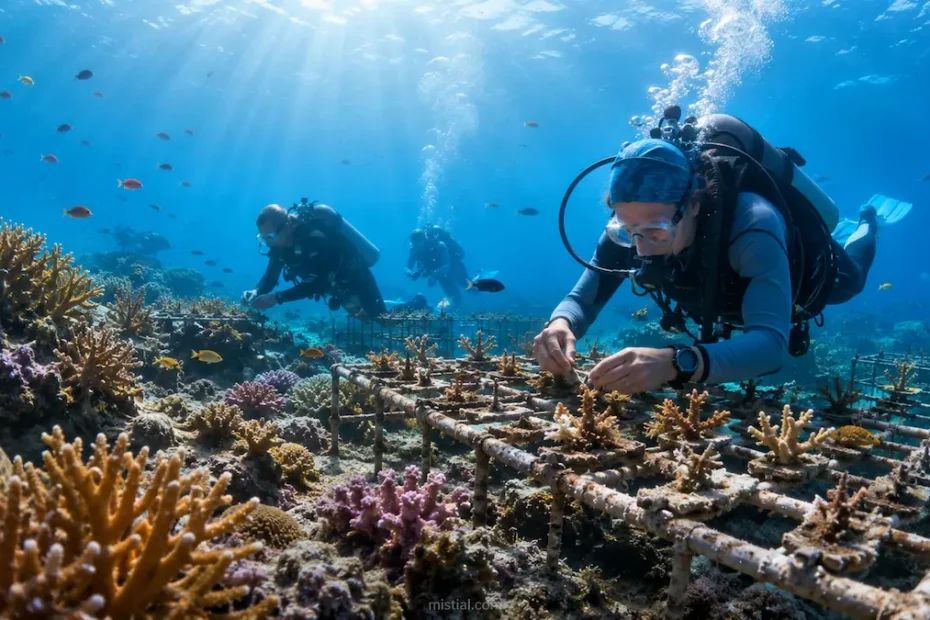
Coral gardening is often the method people imagine first. Small coral fragments are collected from donor colonies or from naturally broken pieces, grown in underwater or land-based nurseries, and later outplanted onto degraded reef areas.
This approach can work especially well with some fast-growing branching corals. It allows restoration teams to grow many fragments from a limited amount of source material. It also gives practitioners time to monitor growth, remove algae, check for disease, and select fragments that appear healthy before outplanting.
But coral gardening has limits. Nursery-grown corals still face the same ocean conditions after they are outplanted. If a severe marine heatwave arrives soon after planting, survival may fall sharply. If the restored site has too much algae, unstable rubble, or poor water quality, young corals may struggle to establish.
NOAA’s coral restoration work includes improving population enhancement, supporting emergency restoration after damage, and increasing resilience to climate change. That broader framing is important because coral gardening alone is not enough when the reef environment remains hostile.
Larval restoration and why genetic diversity matters
Fragment-based restoration can quickly increase coral cover, but it often relies on clones. This is useful for rebuilding structure, yet it may not always provide enough genetic diversity for long-term adaptation.
Larval restoration takes another route. During coral spawning events, eggs and sperm are collected, fertilized, and reared until larvae are ready to settle. These larvae can then be released onto suitable reef areas or settled onto small devices before being placed in the ocean.
The appeal is clear: sexual reproduction can create new genetic combinations. In a changing climate, diversity matters because some coral individuals may cope better with heat, disease, or local stress than others. The difficulty is that coral larvae are tiny, vulnerable, and highly dependent on timing, water conditions, and suitable surfaces.
Researchers are also exploring robotics and automated reef restoration tools to help scale larval delivery and identify suitable reef substrate. Experimental systems may reduce some manual labor, but they do not remove the ecological challenge: larvae still need a reef environment where they can settle, survive, and grow.
Artificial structures can help, but they are not a shortcut
Artificial reef structures are sometimes used where the physical reef framework has been damaged or where loose rubble prevents young corals from attaching. The idea is to provide stable surfaces and three-dimensional habitat.
Some recent research suggests artificial structures can support coral recovery in certain conditions, especially when they create stable settlement space and are designed with ecological function in mind.
However, artificial structures can also fail when they are treated as a universal solution. Poorly designed materials, unsuitable placement, weak anchoring, or lack of biological planning can create debris rather than habitat. A structure may look impressive in photos but still do little for reef recovery if corals do not settle, fish communities do not use it, or it becomes covered with algae.
The best projects usually start with the reef problem, not with the object being installed. Is the substrate unstable? Is coral recruitment limited? Has storm damage removed habitat complexity? Are there surviving corals nearby? These questions should shape the design.
Heat-tolerant corals and the promise of assisted adaptation
As marine heatwaves become a larger threat, some restoration programs are investigating whether corals with higher heat tolerance can be used to improve future resilience. This can include selective breeding, conditioning corals under warmer conditions, studying naturally tolerant populations, or exploring assisted gene flow.
The Great Barrier Reef Foundation describes assisted evolution as a group of approaches aimed at improving coral heat tolerance by accelerating naturally occurring evolutionary processes, while also emphasizing the need to understand risks and benefits.
This area is promising, but it is also sensitive. Moving corals or genes between areas can raise ecological and governance questions. A coral that performs well under heat stress may not be the best fit for every local ecosystem. There may be trade-offs involving growth, reproduction, disease resistance, or relationships with symbiotic algae.
For this reason, assisted adaptation should not be presented as a miracle fix. It is better understood as a developing toolkit that may support restoration under future ocean conditions, provided it is tested carefully and used with transparent ecological safeguards.
What makes a restoration project more likely to succeed
Successful coral reef restoration is not just about growing corals. It depends on choosing the right site, setting realistic goals, reducing stressors, and measuring results over time.
Site selection
A reef area should be assessed before restoration begins. Teams usually need to understand water quality, temperature patterns, wave exposure, herbivore presence, algae cover, disease risk, sedimentation, and the condition of nearby coral populations.
A site that looks damaged may not be suitable for immediate outplanting. Loose rubble, chronic pollution, or dense algae can make coral survival unlikely. In such cases, habitat stabilization or threat reduction may need to come first.
Clear goals
Not every project has the same goal. Some aim to rebuild coral cover after ship grounding. Some focus on endangered coral species. Some try to improve shoreline protection. Others are designed as research projects to test methods.
Clear goals help avoid vague claims. “Restore the reef” is too broad. “Increase survival of nursery-grown fragments over three years,” “stabilize rubble in a storm-damaged area,” or “support sexual recruitment of selected coral species” are more measurable.
Long-term monitoring
Corals may look healthy shortly after planting, but early appearance can be misleading. A meaningful project needs monitoring across seasons and stress events. Survival, growth, bleaching response, disease, reproduction, and effects on surrounding reef life all matter.
What often goes wrong
Some restoration projects fail because they start with enthusiasm but not enough ecological planning. Others succeed technically at growing corals but fail to change the long-term condition of the reef.
- Planting before fixing the cause of decline. If sediment, pollution, destructive fishing, or anchor damage continues, new corals remain under pressure.
- Choosing easy species only. Fast-growing corals can quickly improve cover, but a reef dominated by one or two species may not reflect natural diversity.
- Ignoring genetic diversity. Large numbers of cloned fragments can look impressive while offering limited adaptive potential.
- Measuring success too early. Survival after three months does not prove ecological recovery.
- Using restoration as a substitute for protection. Restoration cannot compensate for unchecked emissions, poor coastal planning, or weak marine management.
These mistakes do not mean restoration is ineffective. They show that restoration is a tool, not a replacement for reef conservation. The most credible projects are usually honest about uncertainty, limits, and site-specific results.
How climate change changes the restoration conversation
Coral bleaching occurs when corals lose the symbiotic algae that provide much of their energy. If stressful conditions ease quickly, some corals can recover. If heat stress is severe or prolonged, corals may weaken or die.
In 2024, NOAA and partners confirmed the fourth global coral bleaching event, with bleaching-level heat stress affecting reefs across multiple ocean basins. Reuters reported that the event had been documented in many countries and territories since early 2023.
This matters for restoration because the future ocean may not resemble the past ocean. A restoration plan based only on historical conditions may be too optimistic. Projects increasingly need to consider heat exposure, future bleaching risk, coral traits, genetic diversity, and whether restored populations can reproduce under changing conditions.
Обратите внимание: restoration can improve local recovery, but it does not remove the need to reduce greenhouse gas emissions. Without addressing warming, many restored corals may remain vulnerable to repeated bleaching.
When professional ecological assessment is essential
Coral reef restoration should not be improvised by well-meaning volunteers without expert guidance. Reefs are sensitive ecosystems, and poorly planned actions can damage living corals, spread disease, introduce unsuitable materials, or disturb protected areas.
Professional assessment is especially important when:
- a project involves collecting coral fragments or moving corals between locations;
- the reef is inside a protected marine area;
- artificial structures or anchors will be placed on the seafloor;
- there is visible disease, bleaching, or mass mortality;
- the project aims to restore threatened coral species;
- local laws require permits for marine work.
Scientists, marine park managers, restoration practitioners, local communities, and government agencies often need to work together. A technically good restoration method can still be inappropriate if it conflicts with local ecology, law, or community priorities.
What communities and visitors can realistically do
Not everyone can run a coral nursery, and not everyone should. But many people can support reef recovery by reducing local stress and backing credible conservation efforts.
- Choose reef-safe behavior when swimming, snorkeling, or diving: avoid touching corals, standing on reef flats, or stirring sediment.
- Use mooring buoys where available instead of anchoring on reefs.
- Support local water quality improvements, especially wastewater treatment and sediment control near coastlines.
- Follow fishing rules and respect herbivorous fish protections where they exist, because grazing fish can help control algae.
- Volunteer only with projects that have scientific oversight, permits, safety standards, and long-term monitoring.
- Be cautious with simple “plant a coral” claims unless the project explains survival, monitoring, local threats, and ecological goals.
Small actions do not solve global reef decline by themselves, but they can reduce avoidable pressure. This is especially valuable in places where reefs are already struggling with heat stress.
How to judge whether a coral restoration project is credible
A good restoration project should be able to explain what it is doing, why that method fits the site, and how success will be measured. The most reliable projects usually avoid exaggerated promises.
| Question to ask | Why it matters |
|---|---|
| What problem is the project solving? | Restoration should respond to a specific ecological issue, not just create a positive image. |
| Are local threats being reduced? | New corals need suitable conditions to survive. |
| Which coral species are used? | Species selection affects growth, diversity, habitat value, and resilience. |
| How is genetic diversity handled? | Greater diversity may improve long-term adaptive potential. |
| How long is monitoring planned? | Short-term survival is not the same as reef recovery. |
| Are permits and local partners involved? | Marine restoration often requires legal approval and community coordination. |
If a project cannot answer these questions, it may still be well-intentioned, but it is harder to judge its real impact.
FAQ
Can coral reef restoration save all damaged reefs?
No. Coral reef restoration can help selected reefs or reef areas, but it cannot save all reefs on its own. Its success depends on water quality, heat stress, local protection, coral species, site conditions, and long-term management.
How long does coral reef restoration take?
It depends on the method and the species. Some branching corals can grow relatively quickly, while massive corals may take much longer. Ecological recovery usually requires years of monitoring, not just a single planting event.
Is coral gardening the same as restoring a whole reef?
Not exactly. Coral gardening can increase coral cover and help rebuild parts of a reef, but a whole reef includes many species, physical structure, fish communities, water quality, and ecological processes. Planting corals is only one part of restoration.
Are artificial reefs good for coral restoration?
They can be useful in certain situations, especially where stable habitat is missing. But artificial structures must be carefully designed, placed, and monitored. Poorly planned structures can become debris or fail to support meaningful coral growth.
Why not just plant heat-resistant corals everywhere?
Heat tolerance is only one trait. Corals also need to fit local ecological conditions, reproduce successfully, resist disease, and interact with the surrounding reef community. Moving or breeding corals for heat tolerance requires careful testing and oversight.
What is the biggest limitation of coral reef restoration?
The biggest limitation is that restoration cannot fully overcome large-scale stressors such as ocean warming and acidification. Local work can improve resilience, but long-term reef survival also depends on reducing climate and pollution pressures.
What is worth remembering
Coral reef restoration is valuable when it is honest, science-based, and connected to broader reef protection. It can repair physical damage, support threatened species, rebuild coral cover, and test methods that may help reefs survive under changing ocean conditions.
But it is not a magic reset button. A restored coral still needs clean water, stable habitat, balanced reef life, and a climate it can tolerate. The most useful way to think about restoration is not “plant corals and the reef is fixed,” but “reduce the pressures, rebuild what can be rebuilt, and monitor the ecosystem carefully.”
Used this way, coral reef restoration becomes a practical conservation tool: limited, imperfect, but important when applied in the right place, with the right goals, and with enough respect for the complexity of reef life.
