


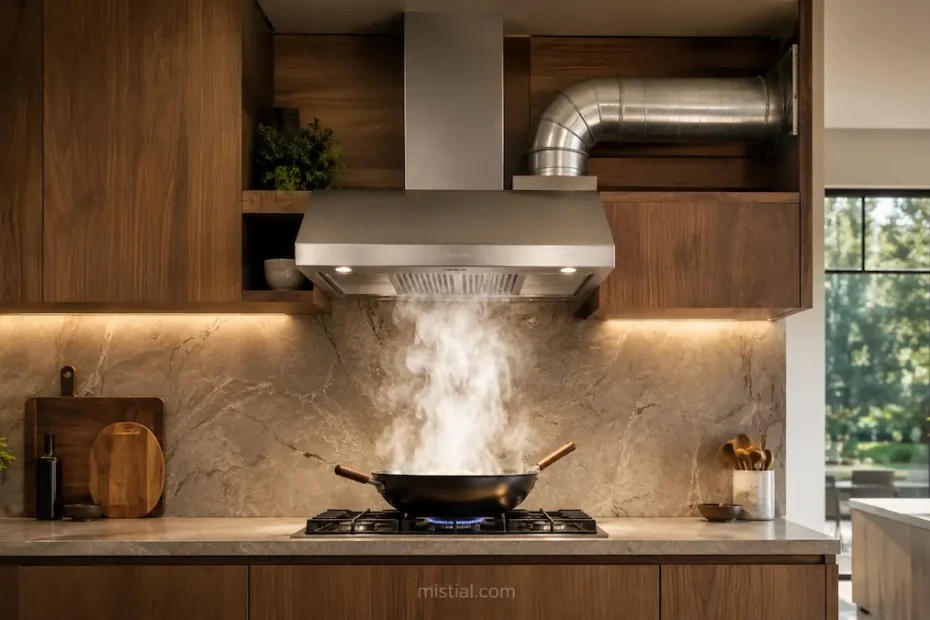
People love comparing CFM numbers, but that is only part of the story.
Take the ROBAM 86H1S 30-inch range hood. On paper, 1300 CFM is already strong enough to catch attention. But in a real kitchen, the number I would look at just as carefully is its 1000 Pa static pressure.
Why? Because most homes do not have a perfectly straight exhaust duct.
The duct may run through a cabinet, turn 90 degrees, travel several feet, then exit through an exterior wall. Every bend makes the hood work harder. If your kitchen has two elbows in the duct, I would care more about pressure performance than another 100 or 200 CFM on the box.
This becomes obvious when cooking at high heat. Stir-frying beef or pan-frying fish produces smoke quickly. Once that smoke escapes past the hood, a powerful motor does not help much.
Grease handling also matters. ROBAM says the 86H1S reaches 98.1% oil separation through its CleanAir system. I would not take that as a reason to forget cleaning, but it does matter if you cook oily food several times a week. Less grease travelling into the duct usually means less mess later.
One thing worth checking before buying is the existing ductwork. Measure the duct diameter, look at how many turns it makes and find out where it exits. I have seen good range hoods perform badly simply because the duct was too narrow.
The R-Link controls and automatic speed adjustment are nice to have, but they would not be my first reason for choosing this model.
If you are looking through ROBAM Canada for a new range hood, start with the way you actually cook. A family doing high-heat wok cooking every evening has very different ventilation needs from someone who mostly boils, bakes and reheats meals.
A practical comparison should include installation conditions. Ask the installer to confirm duct diameter, total duct length, the number of elbows and the type of exterior cap. Then compare that layout with the hood’s installation requirements before the cabinet work is finished. It is also worth checking how easily filters and grease trays can be removed, because maintenance affects real performance over time. After installation, test the hood during the cooking method that produces the most smoke, rather than judging it only by sound or airflow with an empty cooktop. Record whether smoke escapes at the front or sides and whether the normal fan setting is comfortable enough for everyday use; those observations make later adjustments more specific.
