


- 1 Visual art teaches children to see, not just look
- 2 Art gives children a safe place to experiment
- 3 Why creativity needs practice, not just talent
- 4 The connection between art, language, and thinking
- 5 Emotional development without turning art into therapy
- 6 What children learn through different visual art activities
- 7 Why visual arts matter in a screen-heavy childhood
- 8 Art supports inclusion when it is taught well
- 9 Where schools often get art education wrong
- 10 What a stronger visual arts program can look like
- 11 How parents can support visual arts without pressure
- 12 When extra support may be helpful
- 13 Why cutting art can cost more than it saves
- 14 FAQ
- 15 What matters most
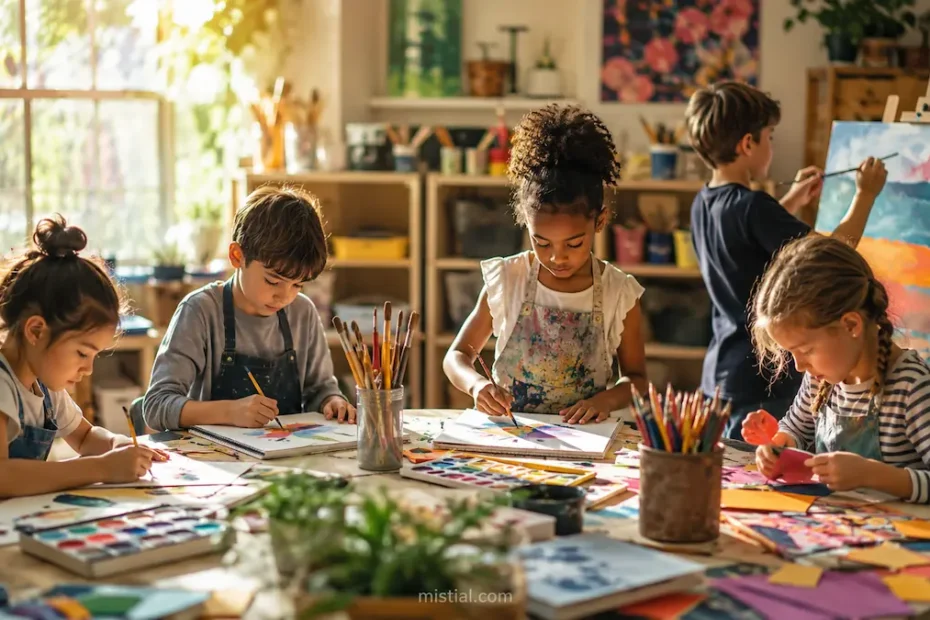
Visual arts education is often treated as something pleasant but secondary: a break between “serious” subjects, a decoration for school corridors, or an activity for children who are already considered creative. That view misses the point. Drawing, painting, sculpture, collage, photography, design, and other visual practices help children learn to observe, interpret, plan, experiment, revise, and express ideas that may be difficult to put into words.
Children do not need more visual arts education because every child should become an artist. They need it because art gives them a different way to understand the world and their place in it. A child who studies visual art learns to notice details, make choices, handle uncertainty, work through mistakes, and communicate meaning. These are not narrow “art room” skills. They are human skills that support learning, confidence, emotional development, and cultural awareness.
Visual art teaches children to see, not just look
One of the quiet strengths of visual arts education is that it slows children down. In many school tasks, speed is rewarded: answer quickly, finish the worksheet, choose the correct option. Art asks for another kind of attention. What shape is this leaf? How does the shadow change near the edge? Why does one color feel warm and another feel distant? What happens if the same object is drawn from a different angle?
This kind of observation is not passive. It trains children to compare, notice relationships, and pay attention to small changes. A child drawing a hand, a building, a face, or a bowl of fruit is not simply copying. They are learning how to break a complex object into lines, shapes, proportions, textures, and spaces.
That matters beyond art. Careful observation is useful in science, reading, writing, problem-solving, and everyday judgment. A child who learns to notice visual details may also become more comfortable asking, “What am I actually seeing?” instead of relying only on first impressions.
Art gives children a safe place to experiment
Many children become anxious when there is only one correct answer. Visual arts education offers a different kind of learning environment. There are still techniques, limits, and quality standards, but there is usually more than one possible solution. A drawing can be realistic, abstract, symbolic, playful, quiet, bold, or deliberately strange.
This does not mean anything goes. Good art education is not random activity with paint. It teaches children how to make choices and understand consequences. If a child presses harder with a pencil, the line changes. If they mix too many colors, the result may become muddy. If they place a figure near the edge of the page, the composition feels different. These are real lessons in cause and effect.
Art also teaches revision. Children learn that a first attempt is not the final truth. They can adjust, repaint, cut, rearrange, layer, erase, simplify, or start again. This is valuable because many children associate mistakes with failure. In art, mistakes can become part of the process.
Important: visual arts education should not be reduced to “free expression” without guidance or to rigid copying without thought. Children benefit most when they have both structure and room for personal decisions.
Why creativity needs practice, not just talent
Creativity is often described as a natural gift: some children “have it,” others do not. This belief is limiting. Children may differ in interests, confidence, and early ability, but creative thinking can be practiced. Visual arts education gives that practice a visible form.
When children work on an art project, they make many small creative decisions. What should be included? What can be left out? Which material fits the idea? How can a feeling be shown without writing it directly? How can an ordinary object be made interesting?
These questions develop flexible thinking. Children learn that a problem can have several possible answers and that a strong idea often improves through testing. A poster design, a clay figure, a comic panel, or a mixed-media collage may begin as a vague intention and become clearer through doing.
This is why visual arts education should not be reserved only for children who already draw well. The child who struggles with drawing may still learn composition, color, symbolic thinking, visual storytelling, patience, and self-reflection. In some cases, the child who is not naturally confident may benefit the most.
The connection between art, language, and thinking
Visual art and language are often separated in school schedules, but they can support each other. When children discuss an artwork, they practice description, interpretation, and reasoning. They learn to say not only “I like it” or “I don’t like it,” but “This part feels crowded because the shapes overlap,” or “The dark color makes the scene feel heavier.”
That kind of conversation strengthens vocabulary and critical thinking. It also helps children understand that meaning can be built through choices. A story uses words, rhythm, and structure. An image uses line, color, scale, space, contrast, and texture. Both forms require attention to detail and intention.
Art can also support children who find verbal expression difficult. Some children can show an idea visually before they can explain it clearly. A drawing may reveal a memory, a fear, a question, or a connection that would not appear in a standard written answer. This does not mean art replaces language, but it can open a path toward it.
Emotional development without turning art into therapy
Children often experience emotions before they can fully name them. Visual art gives them a way to externalize feelings safely. A child can use color, shape, pressure, scale, and imagery to explore excitement, anger, confusion, pride, sadness, or calm.
However, it is important not to overstate this. School art lessons are not the same as clinical art therapy. Teachers should not be expected to diagnose children through drawings, and parents should be cautious about reading too much into a single image. A dark color or unusual figure does not automatically mean something is wrong.
What art can do is create a healthy space for reflection. A child may learn that feelings can be represented, shaped, and discussed. They may also experience the satisfaction of completing something personal. This can support confidence, especially when the classroom culture values effort, curiosity, and improvement rather than only neat results.
What children learn through different visual art activities
Visual arts education is broad. Different activities support different kinds of development. A balanced program gives children varied materials and experiences rather than repeating the same seasonal crafts year after year.
| Activity | What it can develop | What adults should watch for |
|---|---|---|
| Drawing from observation | Attention, proportion, patience, visual analysis | Avoid judging only realism; focus on noticing and improvement. |
| Painting | Color awareness, planning, emotional expression, experimentation | Teach basic technique without making every result look the same. |
| Collage | Composition, decision-making, layering, reuse of materials | Encourage intentional choices rather than random decoration. |
| Clay and sculpture | Spatial thinking, hand strength, form, balance, problem-solving | Allow enough time for building, failure, repair, and refinement. |
| Photography | Framing, perspective, storytelling, attention to environment | Discuss privacy, consent, and responsible image use. |
| Design projects | Purpose, audience, clarity, visual communication | Help children connect beauty with function and meaning. |
Why visual arts matter in a screen-heavy childhood
Children now encounter images constantly: videos, games, ads, icons, memes, photos, animations, interfaces, and social media visuals. More visual exposure does not automatically mean better visual understanding. In fact, it can make visual arts education more important.
Children need to learn how images work. Why does one image persuade? Why does another feel trustworthy? How can cropping change meaning? What is the difference between making an image and being manipulated by one? These questions are part of visual literacy.
Visual arts education helps children become more active viewers. They learn that images are constructed. Someone chooses the angle, color, lighting, scale, expression, symbol, and composition. Once children understand that, they are less likely to treat every image as neutral or accidental.
This is not about making children suspicious of everything. It is about giving them tools. A visually literate child can enjoy images while also asking thoughtful questions about purpose, context, and effect.
Art supports inclusion when it is taught well
Visual arts can give different children different ways to participate. A child who struggles with reading may excel at spatial design. A quiet child may communicate strongly through images. A child who speaks another language at home may feel more included when the task does not depend entirely on verbal fluency.
But inclusion does not happen automatically. Art education can also become discouraging if adults praise only “natural talent,” compare children publicly, or treat neatness as the main sign of success. Some children stop making art because they decide too early that they are “bad at drawing.”
Good visual arts education broadens the definition of success. It values observation, risk-taking, problem-solving, persistence, imagination, cultural understanding, and the ability to explain choices. A technically polished drawing is impressive, but it is not the only meaningful outcome.
Where schools often get art education wrong
Many schools support art in principle but weaken it in practice. The problem is not always lack of goodwill. Often, it is a combination of limited time, limited materials, pressure from tested subjects, and misunderstanding of what art education is for.
- Treating art as a reward. If art happens only after “real work” is finished, children learn that creativity is optional and secondary.
- Using only copy-based projects. Step-by-step crafts can teach following instructions, but they should not replace personal decision-making.
- Focusing too much on pretty outcomes. Display-ready work can be nice, but learning often happens in messy drafts and experiments.
- Removing art for struggling students. Taking away art to make more time for remediation may remove one of the spaces where a child feels capable.
- Offering too little time. Deep work needs planning, making, reflection, and revision. A rushed lesson often becomes surface-level activity.
These mistakes can make visual arts education look less valuable than it really is. When art is reduced to decoration, it becomes easier to cut. When it is taught as serious creative thinking, its role becomes harder to dismiss.
What a stronger visual arts program can look like
A strong visual arts program does not need to be expensive or overly complicated. It needs consistency, thoughtful teaching, and respect for the process. Children should have regular opportunities to make, observe, discuss, revise, and connect art with life beyond the classroom.
Regular practice
Art skills develop through repeated experience. A single project before a holiday cannot replace steady exposure. Regular practice helps children become comfortable with materials and more confident in their choices.
Open-ended tasks with clear limits
Children often create better work when they have a clear challenge and room for interpretation. For example, “Create an image that shows movement using only three colors” gives more meaningful structure than “draw anything” and more freedom than “copy this exact picture.”
Discussion and reflection
Talking about art helps children understand their own decisions. They can explain why they chose a color, what they changed, what was difficult, and what they might try next time. Reflection turns activity into learning.
Exposure to different artists and cultures
Children should see that art does not belong to one style, country, museum, or historical period. Visual culture includes traditional crafts, contemporary design, community murals, architecture, illustration, textiles, photography, and digital media. This wider view helps children see art as part of human experience, not as a narrow school subject.
How parents can support visual arts without pressure
Families do not need to turn the home into a studio to support visual arts education. The goal is not to produce perfect drawings, but to make visual exploration normal and valued.
- Keep simple materials available: paper, pencils, crayons, safe scissors, glue, recycled cardboard, or washable paints if practical.
- Ask open questions about the process: “What did you try here?” or “Which part was hardest?” instead of only saying “That’s beautiful.”
- Avoid correcting every proportion or color choice. Children need room to experiment before they worry about accuracy.
- Visit public art, museums, local exhibitions, libraries, or community spaces when possible, and talk about what you notice together.
- Let children see adults making, fixing, designing, cooking, decorating, arranging, photographing, or building things as part of everyday life.
- Save some process work, not only polished results, so children can see their own progress over time.
Supportive adults can make a major difference by changing the tone around art. Instead of asking whether a child is talented, it is often better to ask what they are noticing, trying, changing, and learning.
When extra support may be helpful
Most children do not need special intervention to benefit from visual arts. They need access, encouragement, and good teaching. Still, there are situations where additional support or a more thoughtful approach may help.
If a child becomes extremely frustrated with fine motor tasks, avoids all drawing or making activities, or shows strong anxiety around creative work, it may be worth speaking with a teacher, occupational therapist, school counselor, or another relevant specialist depending on the situation. The goal is not to force art, but to understand whether the difficulty comes from motor skills, perfectionism, sensory discomfort, low confidence, or previous negative experiences.
Children with disabilities may also need adapted tools, more time, different materials, or alternative ways to participate. Inclusion in visual arts should not mean every child does the same thing in the same way. It should mean every child has a meaningful way to engage with visual thinking and creative expression.
Why cutting art can cost more than it saves
When school schedules become crowded, visual arts are often among the first subjects reduced. The argument may sound practical: more time for math, reading, science, or test preparation. But this trade-off can be too narrow.
Visual arts can strengthen habits that support other learning: persistence, observation, interpretation, planning, attention to detail, and willingness to revise. They can also give children who feel unsuccessful elsewhere a place to experience competence. Removing that space may reduce motivation rather than increase achievement.
There is also a cultural cost. Children who rarely study visual arts may grow up surrounded by images but without enough practice interpreting them. They may consume design, media, advertising, and visual culture without understanding how visual messages are made. In a society filled with images, that is a serious gap.
FAQ
Why is visual arts education important for children?
Visual arts education helps children develop observation, creativity, problem-solving, communication, emotional expression, and visual literacy. It also gives them a way to explore ideas that may be difficult to express only through words.
Does visual arts education help children academically?
It can support habits that matter across subjects, such as attention, persistence, interpretation, planning, and revision. Art should not be valued only because it may support other subjects, but it can strengthen broader learning skills.
What if a child is not good at drawing?
Drawing skill is only one part of visual arts education. Children can learn through color, shape, collage, sculpture, design, photography, visual storytelling, and discussion. The goal is growth, not instant technical perfection.
How much visual arts education do children need?
There is no single amount that fits every school or family, but regular exposure is better than rare, isolated projects. Children benefit from repeated chances to make, observe, reflect, and improve over time.
Can digital art count as visual arts education?
Yes, if it involves real visual decision-making rather than passive screen use. Digital drawing, photography, animation, design, and image editing can all be meaningful when children learn purpose, composition, ethics, and technique.
Should parents correct children’s artwork?
Usually, it is better to ask questions and encourage reflection rather than correct every detail. Gentle guidance can help, but constant correction may make children afraid to experiment. The balance depends on the child’s age, goal, and confidence.
What matters most
Children need more visual arts education because they need more ways to think, notice, communicate, and make sense of experience. Art is not a soft extra that belongs only to naturally talented children. It is a disciplined, flexible form of learning that combines attention, imagination, skill, and reflection.
A strong visual arts education does not ask every child to become an artist. It gives every child the chance to become more observant, more expressive, more thoughtful, and more comfortable with the process of trying, revising, and creating meaning. That is a practical need, not a luxury.
