


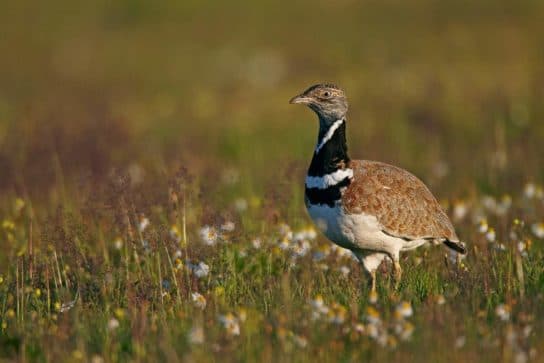
The little bustard is a stocky bird of the bustard family with a distinctive neck pattern in breeding plumage. In the adult male, during courtship, thin, black, wavy lines appear on the upper part of the bright brown plumage.
Description of the appearance of the bird
The male has a “crown”, black neck and chest, a wide white V-shaped pattern on the front of the neck and a wide white stripe on the chest on a blue-gray head with striped-brown veins.
The upper part of the body is yellow-brown, with a slightly wavy black pattern. On the wings, flight and large feathers are pure white. In flight, a black crescent moon is visible at the bend of the wing. The tail is white with brown spots with three stripes, the underside is white, the paws are grayish-yellow, and the beak is slate-colored. The lower body is white. Black feathers on the neck, when the bird is excited, form a ruff.
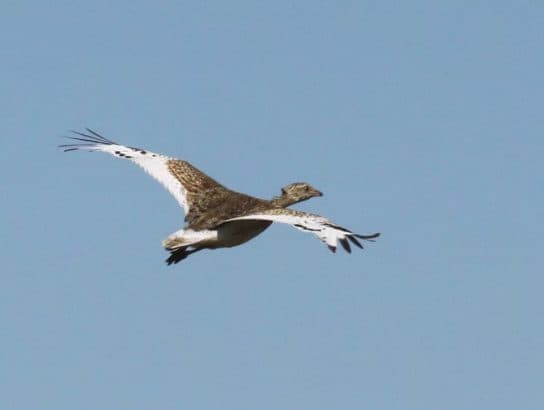
The non-breeding male lacks a black and white neck pattern, and blackish brown spots are visible on the feathers. The female is similar to non-breeding males, with more pronounced markings on the upper body.
Adolescents resemble an adult female, they have a large number of red and dark stripes on their wing feathers.
Habitat trembles
The bird for residence chooses steppes, open plains and plains with short grass, pastures and sown areas of legumes. The species needs vegetation and nesting places untouched by humans.
In which regions do little bustards live
The bird breeds in southern Europe and North Africa, in West and East Asia. In winter, northern populations migrate south, southern birds are sedentary.
How little bustards fly
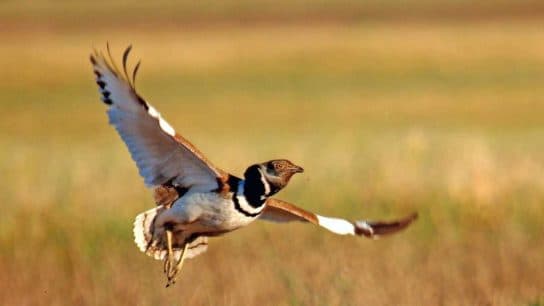
The bird walks slowly and prefers to run, if disturbed, does not take off. If it does rise, it flies with an extended neck, makes quick shallow flaps of slightly curved wings.
What do birds eat and how do they behave?
Little bustard feeds on large insects (beetles), earthworms, molluscs, amphibians and terrestrial invertebrates, consumes plant material, shoots, leaves, flower heads and seeds. Outside the breeding season, little little bustards form large flocks to feed in the fields.
How males attract females
Little bustards perform impressive rituals to attract the female. The “jumping dance” takes place on a hill without vegetation or on a small area of clean ground.
The bird starts with a short tap, makes sounds with its paws. Then he jumps about 1.5 meters into the air, pronounces “prrt” with his nose and at the same time flaps his wings produce the characteristic sound “sisisi”. This ritual dance usually takes place at dawn and dusk, and lasts a few seconds, but the nasal sound is also pronounced during the day.
During the dance, the male raises a black ruff, shows a black and white drawing of the neck, and throws back his head. In jumping, males open their white wings.
Males chase females for a long time, often stopping to make sounds and waving their head and body from side to side. During copulation, the male repeatedly hits his partner on the head with his beak.
What do birds do after mating rituals?
The breeding season takes place from February to June. A little bustard nest is a shallow depression on the ground hidden in dense grass cover.
The female lays 2-6 eggs, incubating for about 3 weeks. The male stays close to the nesting site. If a predator approaches, both adults circle above its head.
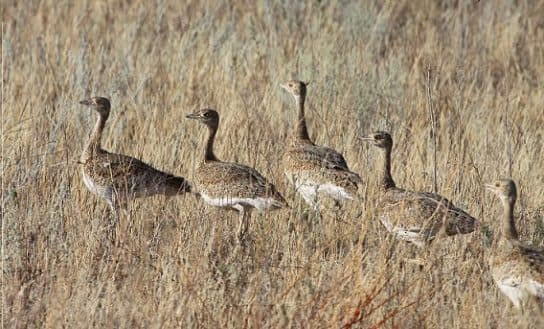
Chickens are covered with dark veins and spots. The down falls off 25-30 days after hatching and is replaced by feathers. Chicks stay with their mother until autumn.
What threatens the little bustard
The species is considered endangered due to habitat loss and changes in agricultural practices.
