


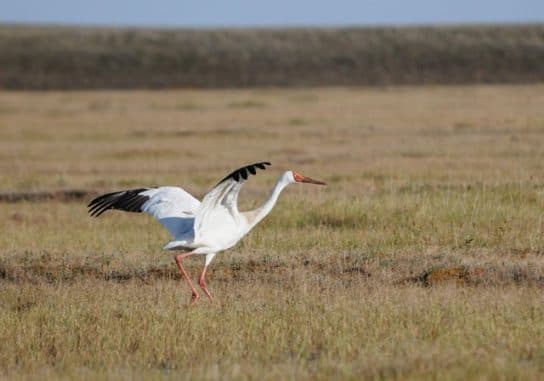
The Siberian Crane (lat.Grus leucogeranus) is a representative of the cranes order, the crane family, its second name is the White Crane. It is considered a very rare species with a limited habitat.
Description
If you look at the Siberian Crane from a distance, there are no special differences, but if you look at it close, the first thing that catches your eye is the large size of this bird. The weight of the white crane reaches 10 kg, which is twice the weight of other birds of the crane family. The growth of the bird is also considerable – up to half a meter in height, and the wingspan up to 2.5 meters.
Its distinctive feature is a naked, without feathering part of the head, all of it, up to the back of the head, is covered with red thin skin, the beak is also reddish, it is very long and thin, and its edges have small sawtooth notches.
The body of the crane is covered with white plumage, only on the tips of the wings there is a black stripe. Paws are long, bent at the knee joints, red-orange. The eyes are large, located on the sides, with a scarlet or golden iris.
Life expectancy of Siberian Cranes is 70 years, however, only a few survive to old age.
Habitat
Sterkh lives exclusively on the territory of the Russian Federation: two isolated populations were recorded in the Yamalo-Nenets Autonomous Okrug and in the Arkhangelsk Region. It is endemic.
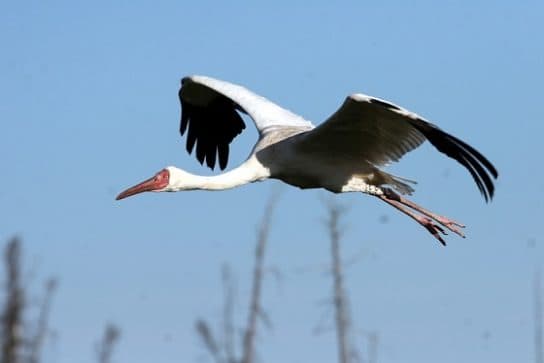
The White Crane prefers wintering places in India, Azerbaijan, Mongolia, Afghanistan, Pakistan, China and Kazakhstan.
Birds prefer to settle only near water bodies, they choose wetlands and shallow waters. Their limbs are perfectly adapted for walking on water and bumps. The main condition for the Siberian Crane is the absence of a person and his dwellings, he never lets people close, and when he sees from a distance, he immediately flies away.
Lifestyle and reproduction
White cranes are mobile and active birds; they devote all their time during the day to searching for food. Sleep is given no more than 2 hours, while they always stand on one leg and hide their beak under the right wing.
Like other cranes, Siberian Cranes are monogamous and choose a pair for life. The period of their mating games is very remarkable. Before starting pairing, the couple performs a real concert with singing and dancing. Their songs are amazing and sound like a duet. Dancing, the male spreads his wings and tries to embrace the female with them, which keeps its wings closely pressed to the sides. In the dance, lovers jump high, rearrange their legs, throw up branches and grass.
They prefer to nest among water bodies, on hummocks or in reeds. Nests are built by joint efforts, on an elevation, 15-20 cm above the water. There are often 2 eggs in a clutch, but under unfavorable conditions there may be only one. The eggs are incubated by the female for 29 days, the head of the family all this time is engaged in protecting her and her children from predators.
Chicks are born weak and frail, covered with light down, only one of the two survives – the one that is more adapted to life and hardy. It will be covered with red feathers only at the age of three months, and, if it survives, it will reach sexual maturity and white plumage by the age of three.
What Sterkh eats
The Siberian Cranes eat both plant foods and food of animal origin. From plants, berries, algae and seeds are preferred. From animals – fish, frogs, tadpoles, various aquatic insects. They do not hesitate to eat eggs from other people’s clutches, they can also eat chicks of other species left unattended. During wintering, their main diet is algae and their roots.
Interesting Facts
- At this time, no more than 3 thousand Siberian Cranes remain in the wild.
- The white crane is considered a bird-deity among the Khanty – the people inhabiting the North of Siberia.
- During the wintering flight, they cover more than 6 thousand kilometers.
- In India, Indira Gandhi opened the Keoladeo Conservation Park, where these birds are called white lilies.
