


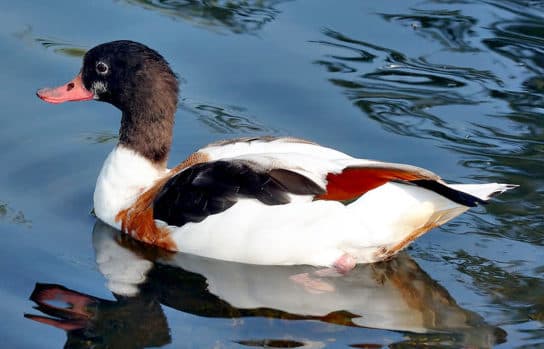
Sheep is a representative of the order Anseriformes, she belongs to the ducks.
Appearance
This is a duck weighing approximately 1 kg. The wingspan of the animal is slightly more than a meter – about 110-130 cm. The male is larger and brighter, and the female is pale. You can distinguish the female from the male by the white cheeks and forehead.
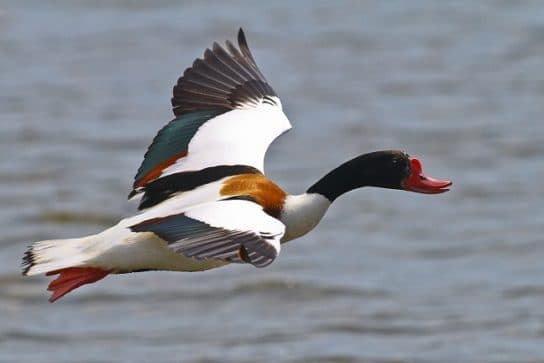
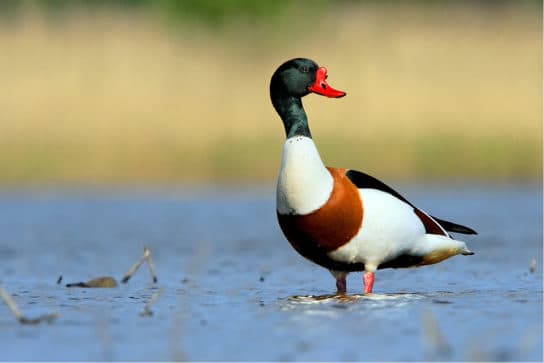
Adult males can be recognized by their black neck and head, their goiter is white, like the neck. A brown stripe can be seen on the upper chest. Only the inner feathers of birds are white, as is the back with the upper tail. A black stripe runs along the belly, and the undertail has a brown tint. Secondary flight feathers have a dark green undertone. The upper wings are white. There is a red growth on the beak, like the iris of the animal.
Listening to the voice of the sheep
Habitat
Shews live in Europe, usually by the sea. They can also be found in Asia, China and western Africa. These birds prefer deserts and steppes, they nest in burrows in the middle of some buildings or stones. Usually near salt water lakes. In fresh water bodies, they can be seen only during the period of roaming.
Lifestyle
It depends on the habitat. Migratory shelves live near the Mediterranean, the Caspian Sea and the Black Sea region. The population living in Europe is sedentary.
Sheep migrate en masse to the area near water bodies during the post-nesting molt. Scientists count thousands of flocks there at this time. During this period, that is, for a month, they cannot fly at all. Birds migrate to Knechtsend – an island located in the Elbe delta. Many birds from Europe flock there. Another famous place is the coast of the English Channel. There are fewer individuals – about 4000. By the end of the month, many animals fly to the nesting site, while others “wander” to their habitual wintering grounds.
For a large amount of time, animals are on the shore, they are able to run and walk quickly. Moreover, their body is in a horizontal position. They fly slowly, flapping their wings sharply. The flock forms a wedge in the air during migrations. Ducks swim well, but they rarely dive unless they are injured.

Birds that live near the coast prefer to rest on land during high tide, and during low tide they actively eat food found in shallow water. Usually there are a lot of small molluscs.
What eats
Shews usually feed on algae, but they also eat worms with shellfish and other marine life. Favorite food is water snails, which have to be taken out of the water with their beak. Birds find other victims in the sand.
Ducks are regulars on the seashore, they rarely go far from the water, as they do not like fresh moisture. You can find shelves and in the field, which is not far from the sea, there they are looking for plant seeds.

Reproduction
Shews are monogamous, they only create one pair during their life. During the mating season, males dance to attract the female to the coast. It is not uncommon for about 10 males to look after one female. All this happens in the spring. During the struggle for a female, the male shows his neck, stretching it out and squeaks, and then bows. Then the newly minted couple begins to look for a suitable place to create a nest.
The nest is carefully covered with grass, and the female makes a clutch, where there are usually about 20 eggs. She incubates them for a month. Shews often create colonies. In this case, the nests of the couples are very close and therefore fights often occur.
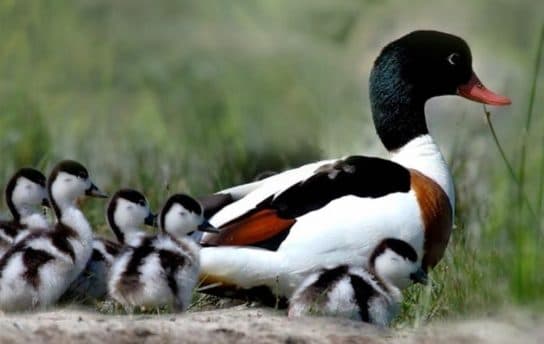
Sheep with ducklings
Chicks are born already developed and can swim calmly. Chicks are almost completely brown except for the forehead. The father usually protects and cares for them. Cubs live next to the nest for a couple of weeks. It happens that chicks from different nests unite into groups that are guarded by their parents. At 6 weeks old, little shelves are already looking for food on their own.
Vocalization
In the spring, males whistle when chasing a female. Males also cackle, and females quack while in the air. She can gag 12 times a second. In moments of alarm, the female yells loudly.

Life span
On average, shepherds live about 15 years, a record age for them – 24 years. That was the number of individuals from the British Isles.
