


The taxonomy of living things in biologists sometimes becomes the subject of controversy. This also affected the classification of the bighorn sheep, a representative of the order of cetopods. Some scientists see it as a separate species of the ram genus, others consider it a subspecies of bighorn sheep. Often the bighorn sheep is called bighorn… Other name – chibouk.
Description and appearance
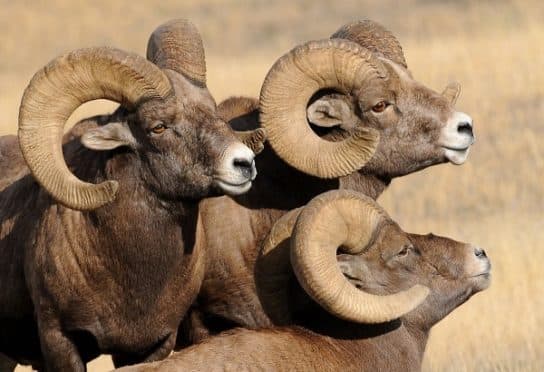
Nature has endowed this mammal with a powerful body with well-developed muscles. He has a short neck and a pointed head. The ears are also rather short (no more than 10-11 cm) and mobile. The brown eyes are set wide apart. The nose is raised, the upper lip is turned up so that the teeth are sometimes visible. Large and unusual horns grow on the head from the middle of the forehead. The diameter of their base is 30 cm. The horns of gray or brown color are twisted back and rolled forward and downward. The tips of the horns are directed forward, which does not bode well for enemies from a meeting with a ram. The length of the horns reaches a meter. In females, the horns are shorter, smaller and slightly curved upward.
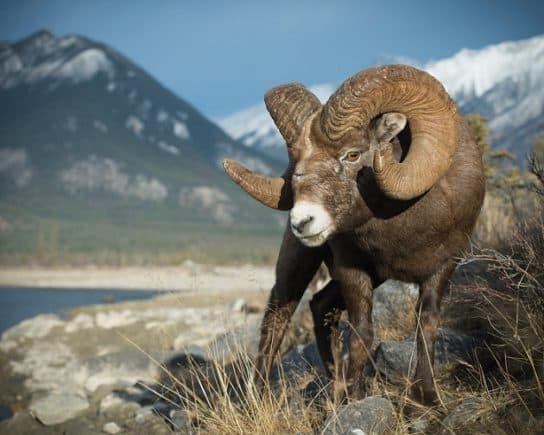
Males are larger: their body length can reach 188 cm, and their weight is 150 kg. Females usually do not reach 180 cm in length, and weigh no more than 68 kg. Bighorn sheep have thick legs. Moreover, the rear ones are longer than the front ones. This is due to a lifestyle that involves walking on mountain slopes. The hooves of animals are also adapted to these conditions. Their sharp edges help hold onto cracks and ridges, and the rough pads on the back of the hooves prevent them from sliding over the smooth surfaces of rocks and ice.
The fur of bighorn sheep can be brown, reddish, gray and even white. The muzzle and belly are usually light: white or yellowish. By winter, the fur becomes thick due to the undercoat. In the spring after molting, it is smoother and shorter.
Distribution and habitats
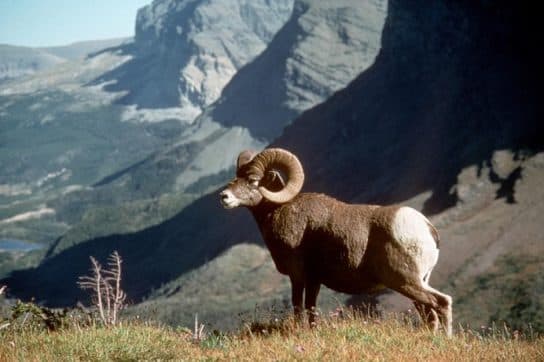
The range of this species of artiodactyls is limited to a small territory of Siberia. It is common in Yakutia, Magadan region, Krasnoyarsk and Kamchatka krais, Chukotka and Sakhalin island. The bighorn sheep live in mountainous areas at an altitude of 300 m. In higher regions, they usually do not settle, since there the snow cover can reach 40 cm. And such a layer of snow does not allow rams to move comfortably and get food.
Rams migrate over short distances, mainly vertically. In winter, they descend lower and look for uneven and little snow places. In summer, on the contrary, they try to move as high as possible to the mountains, leaving the valleys.
Nutrition and lifestyle
The bighorn sheep is a herbivore. Its main diet consists of higher herbaceous plants. Mushrooms and lichens are also eaten. In spring and summer, bighorns feed on cereals, legumes, buckwheat, sedge, and Compositae plants. In the fall, ripe mushrooms and berries are added to this list. To maintain normal levels of minerals in the body, animals look for alkaline soils. From these they get the necessary salts. In winter, animals feed on lichens, thorny twigs, and extract dry grass from under the snow. In this harsh time of the year, plant roots and even needles are eaten.
Reproduction
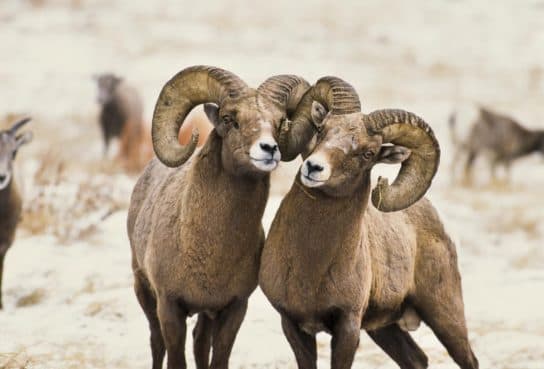
Sheep usually live in groups of 3-4 males and 7-8 females. The reproductive age in females begins much earlier: two years after birth. Males reach maturity by 4-5 years of age. During the mating season, the male part of the herd fights for females, arranging short fights.
Pregnant individuals leave their relatives and settle in a cave and a cleft of rocks. This position protects well from predators. After 5 months, a cub is born. Diversity in bighorn sheep is a rare phenomenon.
Red Book and Number
One of the limiting factors in the number of shanks is their natural enemies: wolverines and wolves. Only these predators manage to track down and catch such difficult prey. In addition, they easily tolerate winter cold. Sheep usually manage to escape by hiding in cracks and caves. There they wait out blizzards and snowstorms.
The number of animals is influenced by hunters. They hunt down rams for meat and a horned head trophy. Bighorn sheep hunting is prohibited, but poaching is still present. The decline in livestock is also influenced by the improvement of the bighorn sheep habitat by humans for pastures of livestock.
In the IUCN Red List, the bighorn sheep is present as the species that is least threatened. However, some subspecies are endangered (for example, Yakut and Putorana). The total number of the species is about 100,000 heads. Among the measures taken to protect these animals, the most effective is their transportation to reserves. Attempts are also being made to cross bighorn sheep with other species.
Interesting Facts
Bighorn sheep are unique and amazing animals. They have adapted to life in very harsh conditions of high mountains, cold and lack of food resources.
The digestive system of the bighorn sheep is perfectly adapted to the harsh conditions. They have powerful jaws. They help animals chew on straw and thorny vegetation. Rams also have very long intestines. This feature allows them to eat large amounts of food, storing it for future use.
The appearance of the bighorn sheep has more in common with mountain goats than other types of rams. This is due to a specific way of life, which implies constant movement through mountainous terrain. Modifications to their skeletal structure improved the balance and jumping ability of the animals.
A meeting with a bighorn sheep is a rare phenomenon, if only because it settles in places that are difficult for humans to reach. You have to track him down on purpose. This is what scientists and, unfortunately, poachers are doing. And if the former conduct scientific activities in order to preserve the species, then the latter kill unique animals more often simply because of a beautiful trophy. Hunting for bighorn sheep is prohibited by law. A fine for the destruction of an individual of this species is punishable in our country by a fine of 100,000 rubles.
