


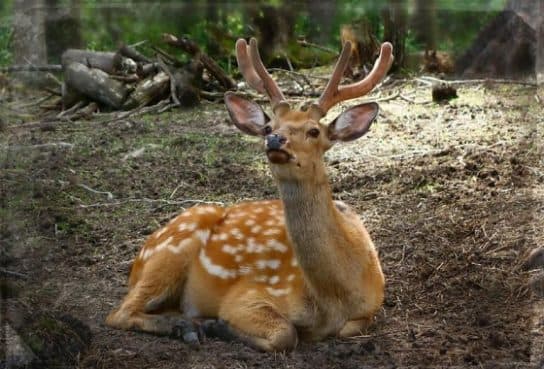
In the twentieth century, the sika deer was on the verge of extinction, only a few remained of the former abundance of individuals of this species. The main factors that influenced the sharp decline in the sika deer population include: killing an animal for meat, skin, horns or unfavorable living conditions (lack of food). Not only humans, but also predatory animals took part in the extermination of the species.
Description
Sika deer belongs to the Real Deer genus, which belongs to the deer family. This species of deer is distinguished by a graceful constitution of the body, its beauty is revealed upon reaching the age of 3 years, when males and females reach their final height and appropriate weight.
In the summer season, the color of both sexes is practically the same, it is a red color with white blotches in the form of spots. In winter, males’ fur darkens and acquires an olive-brown color, while females become light gray. Adult males can reach 1.6-1.8 meters in length and 0.95-1.12 meters in height at the withers. An adult deer weighs 75–130 kilograms. Females are much smaller than males.
The main pride and property of the male are four-pointed horns, their length can vary from 65-79 centimeters, with a characteristic brown color.
The color of each representative of this species is individual and can be either lighter or darker by several tones. On the deer ridge, the color is several shades darker, and on the limbs it is much lighter and paler. The body of the animal is dotted with local spots, which are larger in the abdomen, and much smaller on the back. Sometimes white spots form stripes, the coat can reach a length of 7 centimeters.
Red Book
The Ussuri sika deer belongs to rare species of animals and is listed in the Red Book. The habitat of this species is the southern part of China, as well as in the Primorsky Territory in Russia. The total number of individuals does not exceed 3 thousand heads.
The Red Book is an official legislative document; it contains a list of animals and plants that are endangered or endangered. Such animals need protection. Each country has a red list, in some cases a certain region or region.
In the 20th century, the sika deer was also listed in the Red Book. Hunting for this species is prohibited, in case of killing a sika deer, it will be poaching and is punishable by law.
In Russia, the Ussuri deer is restoring its numbers in the Lazovsky reserve, as well as in the Vasilkovsky reserve. In the XXI century, it was possible to achieve stabilization and increase in the number of this species.
Sika deer life
Animals occupy individual territories. Loners prefer to graze on plots of 100-200 hectares, a male with a harem needs 400 hectares, and a herd of more than 15 heads needs about 900 hectares. When the rutting period ends, adult males form small groups. The herd may contain young of different sexes, which have not yet reached 3 years of age. The number of the herd grows towards winter, especially if the year was good for the harvest.
Males who have reached the age of 3-4 years take part in mating games; they can have a harem of up to 4 females. In nature reserves, a strong male can cover 10 to 20 females. Fights of adult males are very rare. The female bears offspring for 7.5 months, calving falls at the beginning of June.
In the summer, sika deer feed both day and night, and are also active on clear days in winter. During unfavorable weather conditions, for example, during snowfalls, deer prefer to lie down in dense forests.
In the absence of snow, an adult is able to move quickly enough, easily overcomes obstacles 1.7 meters high. Snow drifts slow down the movement of animals, cause them to move in leaps and bounds and cause problems finding food.
Sika deer can carry out seasonal migrations. The life span of deer in the wild is no more than 15 years. Reduce their lives: infections, hunger, predators, poachers. In reserves, zoos, sika deer can live up to 21 years.
Where dwells
In the 19th century, sika deer lived in northeastern China, North Vietnam, Japan, and Korea. Today this species has mainly remained in East Asia, New Zealand and Russia.
In 1940, sika deer were settled in the following reserves:
- Ilmensky;
- Khopersky;
- Mordovian;
- Buzuluk;
- Oksky;
- Tebedinsky.
Sika deer prefer the southern and southeastern slopes of the coastal ridges, on which snow lies for a short time in the winter season. Juveniles and females prefer living closer to the sea or lower along the slope.
What eats
This type of deer eats only plant food, of which there are about 400 species. In Primorye and East Asia, 70% of the diet is trees and shrubs. The sika deer uses as feed:
- oak, namely acorns, buds, leaves, shoots;
- linden and Amur grapes;
- ash, Manchurian walnut;
- maple, elm and sedges.
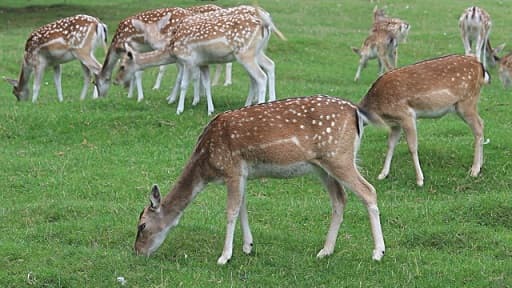
The animal has been using the bark of trees for food since the middle of winter, when large tracts of land are covered with snow, and branches of alder, willow and bird cherry are not neglected. They rarely drink sea water.
