


Blue shark (blue shark, great blue shark) – This is a marine inhabitant that belongs to the order of karharin-like and the family of sawtooth sharks. Today this species is listed in the IUCN Red List.
Appearance
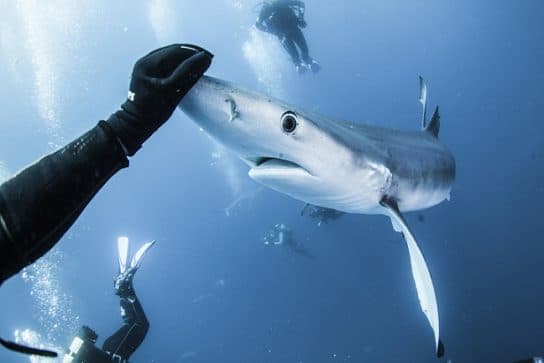
The back of the blue shark is colored indigo, the sides of the specimen are bright blue. The belly is usually grayish. This color is camouflage in nature: the bottom inhabitants simply do not notice blue sharks, because they mix with sunlight.
The shark’s body is elongated; this predator has large pectoral fins, a tapered muzzle and large eyes. There are approximately 5 pairs of gills on each side. Females are usually larger than males. The body length varies from 2 to 3 meters. The female weighs 93-182 kg, and the male about 50 kg. The maximum registered weight is 390 kg.

The teeth of the blue shark are very sharp, the upper killing instruments are triangular in shape and concave inward. The teeth located on the lower jaw are subulate. There are grooves on the face of this marine life, which help to capture odors better. Therefore, blue sharks are able to smell a drop of blood for several tens of kilometers. The shark’s nostrils have a groove and special folds – nasal valves. The third eyelid protects the eyes.
The pectoral fins are sickle-shaped. The anterior dorsal fin is much more massive than the second. The blue shark has a long and flattened tail peduncle on the sides.
The skin scales of this sea dweller are small, they fit tightly to each other. Therefore, shark skin is soft and smooth.
Where dwells
The blue shark lives in temperate and tropical waters. It is often found in the waters off Norway, Denmark. The shark is an inhabitant of the Adriatic and Aegean Seas, and also lives in the waters of the Ionian Sea. The predator lives at a depth of about 350 m. The most pleasant temperature for a shark is 7-16 ° C. However, it can be found in places with temperatures around 21 degrees.
This shark migrates frequently. Young and mature males often hibernate near the Gulf Stream, but most males prefer to do so off the coast of South America. Females native to England swim about 700 miles.
Behavior
The blue shark prefers to lead a solitary lifestyle. Predators form schools very rarely, moreover, such groups consist of same-sex sharks. The weight of the individuals is also almost the same. Females interact with males only during the mating season.
These marine life often migrate with schools of other fish. They can swim thousands of kilometers. It is almost impossible to spot sharks off the shelf.
Sense organs
Blue sharks have well-developed eyesight and smell. They can feel the slightest vibrations in the water. On the lower part of the muzzle, they have Lorenzini ampullae that respond to changes in the electric field.
Natural enemies
The main opponents of blue sharks are white sharks. Young animals are often attacked by elephant seals. Many blue sharks are parasitized by copepods. They live on the skin of marine predators.

White shark – the enemy of blue sharks
The diet
Blue sharks are carnivorous marine life. They hunt shellfish and fish. The basis of the diet is made up of tremoctopus with pelagic octopuses, cranchia squids. Shark fish are distinguished by large-headed alepisaurs and ruvets. Individuals living in the waters surrounding Brazil prefer petrels. They love blue sharks and tuna, mackerel. Many sharks “chase” fishing vessels and eat food leftovers thrown overboard. Blue sharks can also eat carrion, especially whales.
Reproduction
Females reach sexual maturity at 5 or 6 years of age, and males only by 4-5 years. Cavaliers are unusually sympathetic by biting females. Expectant mothers have rather thick skin, so no traces remain. Males most often bite the back, namely the place between the first and second fin.
Individuals mate near the continental shelf. The male and female do not contact after this. Sharks mate with several individuals.
Sperm cells can remain in the body of an expectant mother for a very long time: from a month to several years. This continues until ovulation occurs.
Pregnancy can last 9-12 months. Females give birth in fairly cold waters. From 25 to 50 sharks can be born. The length of the newborn is about 30 cm. These marine predators are fully formed at the time of birth. Cubs remain in subarctic waters until they reach sexual maturity, and then migrate to tropical waters.

Danger
These sharks are very dangerous to humans. They most often attack divers and fishermen going out into the open sea or ocean. There are frequent cases of hunting for people who were saved during a shipwreck.
However, humans are also dangerous to sharks. Because of the tender meat, which is devoid of the ammonia smell, sharks are often hunted. This fishery is the most popular in the United States.
Hunting
Sharks usually swim slowly without making any sudden movements. However, one has only to catch a good moment to attack, the shark breaks down and swims at a speed of 40 km per hour.
Shark Fishing Rules
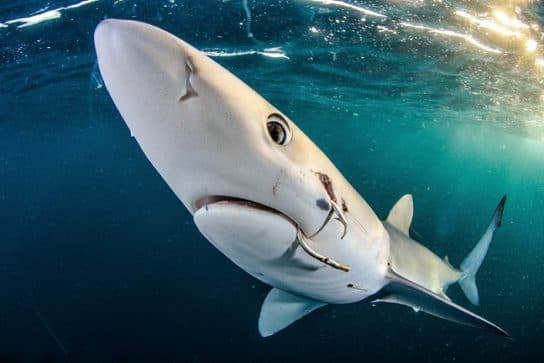
Today you can catch blue sharks. This is usually done with a rod. Mackerel is used to get the shark’s attention. Often, only small sharks 1-1.5 m long can be caught this way. If a shark is caught, whose weight is less than 45 kg, it must be released.
