


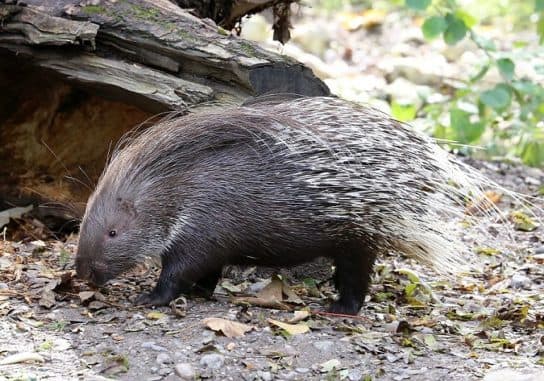
The Indian porcupine is a mammal belonging to the porcupine family and the crested species. He voluntarily distributes seeds, so his role is important in the ecological system. The porcupine is a rather large and weighty representative belonging to the order of rodents.
Appearance
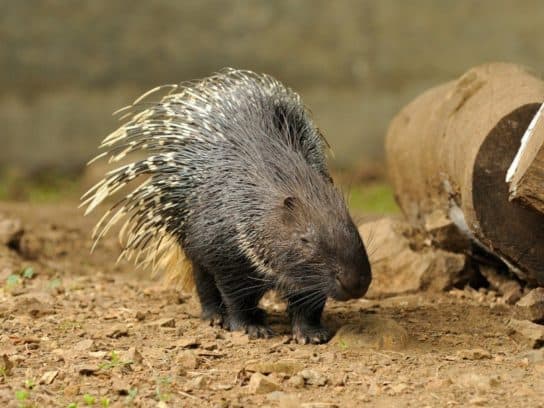
The body of the Indian porcupine is 70 to 90 centimeters long. The tail lengthens the body by another 9-10 cm. The limbs are short, wide with claws. The porcupine digs the ground with its claws. He moves slowly and awkwardly. The head has a gray ridge. Ears and eyes are small. The porcupine sees poorly, but his sense of smell and hearing are wonderful.
The weight of the rodent lies in the range of 12-18 kilograms. Spines are narrow tubes with a horny mass inside. They are not the same, there are two types of them:
- Some are thin, flexible and long. They fall out easily.
- Others are solid, much shorter and thicker.
The spines are black or brown, separated by alternating white stripes. In the cervical and shoulder region, they are long (50 cm), and in the region of the back and back, the spines are much shorter (20 cm). The spines, which are shorter, play a protective role.
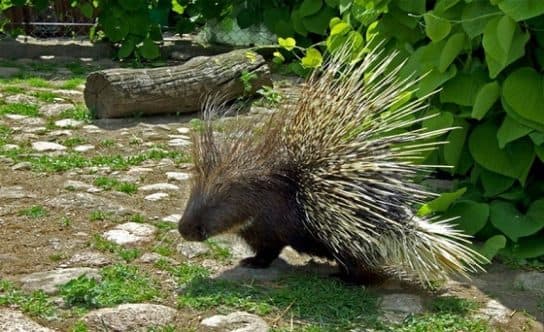
On the tail are concentrated whitish spines, between which there are needles. Porcupine makes noise with their help, at the sight of a predator. The muzzle has a rounded shape, its surface has no needles, but it has hair on it.
Habitat
The Indian porcupine lives in Asia and the Middle East. It is found in the territories:
- Nepal;
- Bangladesh;
- India;
- Sri Lanka;
- Israel;
- Pakistan;
- Saudi Arabia;
- Iran.
The porcupine is great in any locality. These are hills of rocky mountains, a forest or shrub zone.
Nutrition
The diet of Indian porcupine includes fruits of various plants, greens, rhizomes, bulbs, bark.
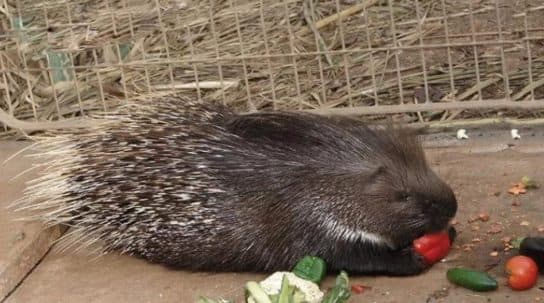
In the spring, the rodent eats roots, bulbs and young shoots. When the fruits ripen on the trees, he appears in the gardens and eats the fruits lying on the ground. In summer, the porcupine hunts in the fields where corn and sorghum grow, and also eats melons and gourds. He sometimes eats insects and small vertebrates.
In the fall, she regales herself with grapes and all ripe fruits. The Indian porcupine differs from desert rodents in that it definitely needs a watering hole.
In winter, the rodent does not sleep, although it becomes less active. It feeds on the bark of shrubs and trees and feeds on plant roots.
Lifestyle
The most active Indian porcupines are in the evening and at night. During the day, they are in burrows, which they build on their own or use ready-made ones. Each burrow has an entrance corridor, three or four exits and a large interior room. They have created families in which parents and their offspring live. Around the burrow, the territory is marked, protected and strangers are not allowed on it.
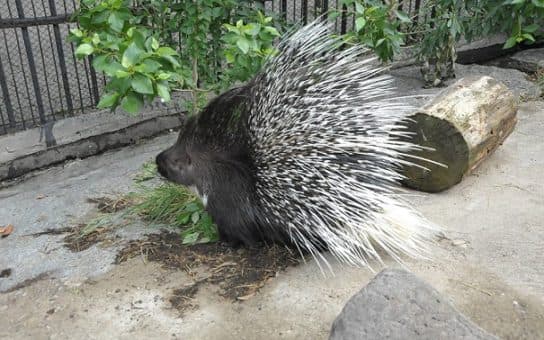
Porcupines are able to climb trees, but prefer to move on the ground. If the need arises, they can overcome the water barrier.
Reproduction
The Indian porcupine reaches sexual maturity by two years of life. Mating takes place all year round, since married couples live together until the death of their partner.
Pregnancy lasts 90-105 days. The female gives birth to 2-4 cubs.
The female feeds the cubs with milk for two to three months. Cubs live with their parents until puberty.
Population and protection
The population of the Indian porcupine is stable. The protection status is the least dangerous. Porcupines play an important role as distributors of pollen and seeds of plants, therefore, provisions are made in the law of India to promote the conservation of the species.
