


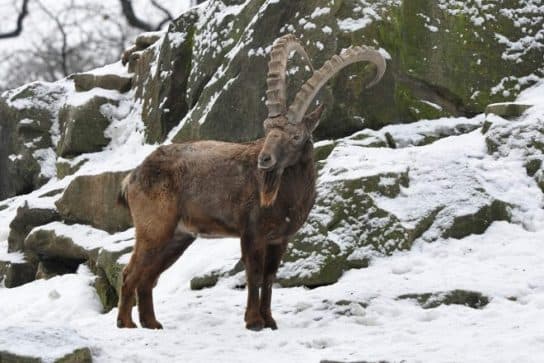
Siberian mountain goat (lat. Capra sibirica) also has another name – the Central Asian stone goat. This is the largest species of artiodactyls. He is distinguished from other goats by his powerful body, grace and grace. Sharp horns combined with a large body give it a formidable and dangerous look. However, in reality, the mountain goat is rather cowardly.
Description
The Siberian ibex belongs to the animal kingdom of the chordate type. He is a representative of the artiodactyl squad of the bovids family. It differs from other goats in its powerful and beautiful appearance.
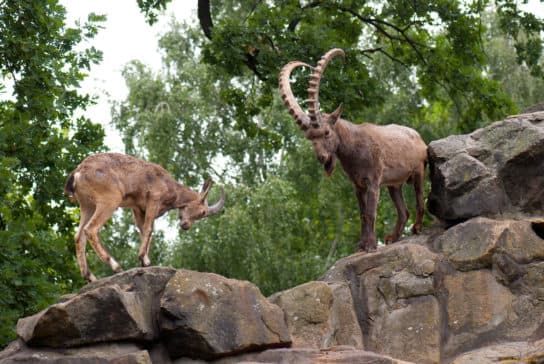
Their main decoration is horns. Their active growth begins in the 2nd year of life of the Siberian ibex. After a short period of time, their development slows down. During the mating season, skirmishes occur between males, because of which the horns quickly wear out and take on a shabby appearance. It is worth noting that in the course of such battles, goats often lose one horn.
Representatives of this species live in a herd or in small families. Their number depends on the season. Most of the animals in the herd are in the winter season. Their number can reach hundreds.

For reference: mountain goats cannot run fast, but they can climb rocks quite well. This is exactly what they do in times of danger. In addition, the rocks save animals from the scorching sun and bad weather. Because of this, the goats never stray far from them.
Appearance
The Siberian ibex is one of the largest representatives of the genus. The body length is 160 cm. The weight of a healthy male reaches 125 kg. The body weight of the female is slightly less – 55 kg, and the body length is 136 cm.
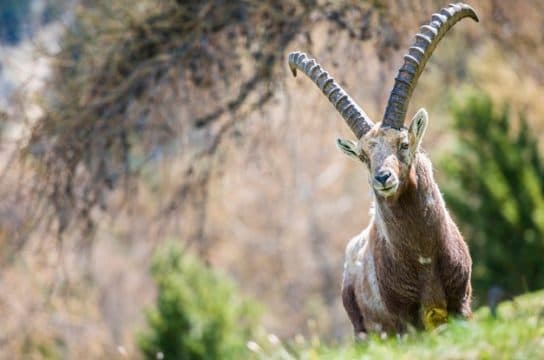
Mountain goats have well-developed neck muscles. She is long and sedentary. The legs are short but strong. The head is shortened, the forehead is slightly convex. This species has a beard. Most often it has a dark color. The rest of their body hair is coarse and thick. There is a dense undercoat. In some individuals, the coat on the chest lengthens. In summer, the fur of the goat has a brownish color, while the bottom is always lighter. With the onset of winter, the color changes to yellowish gray. From the back of the head along the back to the base of the tail, there is a black-brown stripe.
Red Book and Number
It is a rare species whose population is declining. In the Red Book, the Siberian mountain goat is assigned to the 3rd category. It is interesting to note that its status was changed to a declining species only in 2020.
The number of ibex in the Uda river basin in 1961 was 1,000. In 1991, the Khabarovsk hunting expedition estimated the resources of the mountain goat in Tofalaria at 600 pieces. In 2000, the number was 758 heads.
According to new data, in the south of the region, an absolute record for the number was recorded – 874 pieces. The number of goals is 2 hundred more than in 2018 and 2019, which were considered very high.
What zone does it live in
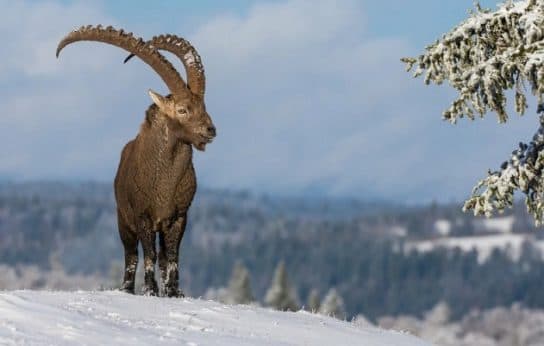
The Siberian ibex lives in Russia, China, Afghanistan, Kyrgyzstan, Uzbekistan, Kazakhstan, India, Pakistan. In Russia, they live mainly in southern Siberia. Most of the heads are in Altai in the Argut river basin. Mountain goats were also found on the territory from the right bank of the Yenisei to Lake Baikal – on the Eastern Sayan.
As a dwelling, representatives of this species choose rocky areas and mountains. They can also settle within the forest zone, but this happens quite rarely. Another favorite place of Siberian mountain goats is the forbs of alpine meadows. In winter, they find the least snowy places to live. This is due to the fact that one hundred under their weight they strongly fall into the snowdrifts, because of which they become helpless.
What eats
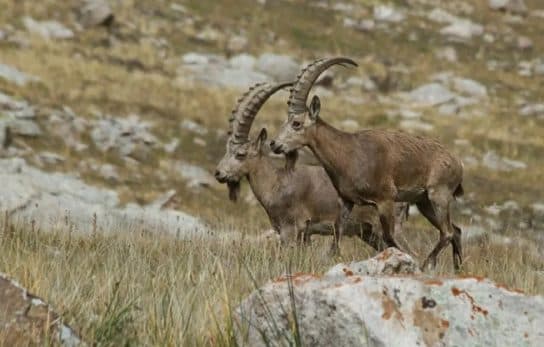
The diet of the mountain goat is dominated by plant foods. In the summer, he feeds on grass. In the fall, cereals appear on his menu. At the same time of the year, he begins to eat wood-branch feed: mountain ash, willow leaves, rose hips, currants. With the onset of the winter months, the animal moves to dry grass. It is easy to find it under a little snow cover, or in those places where it is completely absent.
For reference: the diet of Siberian mountain goats consists of herbaceous plants and young shoots of shrubs. Often in search of food, they visit pastures located in the lowlands of the mountains.
Lifestyle
The peak of activity of Siberian mountain goats occurs during the daytime. They are very careful and discreet. They have keen eyesight and keen hearing. This is what saves them from predators. There is always a guard male in the herd. During rest or feeding, he protects animals. For this, the watchman climbs a hill, from where the surrounding area is clearly visible. When a threat is detected, it instantly notifies the herd of the danger. The Siberian ibex makes almost no sound. He uses a whistle as a danger signal.
Herds are formed from 15-20 heads. With the onset of puberty, males create their own colonies, where hierarchy reigns. The number of such groups does not exceed 10 animals. Like humans, goats have their own personality. Often there are animals with a disgusting disposition. They are not ready to obey anyone, so they live detachedly, or constantly fight with the leader.
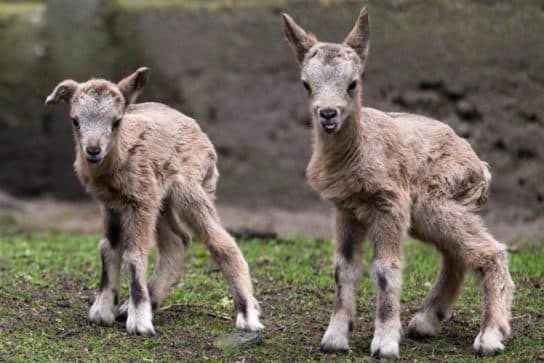
Siberian mountain goat kids
Interesting Facts
The Siberian ibex attracts attention not only with its powerful appearance, but also with interesting facts:
- In winter, animals keep closer to the warm southern slopes, where there is dried grass. To find her under the snow, they rip it open with their forelimbs.
- The animal is considered sedentary, but small seasonal movements are allowed.
- Both females and males have horns. However, in males, they are much more massive and longer. In addition, they are strongly curved back.
- In adult males, next to the tail, there are special folds in which an odorous secret is produced, and its production occurs at the time of the “mating season”.
The Siberian ibex tries to stay away from people. However, if he notices the person, then he does not try to immediately run away. Initially, he will take a closer look at him and observe his actions, being at a decent distance from him. In case of danger, he will quickly and gracefully begin to climb up the rocks.
