


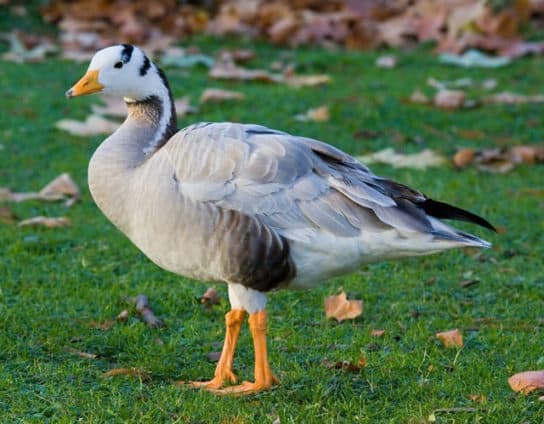
Mountain goose (Anser indicus) – order – Anseriformes, family – duck. It belongs to nature conservation species and is listed in the Red Book, at this time, according to scientists, the approximate number of birds is only 15 thousand individuals.
Description
Due to its plumage, this species is easily recognized. Almost the entire body of the Mountain Goose is covered with light gray feathers, only the dewlap and undertail are white. The head is small, with small light feathers, the neck is dark gray, the forehead and occipital region are crossed by two wide black stripes.
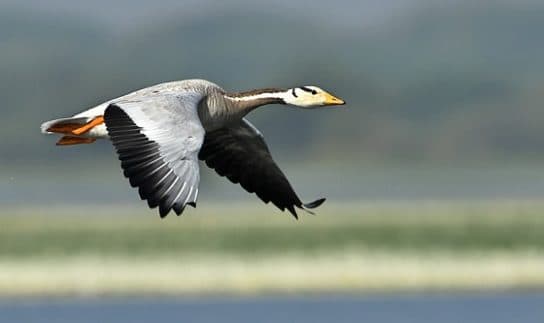
The legs of the bird are long, covered with rough yellow skin, the beak is medium, yellowish. Due to the length of the limbs, the feathered gait seems awkward, waddles over land, but in the water he has no equal – he is an excellent swimmer. Body weight is small – 2.5-3 kg, length – 65-70 cm, wingspan – up to one meter. It is considered one of the highest flying species, it can rise to a height of 10.175 thousand meters, breaking such a record is only possible for vultures, which soar over 12.150 thousand meters above the ground.
Miners fly with a key, or an oblique line, every 10 minutes the leader is replaced by the next one in the column. They land only on the water, before that, be sure to make several circles over the reservoir.
Habitat
The Mountain goose settles, loves in mountainous terrain, its habitat is the Tien Shan, Pamir, Altai and the mountain systems of Tuva. Previously, they could also be found in the Far East, Siberia, but now, due to a decrease in the population, in these regions it is considered extinct. Flies to India and Pakistan for the winter.
It can nest both on mountain heights and on plateaus and even in forests. Nests are built from materials available in the habitat, but they must be lined with fluff, moss, dry leaves and grass. It can also occupy other people’s abandoned clutches. There are cases when the Mountain goose nested in the trees.
Mountain geese form monogamous couples, together they are for life, or until the death of one of the spouses. Every year they lay from 4 to 6 eggs, which are incubated for 34-37 days only by the female, while the male is engaged in the protection of the territory and the brood.
A few hours after birth, the goslings are already quite independent, so the family moves to the reservoir, where it will be easier for the young to protect themselves from danger.
In the first days of life, babies do not swim, when a threat appears, the mother tries to take them to coastal bumps or reeds. Parents take care of the offspring throughout the year, young goslings break away from the family only the next year, after returning from wintering. Sexual maturity in Mountain geese occurs only at 2-3 years, life expectancy is 30 years, although only a few survive to old age.
Nutrition
The mountain goose prefers to eat food of both plant and animal origin. In his diet mainly young shoots of various plants, leaves and roots. He considers cereals and legumes in the fields a special delicacy, which can harm crops. Also, he is not averse to feasting on various small animals: crustaceans, aquatic invertebrates, molluscs, various insects.

Interesting Facts
- The mountain goose is very curious and not shy. The famous geographer and traveler Nikolai Przhevalsky, in order to lure this bird, simply lay down on the ground and waved his hat in front of him. Driven by interest, the bird came close to the scientist, and easily fell into the hands.
- The couples that have taken place at the Mountain Goose are very devoted to each other. If one of them is injured, the second will definitely return, and will protect him with his valuable life until he takes his partner to safety.
- A mountain goose can fly for 10 hours without ever stopping to rest.
- Another feature of these birds is that their chicks jump from the tops of trees or rocky peaks without harm to their body.
