


Quails are small birds, close relatives of pheasants and partridges. They have a characteristic shape – a small squat body and long pointed wings. About 20 different species live in nature, 70 domesticated quail species are kept as poultry.
Specifications
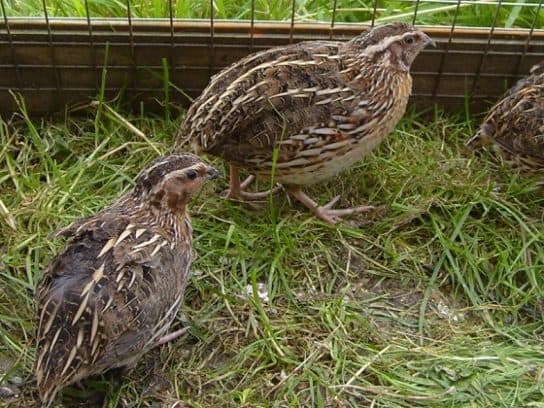
The body of the bird is decorated with feathers in blue, black, brown, cream or white stripes. Quails have long and strong brown legs. The underparts of the bodies are colored warm, bright orange. Quail beaks:
- short;
- curved;
- thick;
- black.
The body length of the quail is 10-20 cm, the bird weighs from 70 to 140 g, the wingspan is 32-35 cm. Quails have long pointed wings, but birds fly over short distances.

Different types of quail are different in color, size and habitat. Some quails have a tuft on their heads, which is in the shape of a tear.
Quail habitat and diet
Quails live:
- in wooded areas;
- in fields and open spaces covered with bushes;
- in the meadows;
- on agricultural land.
The birds are endemic to Europe, Australia, Asia, Africa and America. Wild species of Japanese quail live in Russia, East Asia and Africa.
Birds live in the same area all their lives, most species do not migrate. Quails do not climb trees or bushes.
Quails are omnivorous, but 95% of the diet consists of plant substances, birds eat:
- grass seeds;
- berries;
- leaves;
- roots;
- worms;
- insects such as grasshoppers.
Quail behavior in nature
Depending on the species, quails are active during the day or at night. They scrub feathers to get rid of pests by bathing in the dust. Quails are solitary birds, but they also spend time in pairs.
During the mating or winter season, they form flocks.
Which of the predators hunts quail
Due to the size of birds and the vulnerability of eggs, many predators feast on quail, these are:
- snakes;
- raccoons;
- foxes;
- proteins;
- coyotes;
- skunks;
- hawks;
- dogs;
- cats;
- owls;
- rats;
- affection.
People are the main predators that kill the most quails.
Faced with predators, quail:
- run away and hide.
- fly over short distances;
- freeze motionless.
Some species of quail have heel spurs, these bone structures they use against predators.
Quails are difficult to spot in the grass due to their camouflage plumage.
How birds communicate with each other
Quails emit high-pitched, grunting and giggling sounds, reproduce them rhythmically and harmoniously.
How quails give birth and care for a nest
Nests are located on the ground, preferably in open areas, cereal fields with wheat, maize and meadows.
When the quails are 2 months old, they are ready for marriage. The female lays 1 to 12 eggs, usually 6, depending on the species. Quail eggs are brightly colored. Chicks hatch after about 3 weeks.
In most quail species, chicks are developed, leave the nest and follow their parents immediately after hatching.

How long does a quail live
Wild species live from 3 to 5 years.
Quail in household and agriculture
In some parts of the world, quails are kept as poultry or poultry for meat and dietary eggs. Quail is the smallest farm bird, weighs only 100 grams. 80% of all commercially raised quails are bred in China.
In the EU, 100 million quails are raised per year. In just a year, about 1.4 billion quails are raised in the world.
Quail eggs lay their eggs when they are about 7 weeks old. Chickens are slaughtered at 8 months of age. Quails raised for meat are slaughtered at 5 weeks.
