


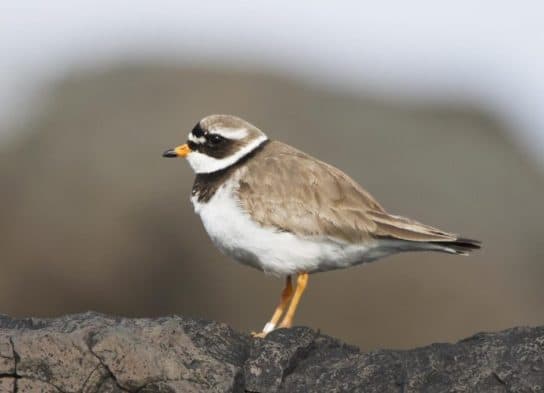
Tie is a bird from the plover family. Its size is small: body length up to 20 centimeters, and weight up to 65 grams. Ties are widespread in the tundra zones of Eurasia, as well as in North America. They are also on the territory of Russia – in the Kaliningrad region, along the coast of the Baltic Sea.
What does a tie look like?
The color scheme of the tie is memorable and even elegant. Here black, gray and white colors alternate, which are distributed in strict areas over the feathers of the bird. The dorsal part and crown of the tie are brown-gray; on the wings the same and black colors alternate. The beak is yellow, with an orange tint, at the tip the color turns to black.
Young birds that have already left the state of chicks, but have not finally matured, look somewhat different. So, the color of plumage in “adolescents” has a less saturated color, and the black color is almost everywhere replaced by brown. Also, a young tie can be identified by its beak: orange and black colors do not have a clear border, mixing into a kind of intermediate shade.
The tie got its name thanks to the “branded” black stripe around the neck. She has a rich black color, clearly standing out from the surrounding white feathers. This gives the bird a strict and businesslike look, immediately associated with a tie.
Tie tie lifestyle
The typical habitat of the tie is the tundra, sandbanks or pebble shores of water bodies. As migratory birds, they return to their nesting sites with the onset of the warm season. Scientists have proven that each bird flies exactly to the place where it nested last year. Thus, all neckties (like many other species of birds) always return to their place of birth.
The nest of this bird does not represent complex design solutions. This is a common pit, the bottom of which is sometimes lined with natural material – leaves, grass and its own down. The nature of this litter may vary depending on the local area and climatic conditions.
An interesting feature of the tie is the creation of false nests. In general, the male is engaged in the construction of the “house”. He digs several holes in a suitable area at a decent distance from each other. And only one of them becomes a real nest.
There are four eggs in a standard tie clutch. It is very rare that this number changes by three or five. Since the nests are located directly on the ground, and do not have special protection, they often become the object of attacks by predatory animals and birds. If the clutch dies, the female lays new eggs. The number of clutches per season can reach five.
In a normal situation, without “force majeure”, tie-makers create a clutch and hatch chicks twice a summer. In regions with a cold climate and tundra terrain – once.
A kind of tie
In addition to the usual tie, there is a web-footed tie. Outwardly, it looks almost the same, but differs, for example, in the presence of membranes on the paws. And the surest sign by which you can distinguish between two birds is a voice. An ordinary tie has a low whistle of a very sad tone. The web-footed “brother” has a sharper and more optimistic voice. His whistle has a rising tone and looks like a kind of “he-ve”.
Webfooted Tie is widespread in Alaska, Yukon, and other northern areas. It also nests in the tundra and flies to warmer regions with the onset of cold weather.
