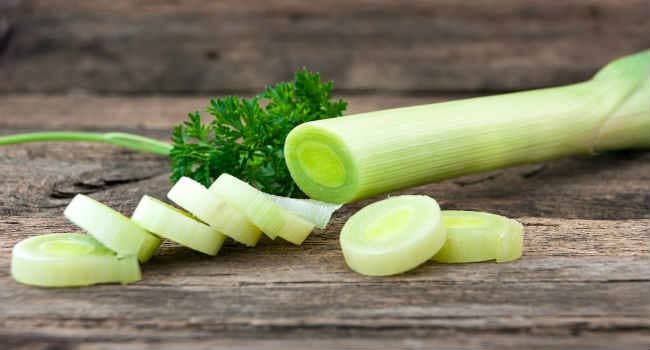


The leek belongs to the Allium family of the onion subfamily, which is grown in different parts of the world. It is known for its long green leaves, which look like the feathers of garlic, and a white stem with a slight thickening at the end. Leek has a sweetish pleasant aroma, more subtle than regular onions or shallots. It can be eaten raw, added to salads, stewed and boiled. In addition, leeks contain several beneficial compounds that may be beneficial to health. Let’s take a closer look at this type of onion and find out what its benefits are and whether there can be harm.Leeks are not yet so widespread in our country and there are not so many people who buy and eat on a regular basis. It just so happened that it immediately alarms consumers because of its name. But in vain. Having learned about its composition, many will love this onion, and gardeners will be happy to grow it in their beds.
What does leek look like
This vegetable is usually called a headless onion or “pearl” onion. Despite the generally known opinion about its Mediterranean origin, the true homeland of leeks is Asia Minor, from where it spread throughout the Mediterranean region and the whole world.
Historians found the first written mentions of pearl onions on the walls of the Egyptian pyramids, in which it was reported that this plant was included in the diet of construction slaves in order to maintain their physical strength.
But in Ancient Rome and Greece such a “delicacy” could only be afforded by rich aristocratic people. For example, there was information that on the table of the emperor Nero, such a bow was always present in huge quantities and helped the latter to maintain a strong voice necessary for delivering long speeches.
Along with European countries, such onions are widely cultivated in the south of Russia and in Africa (although independently growing wild leeks are more common here).
The characteristic external signs of leeks are:
- length from 40 to 90 cm;
- long, cylindrical stem extending directly from the middle of the bulb;
- the onion is exceptionally white;
- wide, elongated green leaves.
In the modern world, two main varieties of this biennial spicy-aromatic plant from the bulbous family are known, differing from each other in the degree of bitterness:
- Bulgarian, or summer (among culinary experts, it is known as the “Bulgarian giant”; it belongs to the category of early maturing and frost-resistant plants; a distinctive feature is the presence of a thick cylindrical leg and powerful thickened leaves; it is not customary to store it);
- karantanskaya, or winter (has a slightly pungent piquant taste; refers to late-ripening varieties that can withstand relatively severe frosts up to -5 degrees and below; it also has a short small stalk).
Among other things, leeks differ from other onion representatives by their sweetish taste and the absence of a pungent pungent aroma, for which onions are famous.
Useful properties of leeks
Leeks are not only distinguished by their culinary taste, but also have beneficial properties for health. Its rich nutritional content gives onions various properties that a person can use to maintain and maintain their health.
Nutritional Information of Leeks
Only recently have biologists discovered the “secret” chemical composition of leeks recognized by all world nutritionists, which explains its maximum benefits for the human body.
Its caloric content per 100 g of product is only 61 calories, and the main criterion for nutritional value (that is, the ratio of proteins, fats and carbohydrates) has a percentage table of 12/5/70%.
The main composition of the eastern spice includes:
- Water (most);
- Basic organic acids;
- Mono – and disaccharides;
- Ash elements;
- Starch;
- Dietary fiber (or fiber);
- Nicotinic acid (also called the niacin equivalent of vitamin PP);
- Biotin (or vitamin H);
- Tocopherol (or fatty vitamin E);
- Antioxidant ascorbic acid (better known as vitamin C), the amount of which increases with the duration of storage;
- Vitamins from group B (except yeast B17);
- Fat-soluble vitamin A and its synthesized part beta-carotene;
- Minerals represented by iron, potassium, phosphorus, magnesium, sodium, calcium, sulfur, zinc;
- Essential oils;
- Kempferol;
- Quercetin;
- Pectic substances.
Vitamins with antioxidant properties support the immune system. Vitamin A is important for the lining of the throat, nose, gastrointestinal tract and urinary tract. In addition, this vitamin is involved in hematopoiesis.
Its antibacterial properties are similar to those of garlic. When cutting onions, allicin and sulfur are released, which negatively affects bacterial strains.
Leeks belong to the oligosaccharide group of carbohydrates that help to grow beneficial intestinal microflora and suppress pathogenic ones.
Fiber and dietary fiber, classified as insoluble fiber, improve the functioning of the digestive tract.
Kemferon and polyphenols are useful for the prevention of diseases such as arthritis, rheumatoid arthritis, atherosclerosis, diabetes mellitus.
Kemferon also plays an important role in maintaining healthy blood vessels, protects against the harmful effects of reactive oxygen or free radicals. In addition, this substance dilates and relaxes blood vessels, which can be the prevention of hypertension.
Vitamin C is important for the reproduction of collagen, the basis of connective tissue, and improves wound healing.
The high content of folic acid makes this type of onion useful in the diet of pregnant women. As you know, eating foods rich in vitamin B9 helps prevent various congenital malformations of the unborn child, especially those associated with the development of the spine and brain.
The benefits of leeks
Due to its unique taste and rich composition of minerals and vitamins, leeks are commonly used not only in folk but also in official medicine. Therefore, this plant helps:
- Prevent the development of colon cancer;
- In protecting men from the development of prostate adenoma;
- Reduce the risks of developing ovarian cancer in women;
- Reduce the level of “bad” cholesterol in the blood;
- Reduce blood pressure in hypertension;
- Replenish important vitamins lost during illness or during the winter-spring period;
- Improve digestion functions;
- Cleanse the liver and kidneys from toxins;
- Improve the outflow of bile;
- Accelerate metabolic processes;
- Increase hemoglobin and improve the quality of hematopoiesis;
- With gout and rheumatism (this is one of the permitted foods);
- fight obesity, because despite the low calorie content, it eliminates hunger and gives a quick feeling of fullness;
- Improve immunity;
- Protect the eye vessels and maintain vision for a longer time;
- In the fight against diseases of the respiratory system;
- Restore the normal functioning of the nervous system in conditions of constant stress;
- Pregnant women in the correct formation and development of the fetus;
- When applied externally, wounds heal faster.
The healing properties of this onion are similar to those of garlic. When the leek stalk is broken, juice is released, which has medicinal properties. This juice can be applied to cuts, burns, and skin inflammations to speed up healing.
Leek leaf compress is used in the treatment of cysts. To do this, the leaves must be steamed and applied to the affected area of the skin and fixed with a bandage. Leave it for a few 
Leek harm
With a sweet taste and no bitterness, the only caveats to eating this onion directly are:
- gastritis in the acute stage;
- peptic ulcer of the stomach, duodenal ulcer and intestines.
The use of leeks in cooking
In those countries where leeks grow constantly, it is customary to use it fresh with ordinary rye black bread. In this case, only young, softer green shoots and the white part of the onion are used.
In general terms, this product, which is often compared by culinary experts in nutritional value with the usual garlic, is added to various soups, borscht, various sauces, instead of the onion variation to potatoes and rice.
For example, the French came up with the idea of frying old wide leaves in batter.
Stewing meat (or minced meat) and fish with chopped leek rings is not a bad combination.
For salads, it is recommended to use a white onion stalk.
Leeks, although an expensive product compared to regular onions, should definitely be included in your menu. After all, it is a source of many useful and necessary vitamins, minerals and compounds that will be of great benefit to the human body.
Leek nutritional value table per 100 grams of product