


- 1 What calendula really is
- 2 Why calendula is so closely linked with skin care
- 3 Common forms of calendula and how they differ
- 4 Where calendula may be helpful
- 5 Where expectations should stay modest
- 6 Calendula for the face: useful or risky?
- 7 Calendula tea and internal use
- 8 Allergy risk: the detail many people miss
- 9 Homemade calendula products: where the problems start
- 10 What people often do wrong with calendula
- 11 How to use calendula more thoughtfully
- 12 When calendula is not enough
- 13 FAQ
- 14 What to remember
Calendula is one of those medicinal plants that looks simple at first glance: bright orange flowers, a gentle reputation, and a long history in home remedies and skin care. It is often used in salves, creams, infused oils, teas, rinses and cosmetic formulas. Because it is familiar and widely available, many people assume it is always mild, safe and suitable for any skin problem. That assumption is not quite right.
Calendula can be a useful plant, especially in topical care for dry, irritated or fragile skin. At the same time, it is not a universal treatment for wounds, infections, burns, rashes or chronic skin conditions. The form matters, the quality of the product matters, and the reason for using it matters even more.
This guide explains what calendula is, how it is commonly used, where it may be helpful, where expectations should stay realistic, what risks people often overlook and when it is better to seek medical advice instead of trying to solve the problem with herbs alone.
What calendula really is
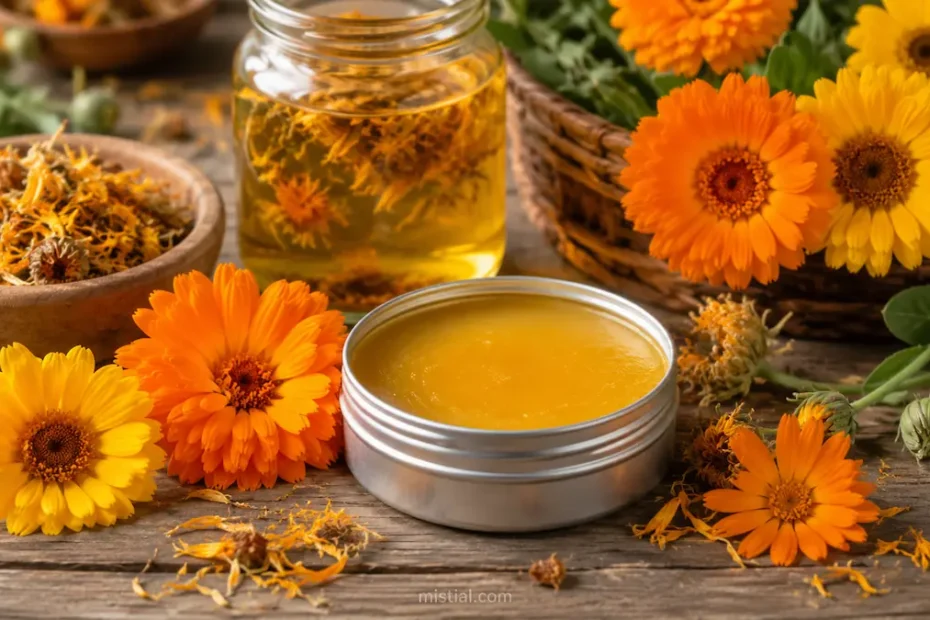
Calendula usually refers to Calendula officinalis, also known as pot marigold. It is a flowering plant with yellow to orange petals and a long tradition of use in herbal preparations. The flower heads are the part most often used. They may be dried for tea, infused into oil, added to ointments, or included in creams and balms.
One common source of confusion is the word “marigold.” Calendula is sometimes called pot marigold, but it is not the same as many ornamental marigolds from the Tagetes genus. The plants may look somewhat similar to a casual observer, but they are not interchangeable in herbal use.
Calendula contains different plant compounds, including flavonoids, triterpenes and carotenoid pigments. These compounds are part of why calendula is traditionally associated with soothing, protective and skin-supportive effects. However, the exact composition depends on the plant material, growing conditions, harvesting, drying and extraction method.
Important: medicinal calendula usually means Calendula officinalis. Do not assume that every plant called “marigold” has the same traditional uses or safety profile.
Why calendula is so closely linked with skin care
Calendula’s strongest everyday association is skin. It is commonly found in creams for dry skin, balms for rough areas, baby-care products, after-sun formulas, lip balms, hand creams and ointments for minor irritation. This does not mean calendula “cures” skin conditions, but it explains why the plant has become popular in gentle topical care.
There are several reasons calendula fits this role. First, its oil-based preparations can help soften and protect the skin barrier when they are made with suitable carrier oils or waxes. Second, calendula has a traditional reputation for calming minor irritation. Third, its color and botanical image work well in natural skin-care products.
Still, it is important to separate the plant from the whole formula. A calendula cream is not only calendula. It may contain oils, emulsifiers, preservatives, fragrances, alcohols, essential oils and other ingredients. Sometimes the skin reacts not to calendula itself, but to something else in the product.
Common forms of calendula and how they differ
Calendula can appear in many forms, and each one fits a different purpose. A tea, an infused oil and a commercial cream should not be treated as the same thing.
| Form | Typical use | What to keep in mind |
|---|---|---|
| Dried flowers | Tea, rinses, homemade infusions | Quality and correct plant identification matter. |
| Calendula tea | Traditional herbal drink or rinse | Oral use is not suitable for everyone, especially during pregnancy without guidance. |
| Infused oil | Skin softening, massage, balms | Depends heavily on the carrier oil and preparation hygiene. |
| Ointment or balm | Dry, rough or irritated skin areas | Can feel protective, but may be too occlusive for some skin types. |
| Cream or lotion | Everyday skin care | The full ingredient list matters, not only the calendula extract. |
| Gargle or mouth rinse | Traditional use for mouth and throat comfort | Should not replace dental or medical care when symptoms persist. |
The safest and most practical use for many people is external, on intact or mildly irritated skin. Oral use and use on damaged skin require more caution, especially if there are allergies, medications, pregnancy, infection or an unclear diagnosis.
Where calendula may be helpful
Calendula is most often used for mild skin discomfort. It may be chosen when the skin feels dry, tight, rough, slightly irritated or sensitive after environmental exposure. In these cases, a simple calendula cream or balm can be part of a broader routine focused on protecting the skin barrier.
For example, someone with dry hands from frequent washing may use a calendula-based hand cream together with gentler soap and gloves for cleaning. In that situation, the benefit may come from the combination: reduced irritation, better moisture protection and a soothing topical formula.
Calendula may also be used in after-sun products, baby skin products, lip balms and preparations for areas prone to friction. But “soothing” does not mean “medical treatment.” If the skin is infected, deeply cracked, bleeding, spreading, painful or not improving, calendula is not enough.
Where expectations should stay modest
Calendula is often presented as gentle and healing, but this can lead to unrealistic expectations. A plant-based balm cannot fix every rash, wound or inflammatory condition. It may support comfort and skin care, but it cannot replace diagnosis.
Skin problems can have many causes: eczema, psoriasis, fungal infection, bacterial infection, allergic reaction, contact dermatitis, acne, rosacea, insect bites, burns, medication reactions, autoimmune disease or poor wound healing. Many of these can look similar at first. Applying calendula without knowing the cause may soothe the area temporarily, but it may also delay correct treatment.
This is especially important with wounds. A small superficial scrape is different from a deep wound, puncture, animal bite, burn, surgical incision or diabetic foot wound. Calendula should not be used as a way to avoid proper wound care.
Important: do not use calendula as the main treatment for deep wounds, infected skin, serious burns, spreading rashes or skin problems that keep returning. These situations need proper medical evaluation.
Calendula for the face: useful or risky?
Calendula is common in facial creams and soothing cosmetic products. For some people, it can be a pleasant ingredient in a gentle routine. For others, especially those with acne-prone, rosacea-prone or highly reactive skin, the result depends on the full formula.
A heavy calendula balm may feel comforting on dry patches, but it may be too rich for oily or acne-prone skin. A fragranced calendula cream may irritate sensitive skin even if the calendula itself is not the problem. A homemade infused oil may be poorly preserved or unsuitable for use on the face.
For facial use, it is better to choose simple, well-formulated products and test them carefully. The face is more visible and often more reactive than the skin on the hands or elbows, so experimenting with strong homemade preparations is not the best approach.
Calendula tea and internal use
Calendula tea is traditionally used as a herbal drink, but internal use deserves more caution than external skin care. The fact that a plant is used in cosmetics does not automatically make it suitable to drink regularly or use for a health condition.
People may drink calendula tea for general herbal support, digestive comfort or throat soothing. However, the evidence for many internal uses is limited, and the effect can vary. Calendula should not be used to treat serious digestive symptoms, fever, infection, unexplained pain or chronic inflammation without medical advice.
Pregnant people, breastfeeding people, children, people with allergies to plants in the daisy family and those taking regular medication should be especially cautious with internal use. If calendula is part of a mixed herbal tea, the other herbs also need to be considered.
Allergy risk: the detail many people miss
Calendula belongs to the Asteraceae family, which also includes plants such as chamomile, ragweed, arnica, echinacea and daisies. Some people who react to plants in this family may also react to calendula, although individual sensitivity varies.
An allergic reaction may appear as itching, redness, rash, swelling, burning, hives or worsening irritation after applying a product. With oral use, allergy symptoms may include itching in the mouth, throat discomfort, swelling or breathing difficulty. Severe reactions are uncommon but should be treated seriously.
This is one reason patch testing is useful before applying a calendula product widely. A small test area cannot guarantee complete safety, but it can reduce the chance of applying an irritating product over a large area.
Tip: if you have a known allergy to ragweed, chamomile, daisies or related plants, be cautious with calendula and consider asking a healthcare professional before using it.
Homemade calendula products: where the problems start
Homemade calendula oil or balm can sound simple: flowers, oil, time and a jar. The risk is that homemade preparations can be poorly identified, contaminated, unstable or unsuitable for the intended use. This matters more when the product is applied to broken or sensitive skin.
The main issues are plant quality, moisture, storage and cleanliness. If flowers are not fully dried, moisture can encourage spoilage. If jars are not clean, contamination becomes more likely. If the oil is stored too long or exposed to heat and light, it may become rancid.
Another problem is overconfidence. A homemade balm may feel natural, but it does not have the same testing, preservation or quality control as a properly formulated product. It may still be useful for simple dry skin, but it should not be treated as a medical wound product.
What people often do wrong with calendula
Most mistakes with calendula come from assuming that gentle means risk-free. In practice, even mild herbal products can be used in the wrong place, at the wrong time or for the wrong problem.
- Using calendula on infected skin. Redness, pus, increasing pain, warmth or swelling should not be managed with herbs alone.
- Applying it to deep wounds. Deep cuts, punctures, bites and surgical wounds need proper medical guidance.
- Ignoring allergies. People sensitive to related plants may react to calendula products.
- Assuming all marigolds are calendula. Pot marigold and ornamental marigolds are not the same.
- Using heavy balms on acne-prone skin. Occlusive products may worsen congestion in some people.
- Trusting homemade products too much. Poor storage or moisture can make homemade oils unsafe.
- Replacing diagnosis with soothing care. A rash that keeps returning needs an explanation, not only a balm.
A better approach is to use calendula for modest, appropriate situations and to stop when the skin clearly does not improve or reacts badly.
How to use calendula more thoughtfully
Calendula works best when it is part of a careful routine rather than a desperate attempt to fix an unknown problem. The first question should always be: what exactly am I trying to soothe, and is it safe to manage this at home?
- Choose the right form: cream or balm for dry skin, tea or rinse only when internal or mucosal use is appropriate.
- Check that the plant is Calendula officinalis, not just any product labeled “marigold.”
- Read the full ingredient list, especially if you have sensitive skin or allergies.
- Patch test a new topical product on a small area before wider use.
- Avoid applying calendula to deep, infected, spreading or unexplained skin problems.
- Stop using the product if redness, itching, burning, swelling or rash worsens.
This keeps calendula in a realistic role: a supportive herbal ingredient for mild care, not a replacement for medical treatment when the situation is unclear or serious.
When calendula is not enough
Calendula should not delay medical care when symptoms point to infection, allergy, injury or a chronic skin condition. It is better to ask early than to keep applying a soothing product while the problem gets worse.
Seek medical advice if there is spreading redness, warmth, swelling, pus, fever, severe pain, red streaks, a wound caused by an animal bite, a deep cut, a burn larger than a small superficial area, or a wound that does not begin to improve. People with diabetes, poor circulation or immune system problems should be especially cautious with foot wounds and slow-healing skin injuries.
A rash also deserves evaluation if it spreads quickly, appears with swelling of the face or lips, affects breathing, involves the eyes, forms blisters, becomes painful or keeps returning. In these cases, calendula may soothe the surface but will not answer the most important question: what is causing the reaction?
FAQ
What is calendula used for?
Calendula is most commonly used in topical skin care for dryness, mild irritation and barrier support. It is also used traditionally in teas and rinses, but internal use requires more caution and should not replace medical care for ongoing symptoms.
Is calendula the same as marigold?
Calendula is often called pot marigold, but it is not the same as many ornamental marigolds from the Tagetes genus. For herbal use, the plant usually meant is Calendula officinalis.
Can calendula be used on wounds?
Calendula may be used in some gentle skin-care products, but it should not be used as the main treatment for deep wounds, infected wounds, animal bites, serious burns or surgical wounds unless a healthcare professional says it is appropriate.
Can calendula cause an allergic reaction?
Yes. People who are sensitive to plants in the Asteraceae family, such as ragweed, chamomile or daisies, may be more likely to react. Stop using calendula if itching, rash, swelling, burning or worsening irritation appears.
Is calendula safe during pregnancy?
Topical cosmetic use may be different from internal medicinal use, but pregnant people should avoid drinking calendula tea or using concentrated herbal preparations unless a healthcare professional advises otherwise.
Can calendula help acne?
Calendula may feel soothing in some formulas, but it is not a primary acne treatment. Heavy oils or balms may worsen clogged pores in some people. Acne that is persistent, painful or scarring should be discussed with a dermatologist.
What to remember
Calendula is a valuable medicinal plant when it is used with realistic expectations. Its strongest everyday role is in gentle skin care: dryness, minor irritation, rough areas and barrier support. It can be a helpful ingredient, but it is not a universal cure for wounds, rashes or inflammation.
The main points are simple: use the correct plant, choose the right form, pay attention to allergies, avoid deep or infected skin problems, and do not let a soothing herbal product replace proper evaluation when symptoms are serious or persistent.
Calendula is best treated as a supportive plant with limits. Used thoughtfully, it can fit well into calm, practical self-care. Used as a substitute for diagnosis or wound care, it can create unnecessary delays and risks.
