


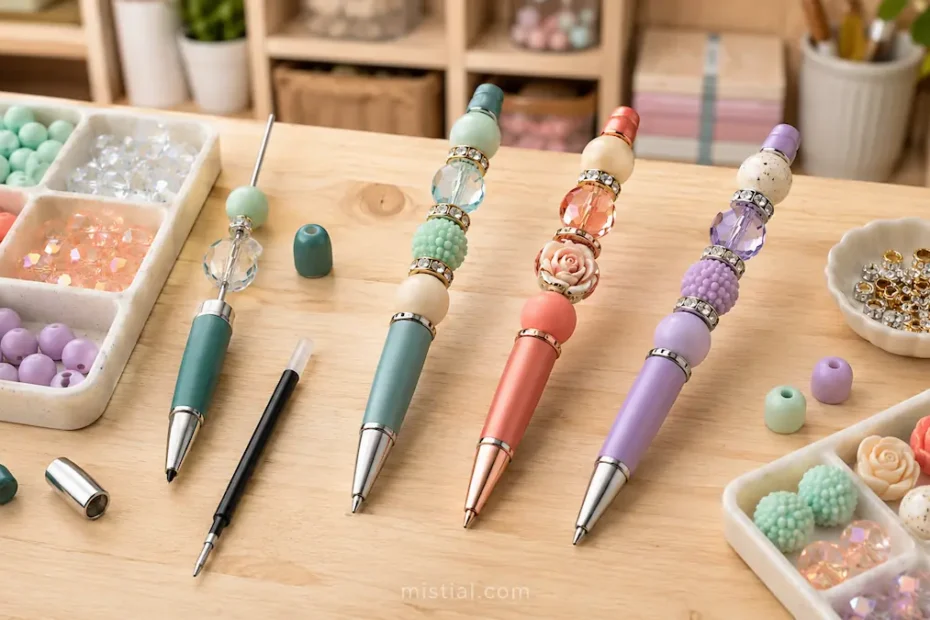
A beadable pen looks simple until you start assembling one. Then the small details begin to matter: the length of the rod, how smoothly the cap tightens, whether the beads sit straight, and whether the finished pen still feels comfortable in the hand.
For someone making a single teacher gift, a minor mismatch is annoying. For a small craft seller preparing twenty pens for a market, it can turn into wasted materials and lost time. A good buying decision starts with the pen base, not the prettiest bead.
Start With the Project, Not the Color
Before choosing a pen, decide what the finished piece needs to do. A compact pen for a badge reel has different requirements from a decorative desk pen. A school-themed design may need a durable, easy-to-clean barrel. A holiday item can carry a larger focal bead because it may be used as a gift or display piece.
It also helps to decide whether the pen will use silicone beads, acrylic beads, rhinestone spacers, or a separate pen topper. These materials differ in weight and hole size. Sketching the bead order on a table before ordering supplies can prevent a lot of trial and error.
Check the Rod and Thread
The center rod is the working part of a beadable pen. It needs enough usable space for the planned stack, while the threaded end must remain clear so the cap can close securely. If too many beads are forced onto the rod, the pen may not tighten correctly. If the stack is too short, the beads can move when the pen is used.
Thread quality matters as well. The end should tighten without grinding or catching. When preparing items for customers, assemble one sample and open it several times. That quick test reveals more than a product photo.
Think About Balance
A heavily decorated pen can look impressive but feel awkward. Large focal beads and metal spacers add weight near the top, which may cause the pen to tip backward in the hand. The easiest fix is not always a lighter focal. Sometimes one fewer spacer or a shorter bead stack creates a much better writing experience.
Balance also affects shipping. A bulky topper may require a wider box or more padding. Sellers should include packaging in the design calculation instead of treating it as a final detail.
Match the Style to the Buyer
Character pens, sports themes, holiday designs, rhinestone barrels, touch-screen styles, and mechanical pencils appeal to different customers. A craft fair table often benefits from variety, but random variety is difficult to manage. A more practical approach is to build small groups.
For example, one group might focus on classroom gifts, another on seasonal characters, and another on sparkling rhinestone designs. Grouping products makes it easier to photograph, price, and restock them. It also gives buyers a clearer reason to choose more than one.
Order a Test Quantity First
Photos are useful, but scale and finish can be hard to judge on a screen. A small test order lets you check barrel color, threading, refill action, and compatibility with the beads already in your supply box. It is also an opportunity to see how the pen behaves after a day of normal use.
Small business owners should keep notes during this test. Record the bead combination, finished weight, assembly time, packaging size, and customer response. Those notes become a reliable guide when the design is reordered later.
Plan for Refills and Everyday Use
A decorative pen should still work as a pen. Check how the refill is replaced and whether replacement ink is easy to source. If the design is intended as a gift, a spare refill can add value at very little cost.
Pay attention to the grip area too. Rhinestones and textured barrels can be attractive, but the area held by the fingers should remain comfortable. For touch-screen pens, test the stylus tip on more than one device. For mechanical pencils, confirm that the mechanism advances lead smoothly after decoration.
Buying for a Small Craft Business
Wholesale pricing is useful only when the assortment matches real demand. Rather than buying one large batch of a single style, many sellers do better with a controlled mix of dependable colors and a few timely themes. Neutral barrels work across many bead sets. Seasonal designs can be purchased in smaller quantities and refreshed throughout the year.
Keep components organized by project rather than by material alone. A labeled tray containing the pen, beads, spacers, and topper for one design reduces assembly errors. It also makes it easier for another person to reproduce a popular item.
A Final Practical Check
Before placing a larger order, ask five questions. Does the pen fit the bead hole size? Is there enough rod length for the planned design? Can the cap tighten fully? Is the finished pen comfortable to write with? Can it be packaged without crushing the topper?
If the answer to all five is yes, the design is ready to move beyond the sample stage. Crafters comparing character styles, rhinestone finishes, blank bases, touch-screen pens, and mechanical pencils can browse this beadable pen collection
