


- 1 Which woods actually survive daily family life?
- 2 Why does table thickness matter as much as wood type?
- 3 What makes quarter-sawn oak worth the premium price?
- 4 When should you choose walnut or maple instead of oak?
- 5 How do you spot quality construction before buying?
- 6 Your coffee table should outlast your sofa
Three coffee tables in five years.
That’s my shameful track record before I finally figured out what I was doing wrong. The mahogany beauty I bought in 2019? Covered in dents within eighteen months. The pine farmhouse table? Looked like a war zone after my kids discovered it doubled as a Lego building surface.
Here’s what nobody tells you when you’re shopping for furniture: the wood species matters about ten times more than the price tag. I learned this the expensive way, spending over £800 on tables that couldn’t survive normal family life.
The frustrating part? Every salesperson I talked to focused on color and grain patterns. Nobody mentioned hardness ratings. Nobody explained why my mahogany table dented when my neighbor’s oak table looked pristine after a decade.
After my third table failure, I got serious. I spent three months researching wood properties, talking to furniture makers, and testing samples in my own kitchen. What I discovered changed how I think about every piece of wooden furniture in my home.
You’re about to learn the single number that predicts whether your coffee table will last three years or thirty, which woods can handle daily abuse, and why paying more doesn’t always mean getting better quality.
Which woods actually survive daily family life?
Oak, maple, and ash dominate the durability rankings with hardness ratings between 1,290 and 1,450 pounds-force on the Janka scale, resisting the dents and scratches that destroy softer woods like pine (380 pounds-force) and mahogany (800 pounds-force) within months of normal use.
I used to pick furniture based on how it looked in the showroom. Massive mistake.
The Janka hardness test measures how much force it takes to embed a steel ball halfway into wood. Think of it like a toughness score for timber. Anything below 1,000 pounds-force will show damage from regular use. Books dropped on the surface, laptops set down, coffee mugs dragged across the top, these normal activities become destructive when your wood can’t handle the impact.
Maple tops the charts at 1,450 pounds-force. It’s basically the superhero of coffee table woods, shrugging off abuse that would wreck softer species. I’ve seen maple tables in family homes with young children that still look fantastic after eight years.
Oak hits 1,290 pounds-force, offering serious durability while costing less than maple. The distinctive grain pattern means small scratches blend into the natural wood character instead of standing out like scars.
Walnut sits at 1,010 pounds-force. It’s the minimum I’d recommend for a coffee table, and only if you don’t have kids or pets. The gorgeous chocolate-brown color comes with a tradeoff in durability.
Anything below 1,000 pounds-force will show damage from regular use, turning your investment into a dented mess within two years.
Here’s where I went wrong with my mahogany table: 800 pounds-force. It looked stunning in the store. The deep reddish-brown finish matched my color scheme perfectly. But hardness doesn’t care about aesthetics. Every phone my teenagers dropped on that table left a visible dent. Every textbook. Every remote control.
Pine at 380 pounds-force is just asking for trouble as a solid tabletop. Furniture makers use it as a hidden substrate under veneer specifically because it’s too soft for exposed surfaces. If you’re drawn to pine’s light color, choose maple instead.
According to the Janka hardness test standard, these ratings predict real-world performance with remarkable accuracy. The test was developed in 1906 and we’re still using it because nothing else comes close to predicting furniture durability.
When I finally started shopping with hardness ratings in mind, I found detailed guides on choosing the right wood for coffee tables that actually listed species specifications instead of just showing pretty pictures. That shift from aesthetics-first to durability-first shopping changed everything.
Why does table thickness matter as much as wood type?
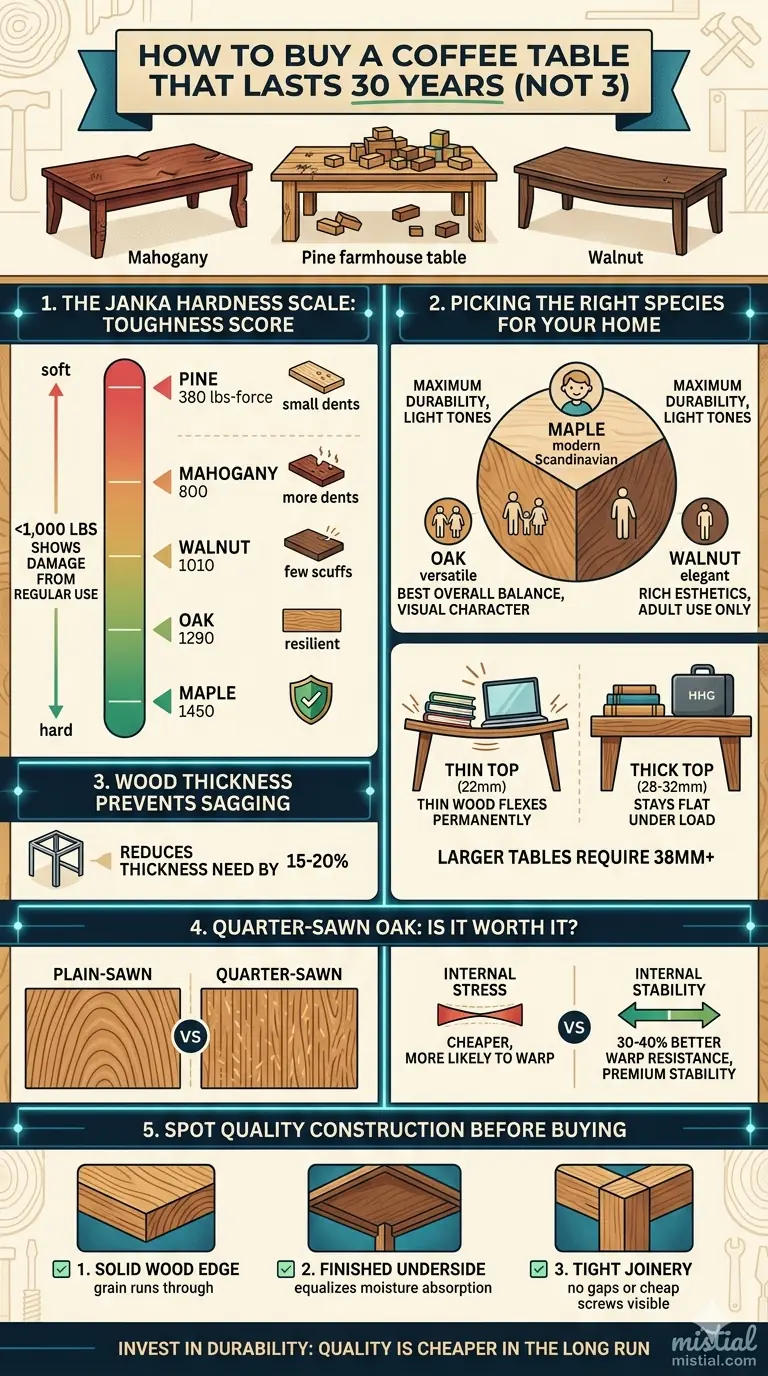
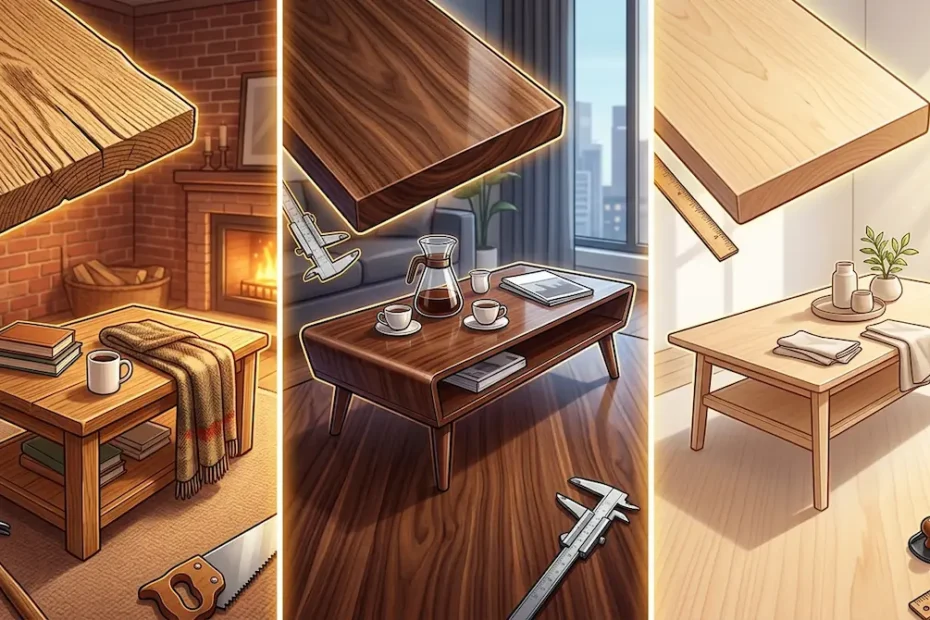
Coffee table tops need 28-32 millimeters thickness for standard sizes (91-107 centimeters long), increasing to 32-38 millimeters for larger tables, because thinner tops sag permanently under the constant weight of books, laptops, and decorative objects, regardless of wood quality.
I didn’t know this was even a consideration until my second table started sagging.
The table was beautiful walnut, properly hardness-rated, but the maker had used a thin 22-millimeter top to keep it lightweight. After six months of normal use, I could see a visible dip in the center. Books stacked in the middle. Laptops. A decorative bowl. Normal stuff.
Wood flexes under load. Thin wood flexes more than thick wood. Eventually, that flex becomes permanent sag. The math involves something called modulus of elasticity, which basically measures stiffness. Harder woods have higher modulus values, meaning they resist sagging better than soft woods at the same thickness.
Here’s the practical version: if you’re buying oak or maple and your table measures around a meter long, look for 28-32 millimeter thickness. Larger tables need thicker tops. A 152-centimeter table should have 38-45 millimeter thickness to prevent the middle from drooping over time.
Thin wood flexes under load, and eventually that flex becomes permanent sag that ruins the table’s appearance and function.
Pine and other softwoods need even thicker construction because their lower stiffness means they flex more under identical loads. A pine table the same size as an oak table needs 20-25% more thickness. This is why quality furniture costs more, the material investment is significantly higher.
Metal frames change everything. If your table has a steel or aluminum support structure under the top, thickness requirements drop by 15-20%. You can get away with a 25-millimeter top that would sag horribly without that hidden reinforcement.
Edge profiles matter too. A beveled or chamfered edge makes a thick top look more refined from normal viewing angles. My current oak table has 32-millimeter thickness with a chamfered edge, and most people guess it’s thinner because you can’t see the full thickness unless you’re looking from directly below.
I learned about thickness the hard way when I tried to save money on that walnut table. The thin top looked elegant in photos but became a constant reminder that structural requirements trump aesthetics. Don’t make my mistake.
Quarter-sawn oak, cut perpendicular to growth rings, resists warping and cupping 30-40% better than plain-sawn alternatives while revealing distinctive ray fleck grain patterns, justifying the 30-50% cost premium through superior dimensional stability and unique visual character.
This is where wood gets interesting.
I always wondered why some oak furniture cost twice as much as other oak furniture that looked basically identical in the store. The answer is how the lumber was cut from the log.
Plain-sawn oak comes from cutting boards parallel to the tree’s growth rings. It’s efficient, wastes less wood, and costs less. But those growth rings create internal stresses that make the wood more likely to cup or warp as humidity changes through the seasons.
Quarter-sawn oak involves cutting perpendicular to the growth rings. This wastes more material during production, driving up costs, but creates boards that stay flat and stable through humidity swings. The cut also exposes those beautiful ray fleck patterns, the lighter streaks that run across the grain and give oak its distinctive character.
I didn’t understand this distinction until I visited a furniture maker’s workshop. He showed me two identical table designs, one in plain-sawn oak for £450 and one in quarter-sawn for £680. I went with the cheaper option.
Quarter-sawn lumber stays flat and stable through humidity swings that would warp plain-sawn boards, making it worth every penny of the premium.
Six months later, during winter heating season, my plain-sawn table developed a slight cup across the width. Not enough to make it unusable, but enough to annoy me every time I looked at it. My neighbor’s quarter-sawn table? Perfectly flat.
According to traditional sawmill practices, quarter-sawing produces the most stable lumber possible from a log, which is why it’s been the premium choice for fine furniture for centuries.
Is the extra cost justified? If you’re keeping this table for a decade or more, absolutely. If you’re redecorating every few years anyway, probably not. I’m keeping my next table for life, so I’ll pay for quarter-sawn.
When should you choose walnut or maple instead of oak?
Walnut suits households without young children where rich chocolate-brown aesthetics outweigh durability concerns, while maple works best for modern Scandinavian designs requiring maximum hardness and light neutral tones, making oak the versatile middle choice that satisfies most situations.
Oak isn’t always the answer.
I’ve got a friend with a stunning walnut coffee table that’s been perfect for her needs. No kids, no pets, just two adults who treat furniture carefully. The warm brown color with subtle purple undertones creates sophistication that oak can’t match.
Walnut costs 2-3 times what oak costs because it grows slower and supplies are limited. You’re paying for aesthetics and exclusivity, not superior durability. At 1,010 pounds-force, it’ll handle normal adult use fine. But if you’ve got kids dropping toys on it or pets jumping up, choose something harder.
The color evolution is interesting too. Fresh walnut is dark chocolate brown. Over years of UV exposure, it lightens to honey-brown tones that many people find even more attractive than the original color. It’s like the wood improves with age.
Maple makes sense for specific design styles. If you’re doing modern or Scandinavian aesthetics with clean lines and light colors, maple’s cream tone and subtle grain work perfectly. At 1,450 pounds-force, it’s the toughest common furniture wood available.
The downside? Some people find maple boring. The grain pattern lacks oak’s dramatic character or walnut’s flowing lines. It’s understated, which is either perfect or disappointing depending on your taste.
Walnut costs 2-3 times what oak costs, and you’re paying for aesthetics and exclusivity rather than superior durability.
Ash deserves mention as the underrated middle option. Hardness sits at 1,320 pounds-force (between oak and maple), costs about the same as oak, and the open grain pattern accepts stain beautifully if you want to customize the color. I’m considering ash for my next table specifically because it offers maple’s durability at oak’s price point.
Here’s my decision framework: maximum durability with light color equals maple, rich dark aesthetics equals walnut, best overall balance equals oak, customizable color with high durability equals ash.
Think about how you actually use your coffee table. Feet propped up while watching TV? Kids doing homework? Dinner trays? Be honest about abuse levels, then choose wood that matches your reality instead of your aspirations.
How do you spot quality construction before buying?
Quality coffee tables feature solid hardwood tops at least 28 millimeters thick (not veneer over particleboard), tight joinery with no visible gaps, finish applied to all surfaces including undersides, and either through-tenon joints or metal frame reinforcement for structural support.
I got fooled by veneer twice before I learned what to look for.
Veneer construction isn’t automatically bad, but it needs to be priced accordingly. A thin hardwood veneer over particleboard or MDF substrate should cost 40-60% less than solid wood. The problem is stores often charge solid wood prices for veneer pieces because most customers can’t tell the difference.
Here’s how to check: look at the table edge. Solid wood shows continuous grain running through the full thickness. Veneer shows a thin surface layer (usually 2-3 millimeters) over a different material underneath. Some makers try to hide this with edge banding, but you can usually spot the seam if you look carefully.
Check the underside too. Quality solid wood tables have finish applied underneath to equalize moisture absorption. Unfinished undersides warp more easily as humidity changes.
Joinery reveals construction quality. Through-tenon joints, where the leg extends through the top and is visible on the surface, create incredibly strong connections. Dowel joints are acceptable. Screws directly into the tabletop are a red flag suggesting cheap construction.
According to traditional woodworking joint techniques, proper joinery should last generations when done correctly, while poor joinery fails within years regardless of wood quality.
Weight tells you something too. Solid hardwood tables are heavy. If a “walnut” table feels surprisingly light, it’s probably veneer. I almost bought a “solid oak” table that weighed less than it should, I checked the edge and found particleboard under thin oak veneer.
Don’t be afraid to ask questions. Legitimate furniture makers are proud of their construction and happy to explain it. Vague answers or reluctance to show underside construction suggest they’re hiding something.
Don’t be afraid to ask questions. Legitimate furniture makers are proud of their construction and happy to explain it. Vague answers or reluctance to show underside construction suggest they’re hiding something.
Your coffee table should outlast your sofa
After three failures and almost a thousand pounds wasted, I finally understand what separates temporary furniture from permanent pieces.
It’s not about spending the most money. It’s about understanding what you’re buying.
My current coffee table is quarter-sawn oak with 32-millimeter thickness, proper through-tenon joinery, and hardwax oil finish on all surfaces. It cost £580, which felt expensive until I calculated that my three failed tables cost £820 combined and lasted a total of five years. This oak table should function beautifully for three decades.
The math is simple when you break it down. A £600 table lasting 30 years costs £20 per year. A £300 table lasting 5 years costs £60 per year. Quality is cheaper in the long run.
Here’s what matters: choose wood with a Janka rating above 1,000 pounds-force. Oak, maple, and ash all qualify. Verify your table has adequate thickness, 28-32 millimeters for standard sizes, more for larger tables. Check that it’s solid wood, not veneer, unless priced accordingly. Look for quality joinery and finish on all surfaces.
Pay the premium for quarter-sawn if you’re keeping the piece long-term. The stability difference is real, and the distinctive grain pattern improves the aesthetics enough to justify the cost.
A £600 table lasting 30 years costs £20 per year, while a £300 table lasting 5 years costs £60 annually, making quality the more economical choice.
Know when to choose alternatives to oak. Walnut works beautifully for child-free households prioritizing aesthetics. Maple suits modern designs needing maximum durability. Ash offers oak’s practicality with greater color customization.
The biggest lesson from my furniture failures? Stop shopping based on how things look in the store. Start shopping based on how they’ll perform in your actual life. That means being honest about how your family uses furniture, what abuse levels you need to accommodate, and how long you actually plan to keep each piece.
My living room now has a coffee table I’m genuinely proud of. It’s not the prettiest table I’ve owned, that honor goes to the mahogany disaster. But it’s the first table that still looks great after two years of heavy use. No dents. No sag. No warping.
That’s what quality wood selection creates: furniture that improves your daily life instead of frustrating you with visible damage and premature replacement.
Start your search by identifying your must-have characteristics. Write them down. Hardness rating, thickness, wood species, budget, aesthetic style. Then shop armed with knowledge instead of just eyeballing what looks nice.
Your coffee table sits at the center of your living space and gets touched, leaned on, and loaded with objects dozens of times daily. It deserves the same thoughtful selection you’d give any piece of equipment you rely on constantly.
Choose wisely, and you’ll never waste money on the wrong wood again.
