


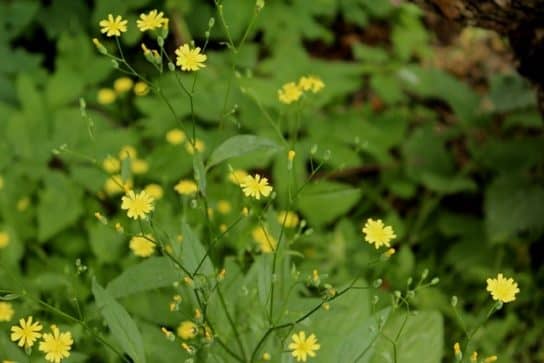
Most wildlife plants are used medicinally. The common wart belongs to the aster family. It is a bright green annual plant that is easy to find in the Caucasus and European Russia. The warthog can grow singly or in a group, sometimes forming whole thickets. The plant is widespread in sparse forests, felling areas and forest edges.
Description and chemical composition
The common wart is a juvenile plant. Its height reaches a maximum of 125 cm. The member of the Aster family has thin leaves, which can be wavy or notched at the edges, as well as scattered hairs. During flowering, small pale yellow flowers appear, combined in special baskets. As a result, fruits are formed – hemicarps.
The flowering period begins in June and ends in the month of July. The plant is also grown in gardens and orchards. In order for it to develop well, drained and fertile soils are used in open areas or in the shade.
The warthog contains flavoioids, rubber, chlorogenic and phenolic acids, and aliphatic hydrocarbons. Thanks to the unique elements contained in the leaves of the plant, medicines, tinctures are made, decoctions and special ointments are made to help get rid of various ailments.
The healing properties of the plant
Funds based on common warthog have an antibacterial, wound healing, analgesic effect. Infusions from the plant are used for diarrhea. During breastfeeding, mothers use chopped grass to treat cracked nipples. Steamed warthog leaves can cure mastitis.
With the help of powders based on the plant, purulent wounds are treated, and the healing process is also accelerated. The leaves of a young warthog are suitable for making salads (they have many vitamins and nutrients).
The use of drugs with the addition of a plant is indicated for colitis, pulmonary tuberculosis, hemorrhoids, flatulence, urolithiasis, arthritis, neuralgia and duodenal ulcer, stomach. A unique remedy has a calming effect, can relieve headaches, enhance lactation, relieve the patient from insomnia and worms.
The common wart is also indicated for cystitis, skin diseases (in particular psoriasis), jaundice, dropsy and cancerous tumors.
Contraindications for use
Before using the warthog externally, you should first drop the agent on the elbow and wait for the body’s reaction. If everything is in order, then you can safely continue the treatment. In the case of taking the drug inside, it is necessary to familiarize yourself with the contraindications and side effects. The warthog should not be taken in the following cases:
- intestinal atony;
- increased blood viscosity;
- pregnancy;
- age up to 12 years.
In the first weeks of admission, it is recommended to monitor the general condition. It has been established that at first the state of health may deteriorate slightly, after which the patient will recover. Since the warthog is not toxic, it can be taken for a long time (many medications are cumulative).
Cooking recipes
In order to make a medicinal infusion that has a laxative effect, it is necessary to pour 1 tablespoon of dry warthog with one glass of boiling water. After the agent is infused (within 2-3 hours), it must be filtered and taken in 1-2 tbsp. three times a day.
It is effective to use “hot pads” that are applied to sore spots. To prepare them, pour boiling water over fresh or dry grass and wrap it in a gauze napkin.
