


Small (black) killer whales are very intelligent, agile and playful animals of the dolphin family, the order of cetaceans. They adapt well to life in captivity, are easy to tame and train. They are often kept in dolphinariums and aquariums. Sometimes small killer whales interbreed with bottlenose dolphins, as well as grinds.
Description
The Killer Whale is a gregarious animal, and there is a strong affection for each other between members of the same herd. Like most marine mammals, small killer whales do not reach sexual maturity at a certain age, but when the young individual reaches a specific size.
They live in groups, which can contain up to several hundred killer whales of all ages. Such large groups are usually subdivided into smaller ones. On average, their number is 10-30 individuals.
Despite the fact that killer whales breed all year round, their peak occurs from late winter to early spring. Pregnancy lasts 11-15.5 months. Only one whale is born. He stays with his mother for 18-24 months, at the same age weaning occurs. Sexual maturity occurs at 8-10 years in males and at 8-11 years in females. After giving birth, females cannot give birth to cubs for an average of 6.9 years.
Kittens are capable of independent movement immediately after birth. After excommunication, they tend to remain in the same social group with their mother.
Appearance
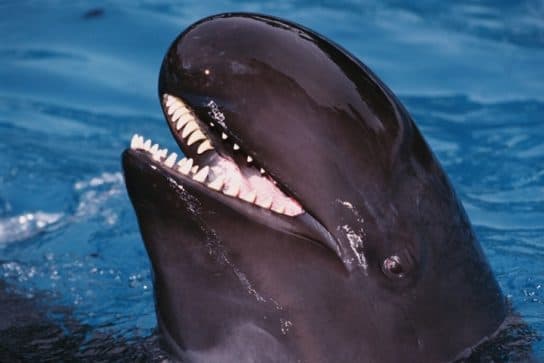
The little killer whale is almost black in color, only on the throat and neck there is a gray color. Due to this color, small killer whales are also called black killer whales. The lateral fins are pointed and narrow, and the dorsal fin is crescent-shaped. The teeth are very large and sharp. There are up to 44 teeth in the mouth.
The head is rounded, the forehead is in the shape of a melon. The body is elongated. The dorsal fin is crescent-shaped, protruding from the middle of the back, the pectoral fins are sharp. The upper jaw is longer than the lower.

Adult males of the lesser killer whale reach 3.7-6.1 m in length, adult females – 3.5-5 m. Body weight ranges from 917 to 1842 kg. Newborns are 1.5-1.9 m long and weigh about 80 kg. The dorsal fin can reach 18-40 cm in height. The physique is more robust than that of other dolphins. Fin length approximately ten times less than body length. There is usually a clearly visible notch in its middle, and the ends of the fin are sharp.
Red Book and Number
The small killer whale (black killer whale) is a rare, poorly studied species. The abundance in the waters of the Russian Federation is very low. Listed in Appendix 2 CITES, Appendix 2 of the Berne Convention. It is necessary to develop measures to prevent accidental or incidental prey of small killer whales
In the coastal waters of China and Japan, the number of small killer whales is estimated at approximately 16,000, in the Gulf of Mexico at 1,038, in the Hawaiian Islands – 268, in the eastern part of the Pacific Ocean, the population of this species consists of approximately 39,800..
While there is controversy over the decline in the number of small killer whales, there is strong evidence for a decrease in the number of predatory fish in the habitat of killer whales. This circumstance can lead to a decrease in their number.

In Japan, killer whales are used as a food source, and in the Caribbean they are killed for meat and fat. A significant number may have been killed on the island of Taiwan. Around the island of Ica, about 900 killer whales were killed during the fishing period from 1965 to 1980.
What zone does it live in
The habitat of small killer whales extends to the temperate and tropical waters of the World Ocean. These marine mammals are found in the Red and Mediterranean Seas, in the Atlantic. In the Pacific Ocean, they live in latitudes from New Zealand to Japan. In the eastern Pacific Ocean, killer whales live off Cape Horn and the coast of Alaska. In the Indian Ocean, this species has chosen the east coast of Africa, as well as in the waters of Southeast and East Asia.

What eats
The diet of small killer whales consists of fish. Cases of attacks of this species on other marine mammals and on their relatives dolphins have not been recorded. This suggests that the little killer whale is much less bloodthirsty than the common killer whale. But these two species are completely different, they have practically nothing in common, other than external similarities. In this regard, small killer whales are also called false killer whales, thereby focusing on the differences between the two species.
Adult black killer whales feed on squid and various predatory fish such as perch, mackerel, salmon or herring. Fishing vessels are often chased, hoping for their share of the catch. Unfortunately, sometimes they get entangled in networks and die.

Lifestyle
To communicate with each other, echolocation is used in the range from 20 to 60 kHz, sometimes 100-130 kHz. Like other killer whales, killer whales can make sounds such as whistling, squealing, or less distinct pulsating sounds. The piercing whistle of whales can be heard from a depth of 200 m.
Small killer whales are very often thrown ashore in huge numbers. Massive beaching has been reported on beaches in Scotland, Ceylon, Zanzibar and along the coast of England.

Interesting Facts
An unsolved feature of the species is the periodic mass washing ashore. For example, in 2005, in the waters of southwestern Australia, namely in Geograf’s Bay, several hundred small killer whales were thrown onto land. Their black bodies filled almost the entire coast. 4 different groups were found on the shore, the distance between the groups was approximately 300 meters. Most likely these were different flocks that, for some reason, sailed to the same coast.
Thanks to the efforts of local authorities, the poor animals were rescued and returned to the water. Human intervention helped to avoid the mass death of small killer whales. Of the total, only one individual died. This rescue operation required the participation of 1,500 volunteers.
