


Coriander seed (spicy) is one of the oldest plants. It is also called in the scientific world “Coriander vegetable“, And the popular name”kinza“. An annual plant, belongs to the genus “coriander”, the family “umbrella”.
Coriander has been used for thousands of years by the inhabitants of China, Egypt and India as a spice for food, as well as for the treatment of diseases.
Description and properties
The eastern Mediterranean is considered the birthplace of coriander. The name comes from the Greek word that translates as “bug”. But some experts believe that the derivative word means “St. John’s wort”.
Coriander or cilantro is cultivated in many countries of Europe, Asia, America. In Russia, coriander appeared in the eighteenth century. Plant coriander melliferous. Coriander loves fertile and moisture-rich soils.
The fruits of the plant are used as medicinal raw materials. From them, a healing essential oil is obtained, which contains many useful components. The fruits also contain vitamins and potassium.
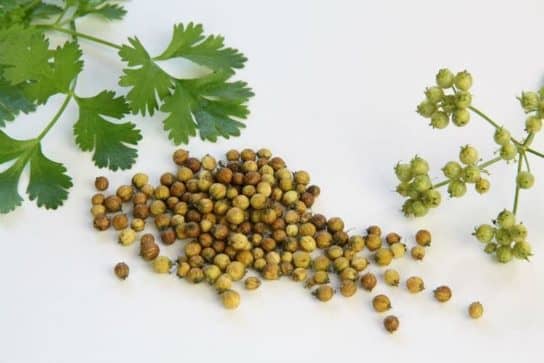
Coriander contains substances that are used for medicinal purposes as pain relievers, antiseptic, wound healing, diuretic, expectorant and digestive aids.
The collection of fruits is carried out in sunny weather, dried in the air. Plants and flowers of coriander can be dried and used both as a remedy and for seasoning.
To obtain greens, coriander is sown from early spring to mid-July every 14-20 days.
Cilantro and coriander – what’s the difference?
Appearance
The root system of coriander is spindle-shaped. The stem is straight, its height ranges from 40 to 70 centimeters. The upper part of the stem is branched.
The leaves near the root have long petioles and are dissected with three wide lobes. The edge of the sheet plates is sawtooth. The lower leaves are attached to the stem with short petioles, crossed into two ovoid lobes. The leaves, which are in the middle and upper parts of the stem, are dissected into three lobes along the line.
In the upper part of the stem, inflorescences are formed in the form of umbrellas, consisting of three to five rays. Small flowers of pink or white color are located on the rays. They bloom in the summer months: June and July.
The fruits ripen, depending on the climatic zone, from July to September. They are spherical or ovoid with a ribbed surface.
Where it grows
Coriander is grown as a spice and medicinal plant in countries such as India, Palestine, Egypt. On the territory of Russia, it is cultivated in the Caucasus, Central chernozem and southern European regions, in Central Asia and the Crimea.
Beneficial features
The healing properties of coriander have been known since antiquity – and are mentioned in the oldest treatises on medicine. For example, the Egyptians used it to obtain a fragrant oil. It was often used for obstetrics and skin diseases.
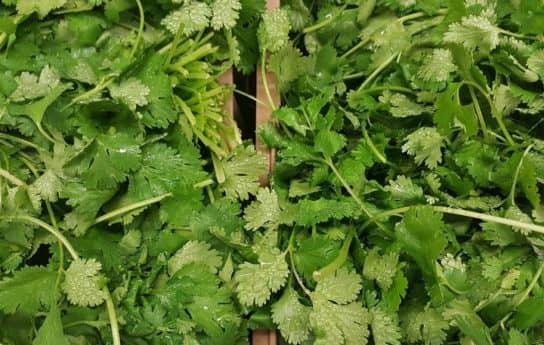
As a rule, almost all parts of the plant are used – coriander uses leaves, roots, and fruits. Greens are most often used: plant leaves contain ascorbic acid, carotene, rutin, and B vitamins. For a long time, coriander has been used as an antiscorbutic and capillary-strengthening agent.
Coriander umbrellas are also used: they are threshed, and this must be done with care so as not to damage the tubules containing the essential oil. They have a yellowish-brown hue and a very specific taste and aroma – spicy, intoxicating. Such fruits should not contain less than 0.5 percent essential oil.
It is known that coriander (in particular, its seeds) has an excellent antispasmodic and mild laxative effect, and also drives bile and can be used as an antiseptic. It can also stimulate digestion and relieve heaviness in the stomach. And this is not to mention its culinary merits as a spice!
Contraindications for use
In the medical field, coriander fruits are used in a wide variety of cases:
- stagnation of bile;
- urinary tract infection;
- renal colic and stones;
- cystitis and pyelonephritis;
- eczema and even conjunctivitis.
Naturally, such a wide scope of application could not but leave behind some contraindications to the use of this almost magical remedy.
As a rule, such contraindications are associated with the activity of coriander essential oils, and, above all, apply specifically to the use of the plant in the form of an essential oil.
When using coriander oil, be careful with the following rules:
- do not exceed the prescribed dose of the product, since the plant oil can inhibit the activity of the heart system and kidneys;
- do not use on open wounds;
- contraindicated in pregnant and lactating mothers.
It should be understood that eating the plant is not recommended in the presence of thrombophlebitis, problems with blood coagulation and allergic reactions (including individual intolerance).
Application
For medical purposes, coriander is used both dried and fresh:
- From the fruits of coriander, an infusion is prepared as a sedative, expectorant, antihelminthic agent. Fruits of coriander in the amount of 3 teaspoons are poured with a glass of boiling water and infused for 15 minutes, closed. After straining, it is used as follows: 2 tbsp. spoons 30 minutes before meals.
- When treating wounds or to prevent eye diseases, apply fresh plant leaves or infusion.
- If severe throbbing pain occurs: Juice of coriander is squeezed out and mixed with milk. Then it is applied to the sore spot.
- Coriander oil is used for inhalation (only 4-5 drops), for foot baths (3-4 drops), for ingestion (drip on a sugar cube).
Young coriander leaves, which are in the rosette phase, are added to salads, meat, fish dishes and soups. They help to improve the taste of food products and also contain vitamins A and C that are beneficial to the body.
