


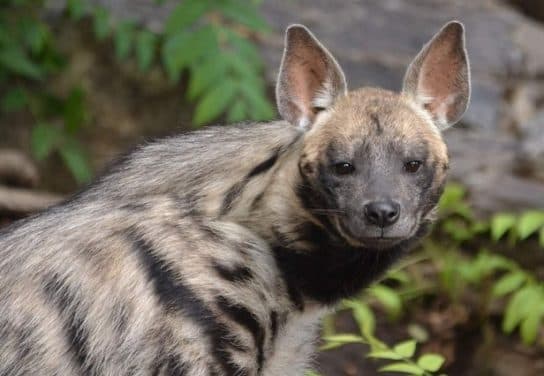
Striped hyena (lat. Hyaena hyaena) are rather large predators living in Africa and Asia. The animals live in families, hunt mainly at night. They belong to the suborder feline, the hyena family.
Few people know that “hyena” in translation from Greek means “pig”. Outwardly, mammals are similar to a large-sized dog, but the distinctive features are special proportions of the limbs and a peculiar body position. You can meet a striped hyena in Africa, Asia, on the territory of the former USSR. Animals love to be in ravines, rocky gorges, dry channels, caves and clay hills.
Description
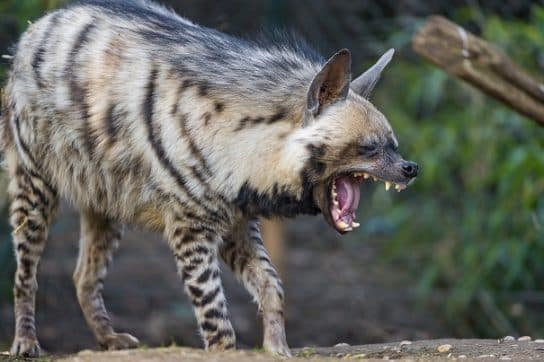
Striped hyenas are one of the largest members of their family. When communicating with other individuals, many sounds are used, however, they do not laugh. The appearance is distinguished by dark, sometimes bright black stripes, large ears.

Appearance
Average characteristics of striped hyenas:
- body length – 120 cm;
- height – 80 cm (at the withers);
- tail length – 35 cm;
- the weight of males is 40 kg;
- the weight of the females is 35 kg.
There are cases when researchers have found predators weighing up to 70 kg.

The coat of these animals is long, hard, color – from brown-gray to straw shades. Contrasting dark stripes run across the body. The skull is massive, wide. Dark shades prevail on the face. The ears are large, triangular in shape, with pointed tips. The hind legs are shorter than the front ones.
Lifestyle
Habits, habits, lifestyle largely depend on where the predators live. The married couples of these predators are strong, relationships are maintained throughout life. Certain features of social behavior are characteristic of different regions. In Israel, striped hyenas try to stay alone, rarely unite in flocks, where males take the leading role. In Central Kenya, predators form small groups. In this case, relationships are built on the harem of females, which are united by one male. Monogamy is maintained among hyenas in Central Asia.
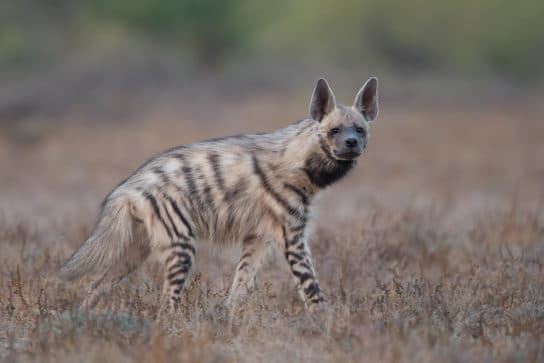
The females of striped hyenas heat up up to three times a year. It takes 3 months to bear puppies. The average number of babies per genus is 3. It is extremely rare – 1 or 4. Up to six months of age, the female feeds her children. Only females take care of the offspring.
Hyenas hunt in the late evenings, at night. During the day they hide in the shade, earthen holes, crevasses, gorges. The territory around the place of residence is marked, fiercely protected from enemies.
Behavior and diet
Striped hyenas live in families, which consist of a male, a female and several grown cubs. Within the group, animals behave friendly and sociable, but towards other individuals they show hostility and aggression. As a rule, two or three families of hyenas live in one region. Each group has its own territory, which is divided into certain areas: a hole, a place to sleep, a restroom, a “refectory”, etc.
Striped hyenas are scavengers. They can also feed on household waste. The diet of mammals contains carrion of zebras, gazelles, and impalas. They eat bones and supplement their diet with fish, insects, fruits, seeds. Striped hyenas also feast on rodents, hares, birds and reptiles. An important condition for the full existence of scavengers is the presence of water nearby.

Reproduction
Hyenas can mate all year round. One male can fertilize a large number of females. The pregnancy of the female lasts about 90 days, resulting in 2-4 blind cubs being born. Babies have brown or chocolate colored coats. They are with their mother for a long time and are trained in hunting, defense and other skills.
Natural enemies
Since striped hyenas are the second largest members of their family, they have few natural enemies. At the same time, in the territories of residence, hyenas cannot be called serious opponents of other predators.
The small number of enemies is due to some features of the behavior and lifestyle of these animals:
- Secluded living;
- Hyenas hunt only in the late evenings and at night;
- The movement of these animals is rather confusing, not straightforward;
- Keeps their distance when spotting other large predators.

Opponents in the wild are lions, leopards, cheetahs.
However, generally speaking, the main enemy of various hyena species is humans. This is due to the bad reputation of these animals, a general erroneous opinion on the part of people.
Interesting Facts
There are many interesting facts about striped hyenas, the main of which need to be considered in more detail:
- According to the conducted research, archaeological finds, scientists were able to prove that before the beginning of the last ice age in Europe, hyenas lived here as well. After that, their habitat narrowed significantly. Now they can be found only in Africa, namely the spotted species – also in Central Asia.
- One of the most common myths about these predators is that the main part of the diet is carrion. However, in 80% of cases, hyenas hunt themselves for food.
- Hyenas can be conventionally called cats, since they belong to the suborder of felines.
- The maximum running speed of hyenas is 65 km / h. At the same time, the predator can maintain such a pace for several hours, due to which, in most cases, the hunt ends successfully.
- According to many observations of researchers, hyenas rarely take prey from other predators. More often they are exposed to similar things from the side of lions.
- Striped hyenas are not aggressive. They rarely get into a fight first. Situations often occur when predators run away from dogs without defending themselves.
- The strongest teeth are in this particular species of the hyena family. Their stomachs can gradually digest even large amounts of bones.
- Female hyenas are much larger and more aggressive than males. However, it is among striped predators that males are the leader in the flock.
On very hot days, these animals can be found in shallow waters. In the water, they save themselves from the heat.
Today, striped hyenas are classified as one of the group of animals that are at risk of extinction. To protect predators from complete extinction, their population is maintained in national parks in Africa, zoos around the world. At the same time, in captivity, with proper nutrition, care, the life span of hyenas increases by 2 times.
