


- 1 A seasonal journey is more than an escape from cold
- 2 The departure date has several layers
- 3 Flight fuel has to be acquired somewhere
- 4 A compass gives direction; navigation requires more
- 5 The shortest line on a map may be the wrong route
- 6 A stopover is habitat with a deadline
- 7 How researchers connect sightings into journeys
- 8 Read a local migration morning without jumping to conclusions
- 9 Make the landing safer
- 10 Questions prompted by the birds passing through
- 11 Look at the place beneath the flight
A small bird feeding in a roadside shrub may have spent the previous night crossing a stretch of sea. By evening it could be gone, leaving no obvious sign that this ordinary patch of vegetation was part of an international journey. Migration becomes easier to understand when we look beyond the birds overhead and notice the places that make their flights possible.
Some birds cross continents; others move between mountain slopes or neighbouring regions. Their journeys connect food, breeding opportunities, weather and an ability to find direction that scientists are still investigating. Understanding those connections also helps explain why a bird appears in your garden for a few days, why migration dates vary, and when helping means simply leaving a resting bird alone.
A seasonal journey is more than an escape from cold
Bird migration is a recurring movement between areas used at different stages of the annual cycle. For many species, it connects breeding and nonbreeding grounds. It differs from a daily flight between a feeding area and a roost, and from dispersal, when a young bird leaves its birthplace to establish itself elsewhere.
Cold matters, but the more useful question is what a bird can eat and whether it can reach that food. Frozen water closes feeding opportunities for some waterbirds. A decline in flying insects affects aerial insectivores. Other species can remain through winter because seeds, concealed invertebrates or other resources are still available.
Moving can also open opportunities for reproduction. Seasonal abundance and long daylight hours at higher latitudes can help parents feed their young. The benefit has to outweigh the costs of travelling, finding unfamiliar resources and surviving the return journey.
Migration is one example of the adaptation of organisms to changing conditions. It is not a deliberate invention by individual birds, nor a universally superior strategy. Over generations, different combinations of movement, timing and physiology have persisted in different environments. Staying put can be equally successful where resources allow it.
Not every member of a species makes the same trip
Calling a species “migratory” can hide substantial variation. In partial migration, some individuals migrate while others remain. Populations breeding in different regions may also behave differently, so a species that leaves one country each autumn may be present year-round somewhere else.
Distance does not define the importance of the movement. A seasonal descent from a mountain can change access to food and shelter without a continental crossing. At the other extreme, an irruption brings birds beyond their usual range in particular years, often in association with changing food supplies. That is different from a predictable journey repeated on a similar annual schedule.
For an observer, this means that one winter sighting cannot settle whether an entire species migrates. Location, population and season all belong in the explanation.
The departure date has several layers
Many migrants begin preparing before conditions become visibly difficult. Changes in day length interact with internal annual rhythms and physiological processes. Food intake, fat storage and activity patterns may change well before departure. In some species, seasonal migratory restlessness can be observed even in captivity.
Being ready to migrate is not the same as taking off that evening. A bird’s condition and the weather can influence the immediate decision. A suitable wind may make progress easier; an approaching storm may favour waiting. Preparation establishes a seasonal window, while local circumstances help determine movement within it.
Think of an arrival date as the outcome of several earlier events. When did the bird leave? How long did it stay at intermediate sites? Did it encounter headwinds? Was food easy to find? A delay at any of these stages can change when it becomes visible at the destination.
A migration calendar belongs to a place
“North in spring, south in autumn” describes many Northern Hemisphere journeys, but it is not a worldwide timetable. Southern Hemisphere seasons are reversed. Tropical movements may follow rainfall and food availability, while mountain birds may change elevation rather than latitude.
Even locally, migration is spread across weeks or months. Different species pass at different times, and adults and young birds do not necessarily travel together. Breeding schedules and the replacement of feathers can influence the order in which groups move.
A useful calendar therefore names both the region and the species or group. A date taken from another continent, or even another part of the same country, may be a poor guide to what should be happening outside your window.
Flight fuel has to be acquired somewhere
Before a demanding flight, many birds increase their energy reserves, especially fat. Fat stores a large amount of energy for its mass, but carrying it still adds weight. The amount needed depends on the journey ahead: a bird crossing open water faces different opportunities from one travelling through a landscape with frequent feeding sites.
Preparation can involve more than gaining weight. Some long-distance shorebirds undergo marked changes in flight muscles and digestive organs across the migratory cycle. These are specialised physiological responses; they should not be assumed to occur to the same extent in every bird.
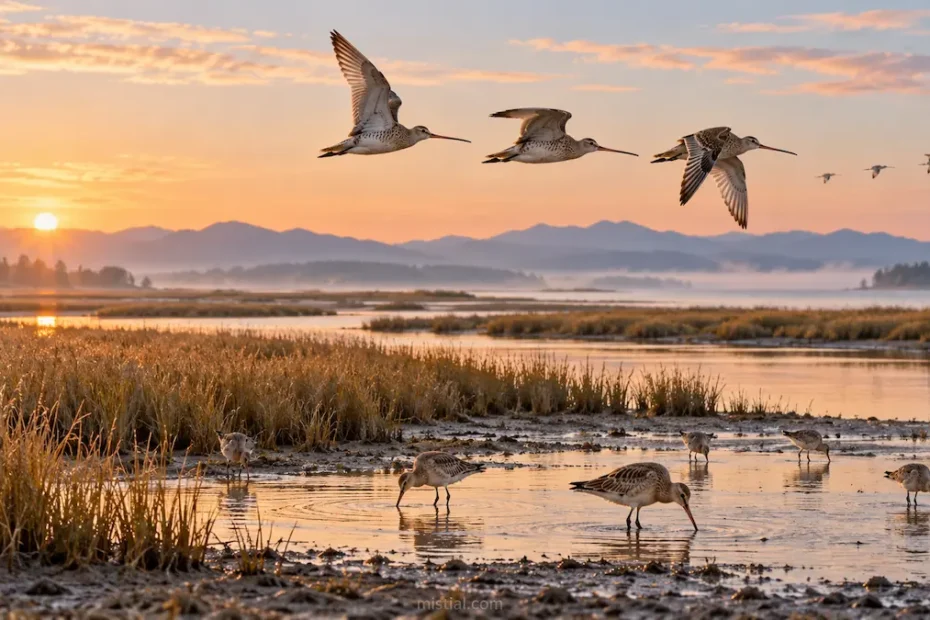
Bar-tailed Godwits travelling from Alaska towards New Zealand illustrate how far this specialisation can go: they can remain airborne over the Pacific for days without feeding. Their endurance is exceptional. It would be misleading to use such a flight as the standard model for the small migrants passing through a local park.
Travel time includes the days spent on the ground
Many migrations consist of flights separated by periods of feeding and rest. The total journey can therefore take much longer than the accumulated hours in the air. A bird remaining at one site for several days may be making essential progress by rebuilding reserves.
This distinction matters when comparing migration speeds. Distance covered during an uninterrupted flight is different from distance divided by the entire journey, including stops. Wind also changes speed over the ground without requiring an equivalent change in the bird’s speed through the air.
A claim that a species travels a fixed distance “every day” often conceals these differences. Before using such a number, ask whether it describes one flight, one tracked individual, or an average across a whole migration.
Orientation means maintaining an appropriate direction. Navigation also involves using information about position to reach a destination. A bird can possess a directional programme without already having an experienced adult’s knowledge of a route.
Different birds use combinations of information from the sun, stars, Earth’s magnetic field, landmarks and, in some cases, smell. A sun compass must account for the sun’s movement through the day. Experiments with some night migrants show that the apparent rotation of the stars helps establish direction.
Magnetic orientation is supported by experimental evidence, but the sensory mechanisms and their integration with other cues remain active research topics. Saying that every bird carries a fully understood biological GPS overstates what is known.
Inherited tendencies and learning both matter, with their relative roles differing among species. Some young birds undertake their first migration without their parents. In other species, travelling with experienced birds provides opportunities to learn. Repeated journeys can refine route knowledge. There is no single answer that fits a young songbird, a goose and an ocean-going seabird equally well.
The shortest line on a map may be the wrong route
A route has to work in moving air and across a changing landscape. A detour can offer feeding habitat, reduce an exposed sea crossing or take advantage of favourable winds. Distance alone is therefore an incomplete measure of how demanding a journey will be.
Soaring migrants often use rising air over land to gain height before gliding onwards. This can concentrate birds near narrow crossings between landmasses. Birds capable of sustained flapping flight may use routes that would be difficult for a species heavily dependent on thermals.
A flyway is a broad migration route or regional system of routes. It is useful for describing connections and organising conservation, but it is not a narrow aerial lane followed by every bird. Many songbirds move across broad fronts. Spring and autumn routes can also differ, producing a loop rather than a simple outward-and-return line.
Why much of the movement is invisible
Many small landbirds migrate at night. Darkness can reduce exposure to some predators, while cooler conditions can help limit heat and water stress. Night travel also leaves daylight available for feeding. These advantages do not apply equally to every species.
Daytime migrants include birds that exploit rising warm air and species that feed while travelling. A quiet daytime sky consequently tells you little about the volume of migration over the same place after dark.
Nor does a flock automatically indicate migration. Birds may be moving towards a communal roost or between local feeding areas. Repeated directional passage, seasonal context and species identification provide a stronger interpretation than flock size alone.
A stopover is habitat with a deadline
A stopover site must offer something useful when the birds arrive. A woodland patch may provide food and cover; a wetland may expose feeding areas at particular water levels. A location that looks green or undisturbed to a visitor is not necessarily suitable for the birds passing through.
Different sites perform different jobs. Some support substantial refuelling before a difficult crossing. Others offer a brief refuge when conditions deteriorate. A small coastal patch may have exceptional value because birds reaching it have few immediate alternatives.
This creates a timing problem for conservation. Protecting a place on a map is not enough if food is unavailable during passage or repeated disturbance prevents feeding. The relevant question is whether birds can use the site successfully during the period when they need it.
Imagine a feeding flock repeatedly taking off because walkers approach too closely. Each departure interrupts feeding as well as requiring energy. A single disturbance may appear minor, but a succession of visitors can leave little uninterrupted time. Watching from farther away protects the function of the site, not merely the appearance of a peaceful scene.
How researchers connect sightings into journeys
A bird seen at two places supplies a different kind of evidence from a bird followed throughout its route. Migration research combines methods because each reveals some movements and misses others.
| Method | What it can reveal | What needs caution |
|---|---|---|
| Ringing or banding | A marked individual links its original capture with later encounters. | A gap between sightings does not reveal the route taken between them. |
| GPS and satellite tracking | Locations can show individual routes, stopovers and travel timing. | Device suitability, battery life and the birds selected affect what can be studied. |
| Light-level geolocators | Changes in recorded daylight allow broad movements to be estimated. | Locations are less precise than GPS, and many devices must be recovered to retrieve data. |
| Automated radio telemetry | Receivers detect tagged birds passing within range. | Detection depends on receiver coverage; silence does not prove that a bird died. |
| Weather radar | Large-scale movement, direction and intensity can be measured. | Ordinary migration radar products do not identify every bird or species. |
| Repeated observer records | Seasonal occurrence patterns emerge across many places and dates. | Observer effort and identification accuracy influence the apparent pattern. |
The strongest interpretation keeps these limitations attached to the result. One tracked bird proves that an individual used a route; it does not establish that every member of its species does so. A concentration of reports may reflect both birds and the concentration of people looking for them.
This is also why a detailed map should not automatically be read as certainty. Check whether it shows recorded positions, estimates between records, modelled abundance or a simplified illustration. These are different products answering different questions.
Read a local migration morning without jumping to conclusions
A park full of unfamiliar birds can be exciting, but several processes could produce the scene. New arrivals may have landed overnight. Weather may have delayed departure. Birds may also have gathered around a temporary food source. The most useful first response is to record what is actually happening.
- Choose a repeatable observation point. Visit the same accessible patch or route so that comparisons are less affected by constantly changing locations.
- Record effort as well as birds. Note the date, start time, duration and approximate area covered. A short visit and a long search are not equivalent samples.
- Describe behaviour. Feeding, resting, directional flight and circling provide different clues. Note uncertainty instead of assigning a migratory explanation to every movement.
- Compare with local seasonal records. Use recent observations alongside longer-term patterns. Treat an identification app as assistance, especially for an unexpected species.
- Let the birds determine your distance. If they stop feeding, repeatedly watch you or move away, retreat. Keep routes to water, cover and resting areas unobstructed.
For much of the contiguous United States, BirdCast offers radar-based information about nocturnal migration. Such products describe regional movement rather than guaranteeing birds at a particular tree the following morning. Elsewhere, local observatories and regional records may be more useful.
A dramatic arrival after difficult weather is sometimes called a fallout. For the observer it can mean unusually close views; for the birds it can mean urgent need for rest and food. Avoid surrounding them or using repeated call playback to draw them into the open.
An early arrival is an observation, not a climate diagnosis
The first bird reported each year is affected by how many people are looking and where they look. A single unusually early record cannot, on its own, establish a shift in the population’s migration schedule.
Changing climate can affect the timing of seasonal resources, habitat conditions and movement. The ecological concern is not simply whether birds arrive earlier, but whether arrival and breeding remain aligned with suitable conditions. Responses differ among species and regions, so “all birds are migrating earlier” is too broad a conclusion.
For a local notebook, preserve the observation without overstating it: species, place, date, evidence and effort. Consistent records become more useful when combined across years and observers.
Make the landing safer
Migration exposes birds to natural hazards, including storms and food shortages, alongside risks created by people. Habitat loss can remove feeding opportunities. Artificial light can attract or disorient nocturnal migrants near buildings. Glass can reflect vegetation or appear to provide an open route.
These problems require different responses. Turning off unnecessary lighting reduces one risk, but does not make reflective glass safe during daylight. Protecting breeding habitat does not replace a lost stopover farther along the route.
- Reduce unnecessary light at night. Switch off decorative lighting and light in empty rooms. Where illumination is needed for safety, limit spill and direct it downwards.
- Address hazardous glass. Use effective exterior screening or closely spaced visible patterns across the relevant surface. A single silhouette on a large window leaves most of the apparent flight path unchanged.
- Retain feeding and shelter habitat. Suitable native vegetation and less intensive tidying can preserve resources. Avoid unnecessary pesticide use that removes potential food.
- Keep pets from pursuing wildlife. Prevent cats from roaming and keep dogs controlled around resting and feeding birds.
- Respect temporary closures. A feeding flat or roost may be especially important for a short period, even if it appears unremarkable at other times.
Feeding stations can assist some species, but they do not replace functioning habitat. Food unsuitable for the species, accumulated waste and crowded dirty feeders can create problems of their own. Follow local wildlife guidance and keep any feeding equipment clean.
A resting bird does not automatically need rescue
A bird quietly using cover may simply be resting. Avoid chasing it to test whether it can fly. Observe from a distance and keep people and pets away.
A known window collision, visible injury, an inability to stand normally or contact with a cat warrants prompt advice from a wildlife rehabilitator or appropriate local wildlife service. Do not force food or water into the bird’s beak, and do not throw it into the air. Follow professional instructions appropriate to the species and situation.
Questions prompted by the birds passing through
Do birds return to exactly the same place?
Some individuals show strong fidelity to breeding, nonbreeding or stopover areas, but the pattern varies. A familiar-looking bird returning to a garden is not proof that it is the same individual. Reliable identification requires something distinctive, such as a readable ring recorded through an authorised scheme.
Does a bird seen in winter mean it failed to migrate?
Not necessarily. It could belong to a resident population, be a normal winter visitor or have moved only a short distance. An unusual date alone does not establish distress. Identification, local records and the bird’s condition matter more than a general expectation that it should have left.
Can a migration forecast tell me which species will visit?
A forecast of movement intensity does not provide a species-by-species passenger list. Seasonal records can suggest likely candidates, but actual sightings depend on habitat, weather and where birds land. Treat the forecast as a reason to pay attention, not as a promised checklist.
Is a bird outside its usual range necessarily lost?
Its presence may reflect displacement, exploratory movement or other variation in movement. A sighting alone rarely establishes the cause. Document it without pursuing the bird, and be cautious about sharing precise locations if publicity could create disturbance.
Look at the place beneath the flight
The next time migrants appear, ask what the location allows them to do. Can they feed without interruption? Is there cover? Is glass reflecting the vegetation they are trying to reach? These questions turn a brief sighting into an understanding of the journey.
You do not need to witness a spectacular crossing to recognise migration. A repeated record from the same park, a safer window or an undisturbed patch of shoreline can connect an ordinary place with movements far beyond it.
